

Looking for an arable farm for sale in Lot means reading a department of strong contrasts: ploughable ground sits along the Lot, the Dordogne and the Célé, and on the edges of the Quercy blanc, while the limestone causses and the wooded Bouriane belong to grass, truffles and timber. Farmers approaching retirement, firms specialising in rural land and notarial offices in Cahors, Figeac or Gourdon describe cropped area, irrigated share, working buildings and the machinery included in the deal. Holdings in this department also appear in our national selection of arable farms for sale.
What a listing leaves out is gathered here: the value of ploughland recorded locally, the districts that genuinely release farms, how to judge a Quercy stone barn converted for grain, and the checks that come with an irrigated cropping system. The route through a setting-up project is set out in our white paper « Créer une exploitation agricole » (in French).
Pricing the land comes first in any plan to buy an arable farm. On the basis of 2025 DVF sales (vineyards excluded), the median in Lot (46) works out at €5,500/ha and the average at €6,345/ha, across 43 transactions. The central range covering 80% of sales runs from €3,399 to €9,880/ha; nationally the median is €5,307/ha.
The SAFER benchmark, the market's second yardstick, gives €5,590/ha in 2025 for vacant land and pasture (-1.1% over twelve months, -0.4% over ten years), beside a national €6,460/ha; tenanted land is worth about 17% less.
An asking price rarely comes down to area alone: it rests on the depth of the alluvium, on access to water and on the validity of the abstraction permit, on how tightly the blocks sit around the yard, on storage and drying capacity, on the age of the harvest line, on the basic payment entitlements attached to the holding and on the contract held with a cooperative or a grain merchant. To place an offer in context, use our land price observatory and our financial calculators.
Down in the valleys, maize and sunflower depend on irrigation: river pumping or a borehole, reels or pivots, the prefectural permit and the volume allocated all deserve scrutiny before an offer, because a complete kit is worth little without the water right that goes with it. On the plateaus, whoever buys a cereal farm looks first at soil depth, stoniness and field shape, which govern the machinery that can be used. On-farm storage, ventilated bins, a dryer, a flat store, counts for a great deal in a department far from the major collection sites, as does whether the tracks carry loaded trailers.
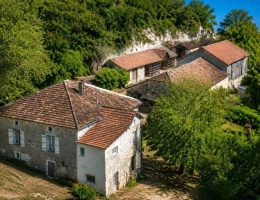
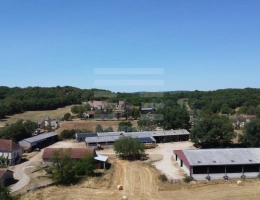
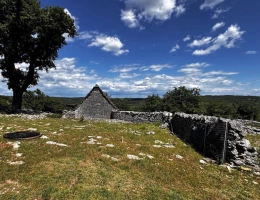
Buildings in the Quercy usually combine a pale stone barn, a steel shed added later and a dwelling set back from the yard. Each belongs to its own market: roof structure and covering on an old barn are expensive to put right, a recent shed is judged on span and clear height, and the house compares with a residential market supported by tourism along the valleys. A former tobacco drying barn or a disused sheepfold can shelter machinery once the structure has been assessed.
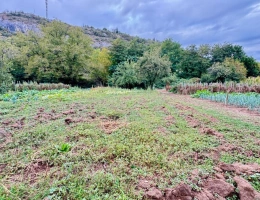
The best ground follows the rivers: the Lot terraces between Cahors, Luzech and Puy-l'Évêque, the Dordogne plain towards Souillac, and the Célé alluvium upstream of Figeac. Maize, durum wheat and sunflower dominate, though the Cahors vineyard and market gardening push land values up on several slopes. To the south, the Quercy blanc, around Montcuq, Castelnau-Montratier and Lalbenque, carries cash crops on limestone soils and supplies part of the arable land coming to market. Eastwards, the Limargue and the Ségala of the Lot, towards Lacapelle-Marival and Latronquière, mix forage cereals and livestock on more fragmented acid ground.
The wooded, sandy Bouriane and the causses of Gramat and Limogne leave little room for cash cropping: grass, ewes and forest take precedence there. Value gaps follow that map, between sought-after valleys and markedly more affordable plateaus. Drive the access tracks before deciding, because scattered blocks weigh on the cost of every field operation as heavily as soil quality does.
Water is the sensitive point. Ask for the abstraction authorisation, the volume granted, the record of summer restrictions and the condition of the pumping gear: low flows on the Lot and the Célé regularly bring limits that can downgrade an irrigated rotation. Then look at how the land is held, since much of it is rented: remaining term of the rural lease, annual rent, and the sitting tenant's pre-emption right. Taking over goes through the structures control, the prefectural authorisation weighed against the area taken on and the applicant's background, while SAFER, the rural land agency, is notified of every sale and may pre-empt it.
Check too the transfer of basic payment entitlements, the match between the graphical field register and the advertised areas, any woodland carrying a neighbour's right of first refusal, rights of way over causse tracks, and delivery commitments given to a cooperative. Where a company holds the farm, the deal may concern shares rather than assets: tax treatment, liabilities taken on and the warranties required then bear no resemblance to a straightforward sale of property.
This list is fed by mandates from owners at the end of their careers, from rural property agencies and from notaries practising in the department. State the area, budget and district you have in mind, switch on an alert so you hear as soon as a matching unit comes onto the market, then widen the search to arable farms for sale in Occitanie.


