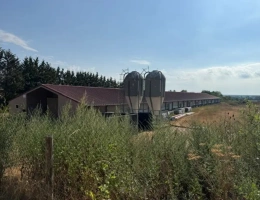
Looking for a poultry farm for sale in Allier? The Bourbonnais is livestock country first: most poultry here is an additional workshop on a suckler or arable holding, alongside a smaller number of label farms selling chicken, guinea fowl and turkey at local markets, plus a few units of laying hens. The listings collected here are placed by farmers stepping back, by rural property specialists and by notaries; they state the floor area of the buildings, the production system, the presence of range and the commercial commitments attached. They form part of all the poultry farms for sale published on the site.
This page adds to the listings what a buyer usually looks for first: the level of farmland values in the department, the districts where supply renews itself, how to read a mixed stock of buildings and the checks the sector requires. To prepare a setting-up project, our white paper « Créer une exploitation agricole » (in French) sets out the formalities and the financial structure.
Land remains the largest item when buying a poultry farm. According to sales recorded by the French tax administration (DVF, vineyards excluded), the median price of agricultural land in Allier (03) stood at €3,520/ha in 2025, with an average of €4,174/ha across 239 sales; 80% of transactions fall between €2,503 and €7,154/ha, against a national median of €5,307/ha.
The SAFER benchmark of land values (2025 figures) puts vacant land and pasture at €4,220/ha (+1.2% year on year, +13.1% over ten years), against a national average of €6,460/ha; land already let sells around 17% lower.
Land is only part of the picture. What carries the value of a Bourbonnais poultry holding is the capacity and compliance of its buildings, the quality of the grassed surroundings, any packing or cutting room on site and, for farms selling direct, the customer base built up at the markets of Moulins, Vichy and Montluçon. Equipment, collection contracts and goodwill where it exists complete the assessment. To frame an asking price, use our land price observatory and our financial calculators.
The stock on offer is mixed: small farm houses with pop-holes and planted range, longer standard sheds built for contract production, and a handful of floor-housed or free-range poultry units. A broiler farm is judged first on its frame, insulation, ventilation system, heating and floor condition, then on silos, feed line, drinkers, entry room and concreted washing area. The oldest buildings, sometimes converted from another production, need a serious costing before they are brought back into service.
Value also rests on the outlet. A unit integrated into a producer group offers visibility on feed, chicks and batch collection, while a farm that slaughters on site and sells direct passes on a customer base, a health approval and processing equipment that must be valued in their own right. Where the sale bundles a dwelling house, storage buildings and grassland, insist on a line-by-line breakdown rather than a single global figure.
The Sologne bourbonnaise in the north-east, between Dompierre-sur-Besbre and Le Donjon, combines ponds, woodland and medium-sized farms, and poultry is a common diversification there. The bocage running from Bourbon-l'Archambault to Cérilly and towards the Combraille remains dominated by the Charolais herd, with livestock buildings available but rarely designed for birds. The Allier valley and the Limagne bourbonnaise, more arable around Moulins and Saint-Pourçain-sur-Sioule, carry clearly higher land values. To the east, the Montagne bourbonnaise offers affordable buildings on ground that complicates logistics.
Volumes stay modest: specialist units rarely change hands, and many handovers are settled privately within the neighbourhood. Extending your watch to the neighbouring Loire and Puy-de-Dôme departments noticeably increases the number of opportunities. For a given budget, communes away from the main roads and the larger towns remain the most accessible.
As everywhere in France, poultry units come under the classified installations regime: declaration, registration or authorisation according to flock size, with the change of operator notified to the prefecture. Ask for the applicable order, any formal notices served, the biosecurity plan and the flock registers. Housing requirements imposed during avian influenza episodes have to be anticipated when the system relies on outdoor range. Distance to third parties and the prevailing wind direction shape what can be built later.
On the land, tenant farming is widespread in the Bourbonnais: establish what is owned and what is rented, and secure the landlord's agreement before signature. The structures control, France's authorisation regime for taking over farmland, applies, as does SAFER's right of pre-emption. Finally ask for the spreading plan and the manure storage capacity; an egg farm additionally requires you to check the building's registration, the packing circuit and the egg supply contracts.
The properties shown here come from private sellers, rural estate agencies and notarial offices. Narrow the results by area, budget or type of production to pick out the holding that suits your plans, save an e-mail alert so that new listings reach you as they are published, and extend your search beyond the department to all poultry farms for sale in Auvergne-Rhône-Alpes.