
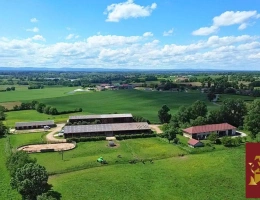
Thinking of buying a poultry farm for sale in Ain? This eastern department combines a long-standing reputation built on Bresse poultry and its protected appellation with broiler, turkey and guinea fowl units run alongside a herd or an arable rotation, and with laying hens kept on a smaller scale. The listings gathered on this page come from farmers handing over their business, from rural estate agencies and from notaries; they set out the covered area, the husbandry system, the ranges attached to the buildings and the organisation the unit belongs to. They sit within all the poultry farms for sale listed across France.
Beyond the listings, this page gives you what you need before a first visit: farmland values in the department, the districts where units come onto the market, how to read the buildings on offer and the checks the sector imposes. If you are setting up rather than expanding, our white paper « Créer une exploitation agricole » (in French) takes you through the process, from professional qualification to the funding plan.
Land remains the largest item when buying a poultry farm. According to sales recorded by the French tax administration (DVF, vineyards excluded), the median price of agricultural land in Ain (01) stood at €3,000/ha in 2025, with an average of €3,187/ha across 144 sales; 80% of transactions fall between €1,959 and €4,500/ha, against a national median of €5,307/ha.
The SAFER benchmark of land values (2025 figures) puts vacant land and pasture at €4,200/ha (+3.7% year on year, +12.3% over ten years), against a national average of €6,460/ha; land already let sells around 17% lower.
Beyond the hectares, the value of a Bresse poultry unit lies in its buildings and their surroundings: usable length of the houses, frame and insulation, ventilation, feed silos, biosecurity entry room, and the wooded range available where the specification requires one. The outlet matters just as much: an integration contract, membership of a producer group, or an established customer base for farms that slaughter and sell at market. To place an asking price in context, see our land price observatory and our financial calculators.
Housing in Ain ranges from modest farm-scale sheds and mobile huts moved across the range to longer houses built for standard chicken or turkey production. Buyers look at the year of construction, the frame, insulation, ventilation system, heating, feed line and silos, then at the floor, the entry room and the concreted washing area. A building recently brought up to standard sells well above an older shed whose return to service implies real work. Lorry access, water supply, available power and enough room to run a full clean-out between batches all weigh on the asking price.
Where the unit falls under the Bresse appellation, the specification governs the strain, the stocking density, the rearing period and the range area; those commitments pass on with the holding and deserve to be checked document in hand. Elsewhere, working under contract with a production organisation secures feed, chicks and collection of the batches. Free-range poultry systems also need enough grass and shade around the houses. When a dwelling house and land come with the sale, ask for the price to be broken down: the production tool and the house are not valued against the same references.
The Bresse country east of the Saône, around Bourg-en-Bresse, Montrevel-en-Bresse and Saint-Étienne-du-Bois, remains the poultry heart of the department: this is where appellation flocks, grass ranges and finishing pens are concentrated. The Dombes to the south mixes ponds, crops and farm poultry, on land keenly sought by arable businesses. The Revermont and the Bugey offer smaller mixed holdings on ground whose relief limits building size. The Pays de Gex and the strip along the Swiss border are heavily built up, with little farmland available and values disconnected from the rest of the department.
Being near a poultry abattoir, a cutting plant or a recognised market changes the economics of a takeover, especially for farms selling direct. Buyers working to a tight budget tend to look inland, in rural communes where land comes free more readily. Moving closer to Bourg-en-Bresse or to the Swiss border, by contrast, means accepting strong competition for every parcel.
A poultry unit falls under the French classified installations regime: depending on flock size it is subject to declaration, registration or authorisation, and any change of operator must be notified to the prefecture. Read the order in force before making an offer, since older requirements can restrict an extension. Check the biosecurity plan, the housing obligations that apply during avian influenza episodes, which are demanding for outdoor systems, and the regulatory distance between buildings and neighbouring homes, which governs any future enlargement.
On the land side, part of the parcels are usually rented: the rural lease continues with the buyer, subject to the landlord's agreement, and the deal goes through the structures control, the French authorisation regime for taking over farmland, as well as SAFER's pre-emption right. Ask about manure management, storage capacity and the spreading plan. An egg farm also calls for a look at the production code stamped on the shells, the approval of the packing centre and the supply contracts in place.
The listings on this page are placed by private sellers, rural estate agencies and notaries. Filter by area, budget or production type to isolate the holding that matches your project, set up an alert so that new listings reach you as soon as they are published, and widen your search beyond the department to all poultry farms for sale in Auvergne-Rhône-Alpes.