
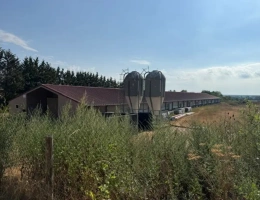
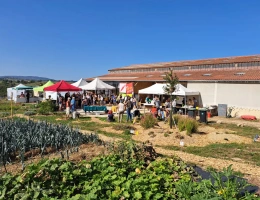
Taking over a poultry farm for sale in Haute-Loire means settling on high plateaux where poultry keeping usually sits alongside a beef herd or forage crops. The department has broiler houses, farm-scale units with outdoor range, and laying hens supplying the short supply chains of the Le Puy basin and the Loire valley. The holdings listed here come from farmers preparing a handover, from rural agencies and from notaries, and state the floor area, the production system and the outlet. They are part of the poultry farms for sale across France.
You will also find here what the listings leave out: farmland prices in the department, the areas where holdings come onto the market, how to judge the real condition of the buildings, and the checks specific to upland poultry keeping. To shape a setting-up project, our white paper « Créer une exploitation agricole » (in French) works through each stage, from the agricultural qualification to the business forecast.
Land remains the largest item when buying a poultry farm. According to sales recorded by the French tax administration (DVF, vineyards excluded), the median price of agricultural land in Haute-Loire (43) stood at €3,487/ha in 2025, with an average of €4,009/ha across 93 sales; 80% of transactions fall between €2,112 and €6,592/ha, against a national median of €5,307/ha.
The SAFER benchmark of land values (2025 figures) puts vacant land and pasture at €4,380/ha (+2.1% year on year, +10.1% over ten years), against a national average of €6,460/ha; land already let sells around 17% lower.
Beyond the acreage, the worth of a holding here rests first on the buildings: insulation, ventilation and above all heating costs, which matter at this altitude, together with the silos, the biosecurity entry room and winter access for collection lorries. Add to that any Auvergne geographical indication the flock qualifies for, the regularity of the batches and, for an egg farm for sale, the direct-sales customer base built up over time. To compare, lean on our land price observatory and our financial calculators.
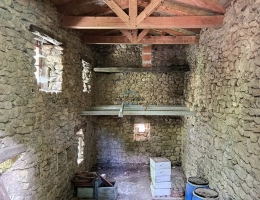
Buildings in Haute-Loire are on average modest in size, often set beside a cattle shed or a storage barn. The inspection covers the frame, the roof and the insulation, the ventilation method, the heating appliances and the fuel they use, then the silos, the feed lines, the drinkers and the floor. At altitude, energy use per batch becomes a decisive item: a well-insulated building fitted with a heat exchanger is not comparable to an older house. Cleared winter access, a washing area, the entry room and the ability to organise a full empty period between batches all feed into what the asking price can be.
Some units work under an integration contract with a producer group, which delivers the chicks and the feed and collects the birds; the remaining term and the transfer conditions of that contract are negotiated alongside the property itself. Farm-scale, organic or label rouge holdings value their processing facility, their health approval and their customers separately. Where a broiler farm on the market brings together buildings, land and a dwelling house, splitting the price across those three items heads off most of the disagreements that arise at valuation.
Poultry keeping in the department is spread across several distinct areas. The Devès plateau and the surroundings of Le Puy-en-Velay combine livestock and upland cropping, with land in demand close to the town. The Emblavez and the Loire valley offer more sheltered sites, well suited to outdoor range. The Yssingeaux country and the Meygal hills, closer to the Rhône valley and more industrial in character, carry mixed holdings where the poultry unit supplements farm income. The Brivadois and the Brioude lowlands, lower down, offer cereal land and larger buildings, while the Margeride remains geared to extensive grazing.
The supply of free-range poultry buildings stays limited and turns over mainly as farmers retire. Buyers often widen the search to the edges of Puy-de-Dôme, Loire or Ardèche to find a tool that matches their plan. Pay attention to snow cover, to how the site is exposed, and to the distance to slaughtering and feed-milling facilities.
Depending on flock size, a unit falls under declaration, registration or authorisation within the French classified installations regime, and the change of operator is notified to the prefecture. Ask for the applicable order: the conditions on distances, effluent storage and odour management are set out there. The buyer then checks the manure spreading plan, the flock register, the biosecurity plan and the avian influenza measures, which govern access to the range and movement between buildings. In a department of scattered hamlets, the distance to neighbouring houses governs any future extension and should be measured on site.
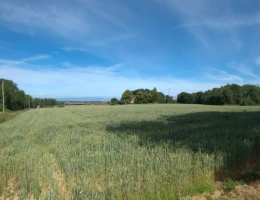
On the land side, the acreage around the buildings determines spreading capacity and therefore room to grow; many parcels are rented and the rural lease continues with the incoming farmer, subject to the landlord's agreement. The structures control, the French authorisation regime for taking over farmland, and SAFER's pre-emption right both apply to the transaction. Have buildings, equipment and land valued separately, and if you are applying for setting-up support, agree the filing date with the seller before any signature.
The listings shown here are placed by private sellers, rural estate agencies and notaries. Filter by building area, by budget or by type of production, then set up an alert to receive new listings in the department. You can also open your search to every poultry farm for sale in Auvergne-Rhône-Alpes.