
Are you prospecting for a poultry farm for sale in Drôme? The department is a reference for free-range poultry in south-eastern France: production under a protected geographical indication, chicken and guinea fowl reared outdoors, a high share of organic farming and laying hens whose eggs go into short supply chains. The listings gathered here are placed by farmers handing over, specialist agencies and notaries; they mention the area of the buildings, the quality scheme, the size of the ranges and the organisation collecting the batches. They form part of all the poultry farms for sale listed in France.
This page adds the benchmarks a buyer needs: the level of Drôme farmland values, the districts where units are concentrated, how to inspect buildings that usually carry a specification, and the controls imposed on the sector. For a setting-up project, our white paper « Créer une exploitation agricole » (in French) presents the steps from training to the funding plan.
Land remains the largest item when buying a poultry farm. According to sales recorded by the French tax administration (DVF, vineyards excluded), the median price of agricultural land in Drôme (26) stood at €8,000/ha in 2025, with an average of €8,181/ha across 63 sales; 80% of transactions fall between €4,032 and €11,504/ha, against a national median of €5,307/ha.
The SAFER benchmark of land values (2025 figures) puts vacant land and pasture at €7,190/ha (+5.9% year on year, +0.1% over ten years), against a national average of €6,460/ha; land already let sells around 17% lower.
What makes the value of a Drôme unit goes well beyond the farmed area: capacity and compliance of the buildings, planted range, access to shade and water, membership of an official quality scheme, organic certification already acquired and conversion time already served, and the contract that secures collection of the batches. Egg packing rooms and on-farm shops are valued in their own right. For comparison, our land price observatory and our financial calculators provide usable benchmarks.
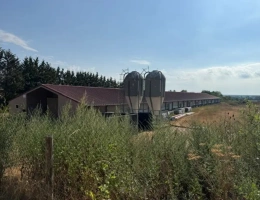
Drôme units combine fixed houses of moderate length, sized for farm-scale specifications, with mobile huts used on planted ranges. Buyers examine frame and insulation, ventilation and the cooling systems that summer makes essential, start-up heating, silos, feed line and drinkers, then the floor, the entry room and the washing area. A building that complies with a quality scheme and has enough range attached sells above an equivalent standard house. The quality of shade and the state of the fencing count for more here than in many other departments.
Contract rearing with a producer group structures much of the output: remaining term, transfer conditions and the group's allocation policy are among the first questions to raise. Farms that slaughter, pack or sell on site hand over equipment and a customer base to be valued separately. Where orchards, lavender or field crops accompany the poultry, ask what each contributes to the result before settling your offer.
The Drôme des Collines, from Saint-Donat-sur-l'Herbasse to Hauterives and Romans-sur-Isère, forms the poultry heart of the department, with a dense population of units, downstream facilities nearby and long-established know-how. The Valence plain combines fruit growing, seed production and poultry on irrigated land that trades high. The Drôme valley, around Crest and Die, gathers many organic and diversified systems. Further south, the Tricastin and the Baronnies offer more affordable buildings but limited water resources and marked residential competition.
Communes close to the Rhône valley routes benefit from simple logistics and direct access to consumer markets, which shows in asking prices. The foothills of the Vercors and the Diois, by contrast, offer larger and less contested holdings, with relief and altitude to factor in. Pressure on irrigated land remains the main reason values differ from one district to the next.
The unit falls under the classified installations regime according to flock size, with declaration, registration or authorisation depending on the threshold reached, and the change of operator notified to the prefecture. Ask for the order in force, the biosecurity plan, the registers and the health history. Avian influenza episodes bring housing obligations that bear heavily on free-range poultry: make sure the buildings can take the birds in acceptable conditions. Distance to dwellings frames any future extension.
Then look into water rights and access to irrigation, decisive on the plain and often tied to a collective network, and at the status of the parcels: the rural lease continues with the buyer, and the transaction remains subject to the structures control, France's authorisation regime for taking over farmland, and to SAFER's pre-emption right. If the holding is certified organic, have the transfer of certification confirmed with the inspection body. An egg farm additionally requires checking the production code and the approval of the packing centre.
The properties shown come from private sellers, rural estate agencies and notarial offices. Refine by area, price or production system to pick out the holding suited to your plans, whether contract-reared or organic, set an e-mail alert to follow new listings as they appear, and take your search further across all poultry farms for sale in Auvergne-Rhône-Alpes.