

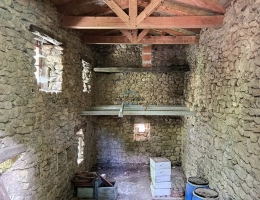
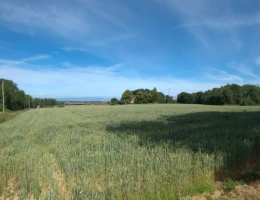
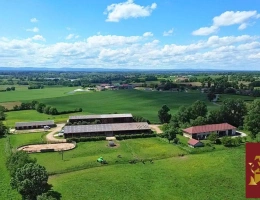
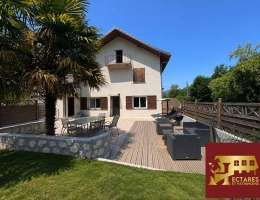
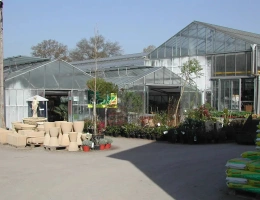
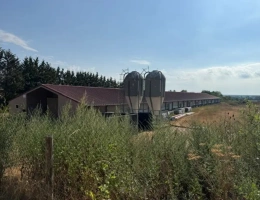
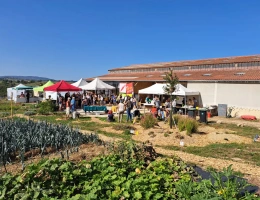
Finding a goat farm for sale in Rhône means searching a compact department where urban pressure sits alongside solid livestock country: the Monts du Lyonnais, the Arbresle area, the slopes south of Lyon, the Beaujolais vert and the Rhône side of the Pilat. Goat herds put slopes and meadows to work here, with a large share of on-farm cheese-making supported by a very wide pool of customers nearby. Sellers preparing to step back, rural agencies and notaries entrust us with these holdings, stating the herd, the milking set-up, the land and how the produce is sold. They take their place among our goat farms for sale.
This page supplies what a listing leaves aside: the level of farmland values in the department, the areas still releasing holdings, the condition of the livestock buildings and the checkpoints specific to a goat unit. If your plan is to set up in farming, our white paper « Créer une exploitation agricole » (in French) summarises the key stages.
Land weighs heavily on the budget for a goat farm. Transfers published by the French tax authorities (DVF, excluding vineyards) put the median for farmland in Rhône (69) at €3,728/ha in 2025, with an average of €4,254/ha over 71 sales. Eight transactions in ten settle between €2,000 and €7,027/ha, where the national median is €5,307/ha.
A second reference, the SAFER land value benchmark, sets vacant land and pasture at €4,630/ha for 2025, -6.3% in a year and +0.4% over a decade; the French average is €6,460/ha, and a sitting tenant costs a plot roughly 17% of its value.
In a department this sought-after, acreage never explains a price on its own. First come the goat house and its milking block, the cheese room with its drying room and cellars, then the herd and its yield. Next, often heavily, comes the goodwill: market customers, box schemes, Lyon shops and restaurants, local reputation, a place in a network of retailers. Sloping grazing and mowing meadows complete the picture. Place the market with our land price observatory and test your takeover plan through our financial calculators.
With an older building stock, a takeover starts with a survey of the fabric: frame, roof, ventilation, natural light, the state of the bedded area, the width of the feed passage, feed barriers, kidding pens and a dedicated space for young stock. Milking follows, and replacing it calls for a serious budget: platform and units, vacuum pump, automatic washing, bulk tank and adjoining milk room. Many farms here occupy old converted farmsteads, so check the electrical compliance, the effluent drainage and whether the goat house could technically be extended one day.
On-farm processing is widespread in this department, which shifts value downstream: make room, drying room, ripening cellar, cold stores, health approval or exemption, refrigerated van and market pitches. In the communes concerned around Condrieu, some producers fall within the Rigotte de Condrieu protected designation: certification of the workshop should be confirmed with the inspection body before you rely on that argument. Where a house comes with the farm, draw a clear line between residential property, much in demand here, and the working tool itself.
The Monts du Lyonnais, around Saint-Laurent-de-Chamousset and Sainte-Foy-l'Argentière, form the heart of local livestock farming and hold most of the goat units. The Arbresle area and the Pierres Dorées combine livestock, vines and strong residential pressure. The Beaujolais vert, towards Thizy-les-Bourgs and Monsols, keeps land more affordable and offers decent-sized grassland holdings. To the south, the slopes above Mornant enjoy customers on the doorstep but a fiercely contested land market. The Rhône side of the Pilat, towards Condrieu, rounds out the picture with slopes well suited to goat grazing.
Everywhere, competition between farming and residential use cuts the number of holdings genuinely available and lengthens the search. Farms come free more often in the west and north of the department than in the ring around Lyon, where several buyers appear as soon as a listing goes live. Reacting quickly, viewing early and arriving with funding already arranged therefore counts for as much as the budget itself.
Above a certain herd size, goat farming falls under the French classified installations regime, by declaration or registration, with the change of operator notified to the prefecture. In a densely settled department, the distance to neighbouring houses deserves particular attention: it governs any extension and explains many neighbourhood disputes. Ask for the order in force, the spreading plan and the storage capacity. On the cheese side, approval must be applied for again in the buyer's name after a veterinary visit, and the herd's health status should be verified with documents in hand, including test results and the monitoring protocol used by the outgoing owner.
Expect a large rented share and fragmented parcels: read the leases and their expiry dates, bearing in mind that the structures control, France's authorisation regime for taking over farmland, and SAFER's pre-emption right both apply. Check the zoning in the local planning document too, as it may restrict agricultural construction. Close to the conurbation, a dairy goat holding is judged on its customer base as much as on its walls.
The holdings shown here reach us from private sellers, rural estate agencies and notarial practices. Target the area, the budget or the presence of a cheese room, then create an e-mail alert: in this department a goat cheese farm or a working smallholding is scarce and attracts several buyers quickly. Widening the net to every goat farm for sale in Auvergne-Rhône-Alpes is often worthwhile.