

Buying a goat farm for sale in Ardèche means stepping into one of the densest caprine departments in France, where the herd turns slopes, heathland and chestnut groves into milk that no other enterprise could draw from them. What appears here is released by breeders arranging their handover, by rural land professionals and by notaries of the Vivarais; the descriptions give herd size, grazing area, how the milk is valued and whether a processing workshop is attached. Each belongs to our national selection of goat farms for sale.
Alongside the listings you will find what actually helps a decision: local land values, the districts where a holding most often becomes available, the state of buildings on steep ground and the checks that raw milk imposes. If a takeover or a start-up is ahead of you, the white paper « Créer une exploitation agricole » (in French) sets out the stages from qualification to funding.
Land weighs heavily on the budget for a goat farm. Transfers published by the French tax authorities (DVF, excluding vineyards) put the median for farmland in Ardèche (07) at €8,069/ha in 2025, with an average of €7,860/ha over 13 sales. Eight transactions in ten settle between €3,842 and €11,161/ha, where the national median is €5,307/ha. * Fewer than 30 recorded sales: indicative value.
A second reference, the SAFER land value benchmark, sets vacant land and pasture at €5,140/ha for 2025, +4.5% in a year and +9.6% over a decade; the French average is €6,460/ha, and a sitting tenant costs a plot roughly 17% of its value.
On terrain like this, hectares matter less than what they carry. A buyer pays for the shed and its airflow, the parlour, the bulk tank, the cheese room and its ripening cellar, the reach of the grazing, the water resource, and then the animals: breeds, age, replacement stock, health record. Outlets sit on top, from Picodon sold at the gate or on market stalls through to milk taken by a dairy. Weigh that against our land price observatory and our financial calculators.
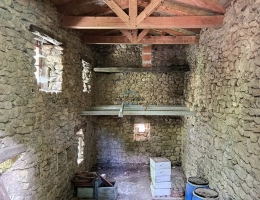
Buildings here range from a stone sheepfold reworked for goats to a steel-framed shed set on a cut platform. Look at ground bearing, at how rainwater is carried away, at ventilation within an often low volume, at access for hay lorries and the water tanker, and at whether forage is stored out of the wind. The parlour, frequently built as a lean-to, is judged on the condition of the milk line, the capacity of the tank and the electrical supply, which can be fragile in high hamlets. A holding already brought up to standard costs more but spares the buyer work that is awkward to carry out on a constrained site.
A cheese room is part of the landscape here: make room, drying room, cellar, cold store and sales point come with a large share of holdings. Its worth rests on the approval or derogation held, the volume processed and the customer base, much of it built on summer visitors. A herd delivering into collection is measured instead on how reliably the tanker comes and on contract terms. When a whole farmstead is on the market, separate the dwelling, the livestock buildings, the animals and the land: the house alone can account for a large slice of the advertised figure.
Goats are kept almost everywhere in the department, but for different reasons. The Ardèche plateau and the Montagne, around Coucouron and Sainte-Eulalie, impose long winters, hay self-sufficiency and well-insulated buildings. The Boutières and the Coiron combine dry grazing, heath and medium-sized herds. The Bas-Vivarais, from Joyeuse to Les Vans and on to Vallon-Pont-d'Arc, mixes chestnut groves, garrigue and heavy tourism, so direct selling pays well while land is contested. The Haut-Vivarais, towards Annonay and Saint-Félicien, leans to dairy cattle, and caprine opportunities are scarcer.
The Picodon designation covers the department and shapes part of the marketing, alongside delivery rounds, producers' shops and the markets of the Rhône valley. The most affordable ground lies at altitude and away from the tourist routes; the valleys near the Rhône and the surroundings of busy sites hold firmer prices.
A dairy goat holding is first placed under the French classified installations regime: depending on herd size it falls under declaration, registration or authorisation, and a change of operator must be brought to the prefecture's attention. Smaller flocks are governed by the departmental health regulation, in particular siting distances from neighbours, a sensitive matter in hamlets where houses adjoin farm buildings. Ask for the herd's status on CAEV, the caprine arthritis-encephalitis virus, and on paratuberculosis and, where milk is processed, for the food safety plan and the self-monitoring results of recent seasons.
The terrain adds checks of its own: the reliability of the spring or borehole, the abstraction permit, late-summer flow, fire risk on scrubbed-over grazing and whether tracks stay usable in winter. Legally, part of the land is rented, sometimes under precarious arrangements: the rural lease continues with the buyer subject to the landlord's agreement, and the deal remains subject to the structures control, the French authorisation regime for taking over farmland, and to SAFER. Fragmented parcels deserve a precise survey before any offer.
Retiring breeders, rural estate agencies and notarial offices place the properties shown on this page. Rank what you see by altitude, by price or by whether the milk leaves in a tanker or goes to the make room, then switch on an e-mail alert: here a smallholding of this kind quickly draws several candidates. Handing over your own farm? Publish the listing. Carry the search on through goat farms for sale in Auvergne-Rhône-Alpes.