
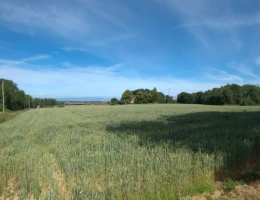
Looking for a goat farm for sale in Isère means choosing between very different farming worlds: the Vercors and Chartreuse plateaus, the slopes above the Grésivaudan valley, the hills of Bièvre and Terres Froides, and the Trièves, where dairy goat herds make use of meadows and rough grazing. The department has on-farm dairies that make and ripen their own cheese, units that send their milk to a creamery, and mixed holdings running goats alongside cattle. Farmers preparing a handover, specialist rural agencies and notaries entrust us with these properties, stating herd size, milking equipment and forage area. They join our listings of goat farms for sale.
A listing rarely tells the whole story. This page adds what a decision needs: the value of land and pasture in the department, the areas where handovers come up most often, the state of the buildings to inspect and the checks specific to goat farming. Our white paper « Créer une exploitation agricole » (in French) covers the funding and legal-status side.
Land weighs heavily on the budget for a goat farm. Transfers published by the French tax authorities (DVF, excluding vineyards) put the median for farmland in Isère (38) at €4,000/ha in 2025, with an average of €4,555/ha over 79 sales. Eight transactions in ten settle between €2,497 and €7,089/ha, where the national median is €5,307/ha.
A second reference, the SAFER land value benchmark, sets vacant land and pasture at €4,950/ha for 2025, -0.2% in a year and +5.1% over a decade; the French average is €6,460/ha, and a sitting tenant costs a plot roughly 17% of its value.
Acreage accounts for only a share of the asking price. What buyers really pay for is the goat house itself, its milking parlour, bulk tank and handling equipment, then the dairy room where cheese is made on site: drying room, ripening cellar, approved workshop. Add the herd, the grazing that can actually be used, the forage in store and, often decisive, the customer base built through markets and box schemes. Place those values using our land price observatory, then test your figures with our financial calculators.
Any visit starts with the goat house: air volume, ridge ventilation, natural light, floor and bedding, width of the feed passages, feed barriers, kidding pens and a separate area for young stock. Milking comes next, since it is the costliest item to replace: single or double platform, automatic cluster removal, milk line, cleaning system, bulk tank and cooling unit. A recent set-up, sized for the herd advertised, sells well above a converted building where everything still has to be renewed. In upland communes, hay storage capacity and winter access weigh as much as the covered area itself.
Where a cheese room comes with the herd, it is assessed separately: make room, drying room, ripening cellar, cold store, washing circuit, health approval and the match between those volumes and the litres actually produced. A dairy goat holding that processes and sells its own cheese cannot be compared with a unit supplying a creamery, whose value rests first on its collection contract. Where a dwelling house is included, separate the working tool from the home at the first viewing: the house follows the local rural property market, the farm is judged on what it can produce.
Goat units sit mainly on the uplands and hillsides. The Vercors and the Trièves, around Villard-de-Lans, Mens and Clelles, combine medium-sized herds, a strong tradition of farmhouse cheese-making and extensive grazing. The Matheysine and the Oisans offer mountain holdings run with summer pasture. Westwards, the Bièvre, the Terres Froides and the Bas-Dauphiné more often pair goats with forage crops on blocks of land that hang together better. The slopes near Vienne and La Côte-Saint-André complete the picture. The Grésivaudan valley and the fringes of Grenoble, by contrast, carry heavy pressure on land and release very few farms.
Being close to the Grenoble conurbation is a commercial asset for anyone selling direct, but it pushes land prices up and thins out opportunities. Buyers therefore widen their search towards the south of the department or the edges of the neighbouring Drôme, where the ground around the buildings is easier to assemble and where holdings change hands more regularly.
Above a certain herd size, goat units fall under the French classified installations regime: depending on numbers, the holding is subject to declaration or to registration, and any change of operator must be notified to the prefecture. Ask for the order in force, the manure spreading plan and the storage capacity, then have the cheese room checked with the veterinary services: health approval does not transfer automatically and must be reissued. The herd's health status should be verified too, test records in hand, before any commitment.
Much of the land is rented rather than owned. The French rural lease continues with the buyer, subject to the landlord's agreement, and the deal goes through the structures control, the authorisation regime for taking over farmland, and through SAFER, the rural land agency holding a pre-emption right. In mountain areas, read the grazing agreements and common land rights, and check the flock protection measures applied where predation occurs. Have buildings, herd, equipment and land priced separately rather than accepting one global figure.
Every goat cheese farm shown here reaches us through a retiring owner, a rural estate agency or a notary, from large units down to a working smallholding. Narrow the results by area, budget or the presence of a cheese room, then switch on an e-mail alert: in this sector demand outstrips supply and properties move quickly. You can also widen your search to every goat farm for sale in Auvergne-Rhône-Alpes.