
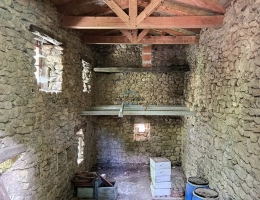
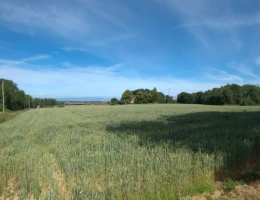
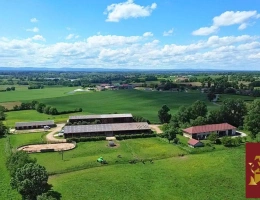
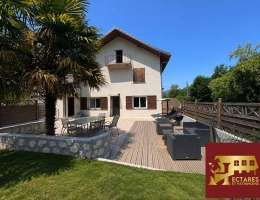
A goat farm for sale in Drôme draws seasoned breeders and newcomers alike, because the department brings together a long caprine tradition, deeply rooted organic farming and consumers close at hand. The properties gathered on this page are entrusted to us by breeders arranging their succession, by rural land specialists and by notaries; they state how many dairy goats are milked, what the shed consists of, whether a cheese room is attached and how much of the area is rough grazing. Each sits within our national selection of goat farms for sale.
Past the listings, this page supplies what is missing when the decision is close: local land values, the valleys where holdings come free, the buildings and milking equipment that deserve inspection, and the checks tied to on-farm processing. To prepare a takeover, our white paper « Créer une exploitation agricole » (in French) describes the procedures and the funding that can be mobilised.
Land weighs heavily on the budget for a goat farm. Transfers published by the French tax authorities (DVF, excluding vineyards) put the median for farmland in Drôme (26) at €8,000/ha in 2025, with an average of €8,181/ha over 63 sales. Eight transactions in ten settle between €4,032 and €11,504/ha, where the national median is €5,307/ha.
A second reference, the SAFER land value benchmark, sets vacant land and pasture at €7,190/ha for 2025, +5.9% in a year and +0.1% over a decade; the French average is €6,460/ha, and a sitting tenant costs a plot roughly 17% of its value.
The worth of a goat cheese farm rests first on its working tool: shed and ventilation, milking platform or parlour, bulk tank, make room, drying room, ripening cellar and sales point. Then come the animals, their breeds, their health record and their capacity to renew themselves, followed by the water resource and access to grazing. The outlet completes the picture, whether a clientele of markets and producers' shops or a collection contract. Cross-read it with our land price observatory and our financial calculators.
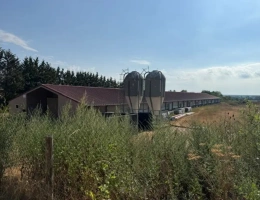
Local buildings mix recent timber-clad sheds, goat housing raised on former sheepfolds and reworked barns. Hot summers steer the inspection: height under the ridge, openings and air movers, the orientation of the building, shade over the collecting yard, insulation of the milk room. Next comes the parlour, its milk line, its washing system and the tank capacity, along with forage storage, often decisive in a department where hay costs dearly in dry years. A unit recently overhauled, with compliant services and effluent handling, sells appreciably higher than one that would have to be rebuilt from the ground up.
On-farm processing is widespread: cheese room, drying room, cellar, cold store and sales point form a whole valued according to the approval held, the volumes handled and the customer base built up. Herds delivering to a dairy are judged differently, through the regularity of collection and the terms of the contract, sometimes under an organic specification. When a farmhouse or a complete holding is offered with dwelling, outbuildings and land, a breakdown becomes essential: residential value here can exceed that of the farming asset itself.
The Diois, around Die, Châtillon-en-Diois and the Drôme valley down to Crest and Saillans, remains the caprine heart of the department, with herds working slopes, heath and rough grazing. The Baronnies provençales, from Nyons to Buis-les-Baronnies, combine livestock with olives and aromatic plants on fragmented parcels. The Royans and the foothills of the Vercors offer grass and buildings often inherited from mixed farms. The plain of Valence, the Drôme des collines and the Tricastin, heavily given over to field crops, orchards and vines, leave less room for goats and show far more contested land.
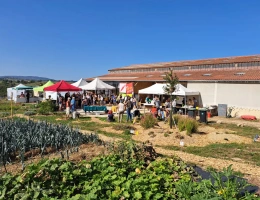
The Picodon designation extends across the department and shapes part of the marketing, completed by markets, producers' shops and steady demand for organic produce. Being close to Valence, Romans-sur-Isère and the Rhône corridor makes selling easier but pushes land values up; the inner valleys of the Diois and the Baronnies stay more affordable, at the cost of harder working conditions.
A goat unit is also judged on its administrative framework: depending on numbers it falls under declaration, registration or authorisation within the French classified installations regime, with any change of operator notified to the prefecture, while smaller herds remain governed by the departmental health regulation and its distances from dwellings. Water deserves particular attention: where the resource comes from, the abstraction permit, flow in dry spells, summer restrictions and drinking arrangements on distant grazing. Ask as well for the herd's status regarding CAEV, the caprine arthritis-encephalitis virus, and paratuberculosis.
Where the farm processes, insist on the food safety plan, the approval or the derogation covering direct supply, and the self-monitoring results; membership of the designation or organic certification is verified with the competent body before you commit. On land, the rural lease over rented parcels continues with the buyer subject to the owner's agreement, and the transaction passes through the structures control, the French authorisation regime for taking over farmland, then through SAFER, which is especially watchful where vines and orchards compete with livestock.
What you see here is offered by private sellers, rural estate agencies and notarial offices based in the Rhône valley and its hinterland. Compare holdings on the share of rough grazing, on budget or on how the milk is valued, and arm an e-mail alert, because a dairy goat holding finds a buyer quickly in this department. Handing yours on? Post the listing. Continue through goat farms for sale in Auvergne-Rhône-Alpes.