
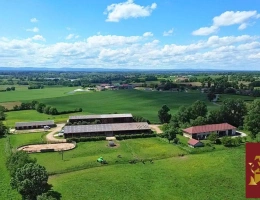
Hunting for a goat farm for sale in Ain means reading a department of contrasts: the Bresse plain, the Dombes ponds, the Revermont ridge and the Bugey plateaux hold systems that have little in common, from small herds whose milk is turned into cheese on the farm to units collected by a dairy. What you see here is placed by breeders organising their handover, by rural property specialists and by notaries, with the herd size, the capacity of the buildings, the presence of a cheese room and the forage area all set out. Each one belongs to our national selection of goat farms for sale.
This page adds what a listing rarely says: what farmland is worth locally, which parts of the department see holdings change hands, which buildings deserve a close look and which checks are specific to dairy goats. If setting up is your plan, our white paper « Créer une exploitation agricole » (in French) walks through the route from the agricultural qualification to the funding plan.
Land weighs heavily on the budget for a goat farm. Transfers published by the French tax authorities (DVF, excluding vineyards) put the median for farmland in Ain (01) at €3,000/ha in 2025, with an average of €3,187/ha over 144 sales. Eight transactions in ten settle between €1,959 and €4,500/ha, where the national median is €5,307/ha.
A second reference, the SAFER land value benchmark, sets vacant land and pasture at €4,200/ha for 2025, +3.7% in a year and +12.3% over a decade; the French average is €6,460/ha, and a sitting tenant costs a plot roughly 17% of its value.
Hectares only tell part of the story for a dairy goat holding in Ain. Value sits in the shed and its airflow, the milking parlour, the bulk tank and its room, the processing workshop with its ripening cellar, and then in the animals themselves: replacement kids, health status, milk yield. On top of that sits goodwill that no valuation grid captures, whether a market and box-scheme clientele or a collection contract. Cross-check all of it against our land price observatory and test your assumptions with our financial calculators.
Start with the shed: air volume, ridge or gable ventilation, natural light, alley width, straw-bedded pens, feed barriers, and whether hay is stored under the same roof or in a separate barn. Then the milking set-up, on a rolling platform or in a fixed parlour, with its automatic wash, its bulk tank and the room around it. A holding whose water and electrical networks have been redone sells well above one patched together over the years, where ventilation and effluent handling will have to be rebuilt. A kid-rearing area and a properly separated buck pen also count when the asking price is weighed up.
Where a cheese room is part of the deal, the reading changes: make room, drying room, cold store, farm shop and health approval form a business in their own right, valued alongside the customers and market rounds it supplies. A herd whose milk leaves in a tanker is judged differently, through the reliability of collection and the terms of the contract. When a dwelling house and land come with the holding, ask for a line-by-line breakdown: house, buildings, animals, equipment and parcels are not measured against the same benchmarks.
Caprine herds in Ain cluster on the higher ground and its edges. The Revermont and the Bugey, from Cerdon down to Belley, carry modest flocks whose cheese is sold close to home; the Hauteville plateau and the Valromey offer grass, rough grazing and buildings often inherited from former cattle farms. Across the Bresse and the Dombes, goats remain a minority among poultry, fish ponds and mixed cropping, yet land is easier to assemble there than near Bourg-en-Bresse or along the Saône valley, where farming uses compete hard for every parcel.
Being close to Lyon, Geneva and the Pays de Gex changes the commercial picture: a farmhouse cheese business sells out without effort, but pressure on land and buildings shows up in the asking prices. The northern fringes of the department and the approaches to the Jura stay more affordable for a first purchase, provided you accept longer delivery rounds.
Above a certain herd size, a goat unit falls under the French classified installations regime: declaration, registration or authorisation depending on numbers, with any change of operator notified to the prefecture. Below that threshold the departmental health regulation applies, including minimum distances to dwellings, worth measuring on the ground before any extension is imagined. On animal health, ask for the herd's status regarding CAEV, the caprine arthritis-encephalitis virus, and paratuberculosis, and request the laboratory results of recent campaigns. A cheese room needs either its health approval or the derogation covering direct supply, backed by an up-to-date food safety plan.
Part of the grassland and rough grazing is usually rented. The rural lease carries on with the buyer subject to the landlord's agreement, and the deal goes through the structures control, the French authorisation regime for taking over farmland, then through SAFER's pre-emption right. Check real forage self-sufficiency, hay included, and water access on summer grazing. Anyone counting on setting-up support must file before signature, so the timetable is agreed with the seller early.
Private sellers, rural estate agencies and notaries feed this page. Work the filters on area, budget and type of unit, then arm an e-mail alert: with more candidates than holdings on the market, a goat cheese farm or smallholding rarely stays available long. Selling yours? Post the listing. To widen the net, look through goat farms for sale in Auvergne-Rhône-Alpes.