
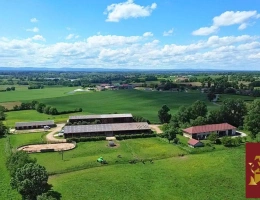
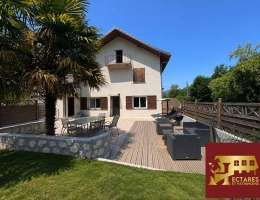
Tracking down a goat farm for sale in Cantal calls for patience: in a department shaped by cattle and by great cow's milk cheeses, goats keep a quiet place, held by farmer-cheesemakers working mountain holdings. The properties listed here are entrusted to us by farmers winding down, by agencies specialising in rural estates and by notaries; each description covers herd size, altitude, the split between meadow and rough grazing and the nature of the workshop. They appear within our national inventory of goat farms for sale.
This page adds what genuinely drives a decision: what local pasture is worth, which districts release a holding, how mountain buildings should be inspected and which checks matter before taking on a dairy unit. To prepare a setting-up project, our white paper « Créer une exploitation agricole » (in French) works through the regulatory and financial route.
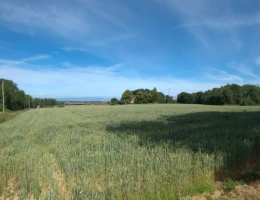
Land weighs heavily on the budget for a goat farm. Transfers published by the French tax authorities (DVF, excluding vineyards) put the median for farmland in Cantal (15) at €7,381/ha in 2025, with an average of €7,166/ha over 136 sales. Eight transactions in ten settle between €3,657 and €10,561/ha, where the national median is €5,307/ha.
A second reference, the SAFER land value benchmark, sets vacant land and pasture at €6,440/ha for 2025, -2.9% in a year and +2.9% over a decade; the French average is €6,460/ha, and a sitting tenant costs a plot roughly 17% of its value.
What makes the price of a dairy goat holding here goes well past acreage: the quality of the shed and its insulation, the milking block, the bulk tank, the cheese room with its ripening cellar and sales point, the hay storage needed to carry the herd through winter, then the animals and their replacement stock. Goodwill built on markets, producers' shops and passing visitors sits on top of all that. Set your benchmarks with our land price observatory and our financial calculators.
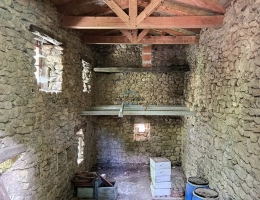
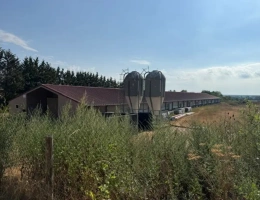
Most caprine units in Cantal came out of a conversion: a cowshed reworked, a barn-byre renovated, a lean-to added at one end. Long winters govern how the building reads: roof insulation, absence of draughts over the bedding, ventilation that nonetheless works, hay storage volume, snow clearing and access for the milk tanker or deliveries. The parlour, often modest, is judged on the state of the milk line, the tank capacity and how dependable the electrical supply proves. A compliant slurry store or muck pad, a concreted yard and a sheltered water point spare upgrades that are expensive to carry out at altitude.
Where the farm processes its own milk, the cheese room changes the equation. Make room, drying room, cellar, cold store and sales point form an asset valued separately, according to the approval or derogation obtained, the volume handled and the loyalty of the customers. A herd whose milk goes into collection depends instead on a tanker round passing nearby, which is far from guaranteed in every canton. Faced with a farmstead sold with house, outbuildings and land, insist on a breakdown: old granite buildings hold value quite apart from the working tool.
The Châtaigneraie, south-west of Aurillac towards Maurs and Montsalvy, offers the kindest conditions: gentler altitude, fragmented parcels, a tradition of small mixed farms and real scope for direct selling. The Cère and Truyère valleys and the edges of the Xaintrie provide steep grazing but few suitable buildings. The Planèze de Saint-Flour, the Margeride and the Cézallier stay dominated by suckler and dairy cattle, with land sought after for expansion. The Monts du Cantal and the Artense add altitude and demanding winters.
Pasture here remains more affordable than in neighbouring arable departments, yet cattle holdings expanding their acreage limit what truly comes free. Buyers do well to target areas where tourism supports farm-gate sales, around the ski resorts, the busy sites of the Monts du Cantal and the markets of Aurillac and Saint-Flour.
Taking on a goat unit means establishing which tier of the French classified installations regime applies: declaration, registration or authorisation according to numbers, with the change of operator notified to the prefecture; below those thresholds the departmental health regulation sets siting distances and effluent storage conditions. Call for the full health history: CAEV monitoring, the caprine arthritis-encephalitis virus, paratuberculosis screening, brucellosis testing and cell counts. Where the farm processes milk, the food safety plan, the approval or the derogation covering direct supply, and the self-monitoring results should all be produced before any offer.
There is no protected designation for goat cheese here: everything hangs on the farm's own name, its presence on market stalls and often an organic certificate, so the customer base counts as much as the stonework. Check forage self-sufficiency over a full year, the aspect of the parcels and winter access. In legal terms the rural lease on rented meadows continues with the buyer subject to the landlord's agreement, the transaction falling under the structures control, the French authorisation regime for taking over farmland, and under SAFER's pre-emption right.
The properties shown here are offered by retiring farmers, rural estate agencies and notarial offices in the department. Sort the properties by altitude, by budget or by whether a workshop comes with the herd, then set an e-mail alert: in Cantal, a smallholding of this kind comes up only a handful of times a year. Selling your own farm? Post the listing. Widen the search through goat farms for sale in Auvergne-Rhône-Alpes.