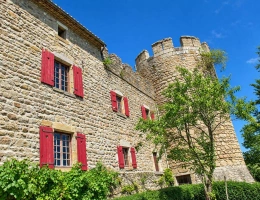
A historic monument for sale in Auvergne-Rhône-Alpes can turn up as easily on the volcanic uplands of Cantal as in the Rhône vineyards or the alpine valleys of Savoie: a reworked hilltop fortress, a Cistercian abbey, a silk-town townhouse or a fortified mill on a Rhône tributary. Shaped by a feudal, religious and industrial past, the region holds a large number of classified or registered buildings, from the Livradois-Forez to the alpine massifs. Browse the historic monuments for sale listed here by private owners, agencies and notaries across the region.
This page sets out the protected building types found across Auvergne-Rhône-Alpes, the areas where they are most common, the administrative duties attached to a classified building or a registered one, and the technical checks to run before any restoration project, in the mountains as much as in town. To place this purchase within a broader approach, read our guide to buying prestige property in France.
Volcanic stone dominates in Cantal, Haute-Loire and Puy-de-Dôme: dark basalt, arkose and polished lava make up fortresses reworked during the Renaissance and Romanesque priories perched on old volcanic necks. In the Rhône and Ain, the architecture turns more urban, with golden-stone townhouses built for silk merchants and canut weavers' houses with tall windows. In Savoie and Haute-Savoie, alpine building mixes limestone, larch timber and steeply pitched roofs, while the Drôme and Ardèche retain fortified farmhouses and oil mills built of river-rolled stone.
Outbuildings matter as much as the main house: a manorial chapel, a dovecote, a wine press, an ice house or a watchtower, depending on altitude and original use. Many of these residences to restore have kept their original timber frames, carved fireplaces or faded wall paintings, but also roofs worn thin by decades of mountain snow and frost. Restoration campaigns generally favour lime renders and local materials, the only ones compatible with approval from the Architecte des Bâtiments de France.
Cantal and Haute-Loire hold isolated fortresses around Saint-Flour, Murat and Le Puy-en-Velay; Puy-de-Dôme and Allier offer noble residences near Riom, Thiers and Moulins. The Rhône, around Lyon and the Beaujolais hills, and Ain, between the Bresse plain and the Pays de Gex, hold sought-after townhouses and country residences. Haute-Savoie and Savoie offer alpine strongholds near Annecy, Chambéry and Albertville, while Isère combines the building traditions of the Grésivaudan with those of the Vercors. Further south, the Drôme, around Valence and Montélimar, and Ardèche, between the Vivarais and its gorges, retain characterful farmhouses and mills.
The Rhône, Ain, Isère and Drôme benefit from TGV stations, at Lyon, Bourg-en-Bresse, Grenoble and Valence, while Savoie and Haute-Savoie are served by Chambéry and Annecy; Cantal, Haute-Loire, Puy-de-Dôme, Allier and Ardèche remain off the high-speed network and are best reached by road or by regional Intercités links from Clermont-Ferrand. The most sought-after areas lie around Lyon, Annecy and the alpine corridor between Chambéry and Grenoble; the Cantal, Forez and Vivarais massifs offer more secluded monuments, generally more affordable for a long restoration project.
The same monument can be classified for all or part of its façades, or only registered on the inventory: the regime differs for any works application, which must go to the Architecte des Bâtiments de France and, for a classified building, to the regional heritage office; the seller must inform the buyer of the exact status, and the administration must be notified at the time of sale. The historic-monument tax regime allows, under conditions to be checked with a professional, certain restoration costs to be deducted.
At altitude, have the timber frame checked for snow-load resistance, the stone-slab or flat-tile roofing checked for watertightness, and the water systems checked for frost exposure across a long alpine winter. In the Rhône and Ain, dry rot and termites found in older timber frames justify a thorough structural survey before signing. Entrust any quote to a contractor qualified for historic monuments, and ask about Fondation du patrimoine grants before any plan to open the property to the public.
Historic monument listings in Auvergne-Rhône-Alpes come from private owners, agencies specialising in heritage property and notaries; narrow the search by department, building type, listing status and outbuildings, and set an e-mail alert to track new listings as they come to market. Widen the search across the wider region through prestige property for sale in Auvergne-Rhône-Alpes.