

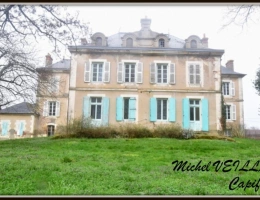
A historic monument for sale in Allier often brings to mind the golden-stone Bourbonnais residence, from the ducal palace of Moulins to the priories scattered around Souvigny, by way of the spa villas and townhouses of Vichy. Once the heartland of the former Duchy of Bourbon, the department has kept dense protected heritage, blending medieval religious architecture, Renaissance residences and nineteenth-century spa buildings. Properties range from a residence already restored and habitable year-round to a Bourbonnais residence still entirely to renovate. Browse the historic monuments for sale listed by the department's private owners, agencies and notaries here.
This page lists the protected building types found in Allier, the areas where they cluster, the obligations tied to a classified building or a registered one, and the checks to make before buying, without touching on financial matters. To place this project within a complete approach, read our guide to buying prestige property in France. Restoration grants offered through the DRAC or the Fondation du patrimoine generally come with a requirement to open the property to the public, a term worth clarifying case by case.
Protected buildings in Allier combine the golden limestone of Bourbonnais residences, used for sober façades in Moulins and Souvigny, with the polychrome brick of Vichy's spa villas, inherited from the nineteenth century. Ducal residences retain corner turrets, mullioned windows and occasionally a parapet walk, while priories and former commanderies show cloisters and vaulted cellars. Slate or flat-tile roofing, depending on the area, covers volumes usually raised over two storeys. Corner turrets built from finely cut golden limestone are a further hallmark of the more prosperous ducal residences.
Outbuildings bring together timber-framed barns, dovecotes isolated in the Bourbonnais plain, private chapels and mills on the Allier or the Sioule. A residence to restore frequently retains beamed ceilings, carved fireplaces and vaulted cellars, while Vichy's spa-era decorative work, where it survives, calls for specialised restoration in joinery and ornamental ironwork. Some Bourbonnais dovecotes retain their original central frame and terracotta nesting holes, features typical of the local seigneurial architecture.
Moulins, the former capital of the dukes of Bourbon, and Souvigny, known for its priory and ducal necropolis, hold most of the protected religious and seigneurial buildings. Vichy and the Allier valley bring together townhouses and spa villas, while Montluçon, to the west, retains a ducal castle and timber-framed houses in its historic centre. To the north, the Bourbonnais Sologne and the Bourbonnais Bocage, towards Bourbon-l'Archambault, offer more scattered rural settlement and more isolated stone residences. Local agents can advise on which sectors of the Bourbonnais plain carry the strictest heritage constraints before a visit is arranged.
Allier has no TGV station: links to Paris run on Intercités trains from Moulins or Vichy, with TER connections across the rest of the department. The most sought-after areas remain the outskirts of Moulins and Vichy; the more rural Bourbonnais Bocage and Sologne offer comparable buildings with more modest access conditions. Beyond rail links, the main road connecting Moulins to Vichy eases travel towards the Bourbonnais Sologne and the Bourbonnais Bocage. Rail connections onward from Moulins towards Paris also pass through Nevers, widening onward options.
First establish whether the property is classified as a historic monument or only registered, since the works authorisation regime differs, and any intervention within the surroundings of a protected monument, outbuildings included, requires approval from the Architecte des Bâtiments de France after review by the regional heritage office. When a classified building changes hands, the seller must tell the buyer about its status and alert the administration, a formality the notary attends to when the deed is drawn up. It is worth asking for copies of any past authorisation decisions issued by the Bâtiments de France office, which show what work has already been cleared.
The historic-monument tax regime, which under conditions may allow certain restoration costs to be deducted, deserves verification with a qualified adviser before any decision. On site, have the condition of Vichy's spa-era decorative work checked where it survives, dampness in the vaulted cellars, and hand the works to a qualified contractor in restoring Bourbonnais heritage. A borescope inspection of the roof timbers is also advisable in the wooded areas of the Bourbonnais Bocage, where damp encourages wood-decaying fungi. Roof access should also be checked ahead of any slate repointing work.
Historic monument listings in Allier are placed by private owners, agencies specialising in Bourbonnais protected heritage and notaries; filter them by building type, protection status and outbuildings, and set an e-mail alert to follow new listings. To compare across the region, browse the historic monuments for sale in Auvergne-Rhône-Alpes.


