
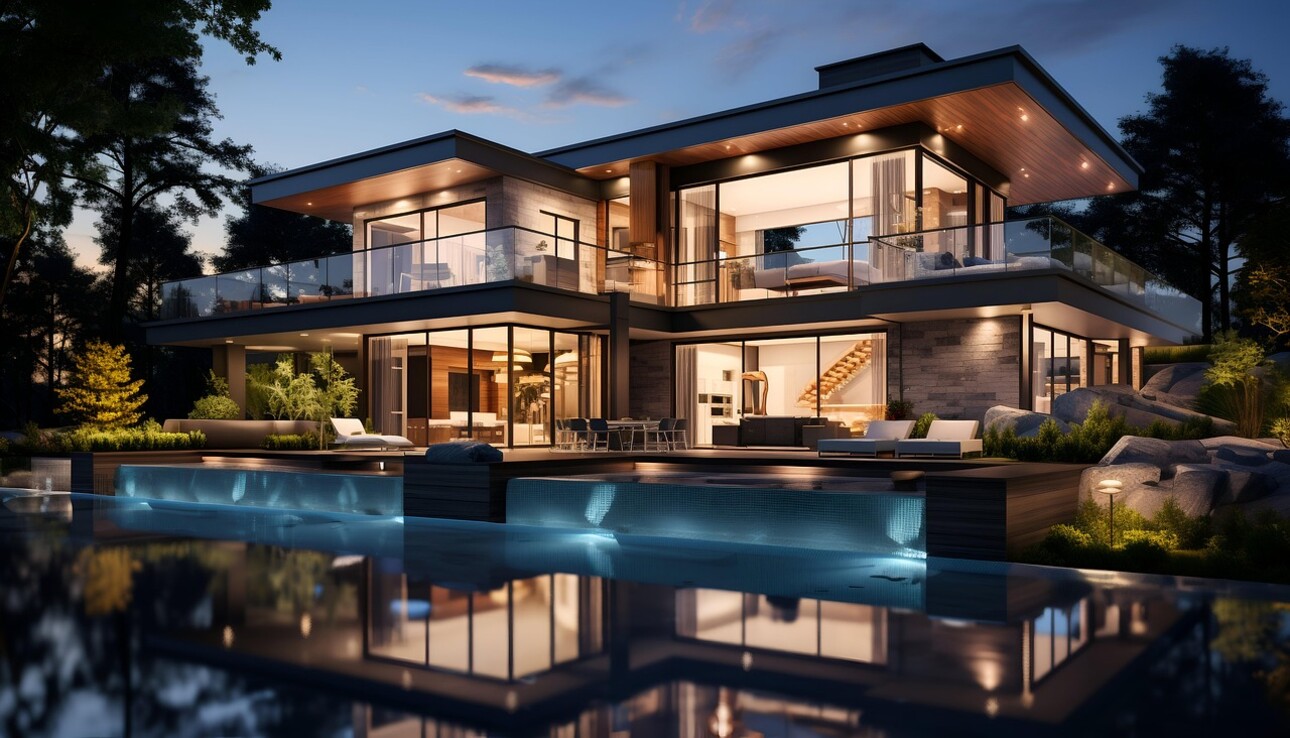
In the high-end market of the South of France, two types of acquisition have long competed with each other: the contemporary villa with a swimming pool, often close to the coast, and the character property (Provençal mas, bastide, maison de maître) set in the hinterland. Choosing between a contemporary villa or a character property is not just a matter of taste. The two properties differ in ownership costs, exposure to energy regulations, rental potential and liquidity on resale.
The DVF data we analysed on prestige properties sold in France between 2020 and 2025 provide an initial benchmark: the median price reaches €6,863/m² on the tourist coast, compared with €2,558/m² in the tourist hinterland. For the same budget, a buyer therefore gets two to three times more floor space by moving away from the coast. The question is what that space will then cost to maintain, rent out and resell.
The contemporary villa is a lifestyle product: single-storey or two levels, large bay windows, swimming pool, pool house, home automation. Its value comes from its location (sea view, proximity to beaches, access to an international airport) and the condition of its fittings and equipment.
The mas or bastide follows a heritage logic closer to that of a château or a maison de maître: old stone walls, outbuildings, several hectares of land, sometimes an olive grove or vines. Its value lies in the authenticity of the building, the surrounding landscape and its rarity. It depreciates less quickly through obsolescence, but requires heavier and more specialised maintenance.
In a recent villa, maintenance items are predictable: swimming pool (filtration, water treatment, liner or surface coating), landscaped garden, air conditioning, windows and doors. The main risk is technical obsolescence: a villa built in the 2000s may need a complete upgrade of its equipment after twenty or twenty-five years to remain at market standard.
In a character property, expenses are less regular but heavier: canal tile roofs, lime render repairs, roof timbers, restoration of outbuildings, mandatory brush clearance in wildfire-prone areas, upkeep of dry-stone terraces (restanques) and driveways. This work requires craftsmen qualified in historic buildings, whose lead times and rates are higher than those of standard construction.
Before comparing two properties, it is therefore useful to reason in terms of annual maintenance budget relative to the purchase price, and to ask the seller for the history of works carried out over the past ten years. A mas whose roof and sanitation system have been renewed does not have the same value as a mas needing renovation, even if the listings look alike.
Energy performance has become a value criterion in its own right. A villa built after 2012 generally benefits from insulation that meets recent standards and more easily obtains a favourable EPC (DPE) rating. An old bastide, on the other hand, often combines large volumes, thick but poorly insulated walls, old windows and oil-fired or electric heating.
The thermal inertia of stone walls provides genuine summer comfort, which the EPC fails to reflect. But the displayed energy class weighs on negotiations and, above all, on the ability to rent the property out. Insulating an old building without altering its character (breathable renders, loft insulation, replacement of the heating system) is possible, but the cost must be factored in from the purchase offer stage.
Holiday lets are often the deciding argument in the South, where summer demand remains strong. But the Le Meur Act of 19 November 2024 changed the parameters. As the Notaires de France website on furnished tourist accommodation points out, properties newly offered as furnished tourist accommodation in municipalities subject to change-of-use authorisation must have an EPC rating of at least E. From 1 January 2034, all furnished tourist accommodation will have to be rated between A and D, with the owner's main residence being exempt.
Taxation has also been tightened. Since 2025 income, the micro-BIC allowance has been reduced to 30% (with a €15,000 revenue cap) for unclassified furnished accommodation, and to 50% (with a €77,700 cap) for classified furnished tourist accommodation. For a prestige property whose revenue exceeds these caps, the actual-expenses regime (régime réel) becomes the rule, which requires bookkeeping and depreciation calculations.
In practical terms, the recent villa with a pool, easy to classify and bring up to standard, remains the simplest product to rent out by the week. The mas or bastide has a different advantage: its outbuildings make it possible to consider gîtes or bed and breakfast rooms, and therefore a structured tourism business rather than occasional rental of the main house. This is a business venture in its own right, not just a supplementary income.
For buyers who favour a contemporary villa, the Côte d'Azur offers the deepest supply, from Saint-Tropez to Menton, including the hinterland of Cannes and Nice. Browsing specialist listings of villas for sale on the Côte d'Azur makes it possible to quickly gauge price differences between the seafront, the first line of hills and hilltop villages.
Several points deserve systematic verification: exposure to risks (wildfire, ground movement, flooding) via the risk disclosure statement (état des risques), compliance of the pool and any extensions with planning permissions, local rules on furnished tourist accommodation if a rental project is planned, and the actual quality of the view, which could be compromised by a neighbouring construction permitted under the local urban plan (PLU).
On resale, a well-located contemporary villa benefits from a broad French and international buyer base, and from a valuation that is relatively easy to establish by comparison. Its limitation is obsolescence: a villa whose equipment and style have aged sells at a marked discount.
A character property appeals to a narrower buyer base, which generally lengthens selling times. On the other hand, a tastefully restored mas in an unspoilt setting is a rare asset that holds up better through market cycles. Its value depends heavily on the quality of the restoration: poorly executed works (unsuitable materials, loss of original character) can damage it permanently.
Neither profile is superior in absolute terms. The contemporary villa buys comfort, simplicity and liquidity; the character property buys space, authenticity and more stable heritage value, at the cost of more demanding management. The right decision always starts from the actual use of the property and the intended holding period.