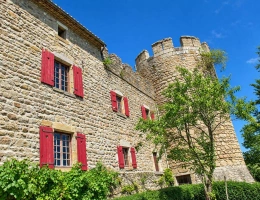
A historic monument for sale in Puy-de-Dôme readily appears in black Volvic stone, the emblematic material of Clermont-Ferrand and Riom, or in granite across the Combrailles and the Livradois-Forez. The volcanic relief of the Chaîne des Puys, now recognised as a world heritage site, together with the Allier and Sioule valleys, has fostered a varied stock of protected buildings, from the fortified urban residence to the isolated rural building. Properties range from a main house already restored and habitable year-round to a volcanic-stone residence still entirely to renovate. Browse the historic monuments for sale listed by the department's private owners, agencies and notaries here.
This page sets out the protected building types found in Puy-de-Dôme, the areas where they cluster, the obligations attached to a registered building or a classified one, and the checks worth making before buying, without addressing financial matters. To consider this kind of project as a whole, read our guide to buying prestige property in France. Financial backing for restoration work, from the DRAC or the Fondation du patrimoine, is typically linked to opening the property to the public, a condition to clarify case by case.
Protected buildings in Puy-de-Dôme are recognised above all by their black Volvic stone, used for carved façades and window surrounds in Clermont-Ferrand and Riom, while grey granite dominates the Combrailles and the Livradois-Forez, to the west and east of the department. Townhouses in the old centre of Clermont-Ferrand retain arcaded courtyards and spiral staircases, while rural residences in the Combrailles adopt a more defensive plan, with a corner tower and narrow openings. Slate or phonolite stone-slab roofs cover compact volumes suited to an upland climate. Window surrounds carved from a single block of Volvic stone are a further hallmark of the more prosperous residences.
Associated outbuildings include barns with heavy-set roof timbers, private chapels, mills on the Sioule or one of its tributaries, and sometimes a freestanding dovecote in the Combrailles. A residence to restore often retains beamed ceilings, carved Volvic-stone fireplaces and vaulted cellars, while renders and stone-slab roofing require regular technical upkeep. Some Combrailles dovecotes retain their original star-shaped timber frame and terracotta nesting holes, typical of Auvergne pigeon lofts.
Clermont-Ferrand and Riom hold most of the protected urban fabric, including townhouses and burgher residences, while Thiers, known for its cutlery trade, retains timber-framed houses set on its steep relief. To the west, the Combrailles offer more scattered rural settlement around Pontgibaud and Pontaumur, amid woods and ponds. To the east, the Livradois-Forez, towards Billom and Ambert, and the Dore valley offer isolated residences in mid-mountain terrain, more affordable than the outskirts of Clermont-Ferrand. Local agents can advise on which sectors of the Combrailles and Livradois-Forez carry the strictest heritage constraints before a viewing is arranged.
Puy-de-Dôme has no TGV station: links to Paris run on Intercités trains from Clermont-Ferrand, with TER connections across the rest of the department. The most sought-after areas remain central Clermont-Ferrand and Riom; the more rural Combrailles and Livradois-Forez offer comparable buildings in a more secluded setting. Beyond rail links, the A75 motorway crosses the department from north to south, easing access to both the Combrailles and the Livradois-Forez.
Check first whether the property is classified as a historic monument or only registered, since works on a protected building or one within a monument's surroundings, including the now world-heritage-listed Chaîne des Puys, require approval from the Architecte des Bâtiments de France after review by the regional heritage office. Selling a classified building requires informing the buyer of its status and notifying the administration, a formality the notary builds into the deed. It is also advisable to obtain copies of any past authorisation decisions from the Bâtiments de France office, which set out what work has already been cleared.
The historic-monument tax regime, which under conditions may allow certain restoration costs to be deducted, should be confirmed with a professional before any decision. On site, have the stone-slab roofing checked for resistance to frost, dampness in the Volvic-stone walls, and hand the works to a qualified contractor skilled in restoring volcanic stone. A borescope inspection of the roof timbers is also advisable in the wooded areas of the Livradois-Forez, where damp encourages wood-decaying fungi. Roof access should also be checked ahead of any lava-stone repointing work.
Historic monument listings in Puy-de-Dôme are placed by private owners, agencies specialising in Auvergne listed chateaux and notaries; filter them by building type, protection status and outbuildings, and set an e-mail alert to follow new listings. To compare across the region, browse the historic monuments for sale in Auvergne-Rhône-Alpes.