

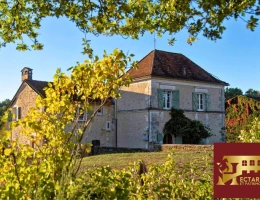


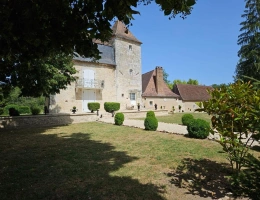
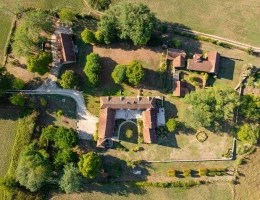

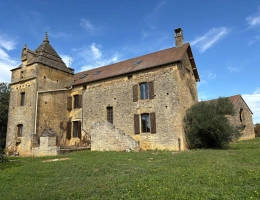
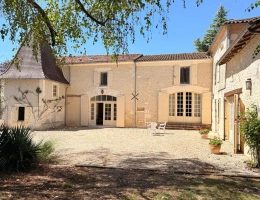
A historic monument for sale in Dordogne belongs to one of the most recognisable families of Périgord heritage: a remodelled hilltop castle, a golden-stone manor or an abbey set beside the Dordogne, the Vézère or the Isle. From Sarlat-la-Canéda to Périgueux, by way of Bergerac, Brantôme and Montignac, the department holds a remarkable number of classified or registered buildings, often surrounded by farm outbuildings that have stood in place for centuries. Properties on offer range from fully restored residences to structures still to be renovated. Browse the historic monuments for sale listed by the department's private owners, agencies and notaries.
This page details the protected building types found in Dordogne, the areas where they cluster, the procedures and grants tied to historic-monument status, and the checks worth making before buying, so a restoration project can be approached with a full grasp of the constraints involved. To approach the purchase of a character residence as a whole, read our guide to buying prestige property in France.
Golden limestone, quarried locally, characterises most of the region's protected buildings: finely jointed dressed façades, moulded surrounds and steeply pitched lauze-stone roofs across Périgord Noir, giving way to flat tiles around Bergerac in Périgord Pourpre. A hilltop castle reworked during the Renaissance, a turreted manor, a Romanesque priory or a timber-framed bastide house make up a strikingly varied built landscape, with keeps, wall-walks and private chapels still standing on certain estates.
Outbuildings often matter as much as the main house: a dovecote tower, a tithe barn, a mill on the Vézère or the Isle, a cellar carved into the rock. Many residences have kept their coffered ceilings and monumental fireplaces but need roofing or frame repairs, since lauze stone demands specific technical upkeep. Recent restorations combine lime renders, local oak joinery and discreet upgrading of services.
Périgord Noir, around Sarlat-la-Canéda, Montignac and Domme, holds the greatest number of protected buildings, set in a landscape of steep valleys along the Dordogne and the Vézère. Périgord Blanc, around Périgueux and Brantôme, offers urban and suburban residences, while Périgord Vert, towards Nontron and Thiviers, has more secluded houses that are often less costly. Périgord Pourpre, around Bergerac and Issigeac, mixes vineyards and golden-stone manors along the Dordogne valley.
No TGV station serves the department; Intercités services connect Périgueux and Bergerac to Paris, and Bergerac-Dordogne-Périgord airport supplements access for an international clientele. The most sought-after areas remain the Dordogne valley between Sarlat and Beynac, while Périgord Vert and the west of the department offer comparable estates on markedly more accessible terms.
Start by establishing the exact nature of the protection: a classified building carries more extensive restrictions than one that is merely registered, particularly for interior works, and any project touching the façade or its surroundings requires approval from the Architecte des Bâtiments de France in liaison with the regional heritage office. The tax regime attached to historic-monument status can ease certain restoration costs, subject to conditions to be confirmed with a notary or tax adviser, and selling a classified building requires informing the buyer and notifying the relevant administration.
On the technical side, have the lauze or tile roof examined, since its specialised laying calls for qualified contractors who are few in the department, along with damp levels in any rock-cut cellars and foundations in karst areas prone to underground cavities. Finally, check any easements attached to access tracks and any public-opening commitments tied to earlier grants from the Fondation du patrimoine. Buyers should also ask whether any past restoration was carried out under prior authorisation, since undeclared works can complicate a future sale.
Historic monument listings in Dordogne come from private owners, agencies specialising in character residences and notaries; filter them by building type, geographic area and state of repair, and set an e-mail alert to follow new listings. To widen the search across the region, browse historic monuments for sale in Nouvelle-Aquitaine. Notaries in the area can also confirm whether restoration grants received by earlier owners carry ongoing conditions, such as a public-opening commitment, that pass on to a new buyer.