
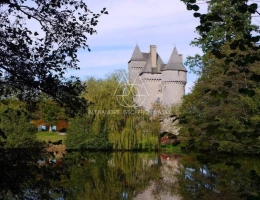
A historic monument for sale in Creuse often appears around a bend in the Creuse valley, known as the painters' valley near Crozant, or along the streets of Aubusson, the tapestry town, and Boussac, overlooked by its chateau. Granite shapes most of the protected building stock, isolated fortified residences, mills on the Creuse or the Sédelle, and former commanderies scattered across a sparsely populated bocage landscape. Discover the historic monuments for sale listed by Creuse's private owners, agencies and notaires.
This page gives an overview of the protected building types found in Creuse, the areas where they cluster, the obligations tied to classified or registered status, the grants available for restoration, and the checks worth making before you buy. Isolation and a harsh climate shape much of what a buyer needs to plan for here. To go further into the process as a whole, read our guide to buying prestige property in France.
Grey granite, sometimes cut into large blocks for the footings, characterises most protected buildings in Creuse, from fortified residences around Boussac to the chateau overlooking the town, often cited as the department's reference listed chateau. In Aubusson, the townhouses and workshops tied to tapestry weaving, some a registered building for their façade, reflect centuries-old skills recognised by UNESCO for the tapestry craft itself. The more modest rural residences often keep corner towers and arrow slits inherited from troubled periods.
Outbuildings include granite barns, dovecotes and, along the watercourses, former mills on the Creuse, the Sédelle or the Petite Creuse, a river dear to the painters who once worked around Crozant. Condition is highly uneven, some carefully restored residences standing near isolated buildings treated as a residence to restore. Projects favour local granite and traditional techniques suited to a harsh winter climate.
The Creuse valley, around Crozant and Fresselines, draws attention for landscapes that inspired many painters in the late nineteenth century, with residences often standing alone above the river. Aubusson and its surrounding area hold a protected urban heritage tied to tapestry, while Boussac, to the north, keeps a remarkable castle heritage close to the Indre border. Guéret, the central préfecture, and the Monts de Guéret offer more rural buildings, and La Souterraine, to the west, marks the transition towards Haute-Vienne. To the south, towards Felletin and the Gentioux plateau, more rugged terrain keeps an even more scattered settlement pattern, where protected residences mix with former farm barns. The Creuse valley and the Aubusson area remain the most sought after; the Monts de Guéret stay more accessible for a comparable building.
Creuse has no TGV station; La Souterraine is served by Intercités links to Paris-Austerlitz, in a little over three hours. The RN145 trunk road crosses the department towards Limoges and Montluçon, and Limoges and Châteauroux airports remain the closest for air travel.
First establish whether a property is classified, which requires the approval of the Architecte des Bâtiments de France for any work on protected features, or registered, a status that leaves more freedom outside the listed parts. The historic-monument tax regime, which can ease the cost of major restoration, remains conditional on sustained upkeep over time, worth checking with a professional before any decision, especially for an isolated, lightly occupied residence.
Selling a classified building requires the buyer to be warned of its status and the relevant administration to be notified as soon as the preliminary contract is signed. On the technical side, have granite walls checked for dampness, inspect roofing exposed to a harsh winter climate, and confirm the availability of contractors qualified in traditional restoration, often limited in a department as rural as Creuse. Also check the status of access tracks to the most isolated residences, sometimes municipal and sometimes private, a point worth clarifying before any purchase.
Historic monument listings in Creuse are placed by private owners, agencies specialising in protected rural heritage and local notaires; filter them by area, protection status and outbuildings, and set an e-mail alert to follow new listings. To compare with Haute-Vienne, Indre or Allier, browse the historic monuments for sale in Nouvelle-Aquitaine.