Looking for a market garden for sale in France and drawn to Bourgogne-Franche-Comté? This is a region of small and medium units, usually set close to the towns they supply through markets, producer shops and school and hospital catering. Vegetable growing, under cover and in the open, sits alongside ornamental businesses producing pot plants and cut flowers, and nurseries raising shrubs and young stock. Sellers here are growers stepping back, rural agencies and notaries, and the entries set out the area, the structures, the water supply and the customers already in place. They join the market gardens and nurseries for sale listed throughout France.
This page adds the benchmarks that are usually missing at decision time: what land is worth in the region, which departments see the most handovers, how to read a set of growing structures and the way it has been maintained, and what to verify before signing. Our white paper « Créer une exploitation agricole » (in French) deals with the setting-up project itself, from the agricultural qualification to the funding plan.
Land value drives much of the asking price for a market garden or nursery. French tax transfer statistics (DVF, vineyards excluded) show, for 2025, a median of €2,773/ha in Bourgogne-Franche-Comté, an average of €2,907/ha and 1,303 sales; 80% of transactions settle between €1,813 and €4,185/ha, against a national median of €5,307/ha.
On the SAFER side, the value of vacant land and pasture is set at €2,740/ha for 2025, moving -6.2% over a year and -8.1% over ten, against €6,460/ha nationally; expect an average discount of 17% where a lease is running.
Land never accounts for the whole price of a holding like this. Glasshouses and multi-span houses count, as do tunnels and their films, heating, irrigation and drip lines, the borehole and its permit, the washing and grading shed, cold storage, growing benches and standing ground for young plants. Then comes the goodwill itself: market pitches held, box-scheme subscribers, garden centre accounts, public catering contracts. Gauge the price levels with our land price observatory and build your figures with our financial calculators.
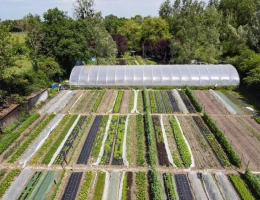
The region's continental climate, with late frosts and sometimes dry summers, gives protected cropping particular weight. Look at the tunnel hoops and the age of the films, the frame and glazing of the houses, whether heating and thermal screens are fitted, how venting is automated and how everything is anchored against wind and snow. A well-kept greenhouse business, linked to a reservoir and a drip network, is worth more than a large covered area needing full renewal. A plant nursery for sale is judged in addition on its container beds, its shading and how well its alleys carry machinery.
Then look downstream: washing and grading line, cold room, packing area, loading bay and a refrigerated van for the rounds. Many units in the region deliver direct, which calls for order-picking space sized to the job. Where the sale covers a holding with a dwelling house, separate from the first visit the share of the house, that of the structures and machinery, that of the land and that of the goodwill: funding terms and write-down periods differ across them.
In Côte-d'Or, the growing belt around Dijon and the Saône plain hold much of the supply, on alluvial land that is straightforward to irrigate. Doubs and Territoire de Belfort follow the same pattern around Besançon and the Belfort-Montbéliard conurbation: modest areas, direct selling and keen competition for land near the towns. Saône-et-Loire, from the Saône valley into the Bresse, mixes open-field crops with protected ones, while Jura mainly holds diversified units built around selling at the farm gate.
Yonne benefits from its position between Paris and Dijon, with valley land and a long tradition of vegetable growing along the rivers. Nièvre and Haute-Saône remain more rural: a smallholding is bought there on easier terms, provided the logistics towards the towns are organised. Broadly, the further you move from the conurbations, the more land prices ease and the more the question of outlets decides the project.
Begin with water: where it comes from, river, aquifer or reservoir, the abstraction permit and the volumes granted, and the drought orders that recur in certain catchments. Check the local planning zoning, whether the houses and buildings were lawfully put up, and whether the washing area drains to a compliant system. Soil condition is verified before purchase: depth, drainage, compaction, cropping history and soil-borne disease pressure all govern which rotations are possible and how quickly the beds can be brought back into production.
The transaction falls under the structures control, the French authorisation regime that applies when farmland changes hands, and under SAFER's pre-emption right; rented parcels stay bound by the lease in force. An ornamental business is also valued on its range of varieties and its accounts, and a vegetable farm on the regularity of its catering orders. Confirm that organic certification continues without a new conversion period, and secure your seasonal labour, housing included, before committing.
The listings gathered on this page come from private sellers, from agencies specialising in rural property and from notaries. Sort by department, area or budget, switch on an alert so the next holding to reach the market does not pass you by, and carry on through all the farms for sale in Bourgogne-Franche-Comté.