

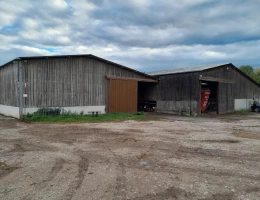
The Loire valley shapes the whole picture here. A market garden for sale in Nièvre is most often found on the alluvial terraces that follow the river, between Nevers, Fourchambault and La Charité-sur-Loire, where the ground dries early and water is never far away. The department also holds micro-holdings on the edge of the Morvan uplands and a few nurseries raising hardy stock. Growers arranging their exit, rural property firms and notarial offices entrust these holdings: each listing states the area cropped, how much sits under cover, where irrigation water comes from and which outlets are already running. They take their place in our national selection of market gardens and nurseries for sale.
A listing says nothing about what land is worth locally, where holdings genuinely come up, how to read an ageing set of structures or the formalities a takeover must clear. That is what this page covers, area by area. To shape the project itself, from legal status and farming qualification to the cash plan, our white paper « Créer une exploitation agricole » (in French) takes over.
Land value drives much of the asking price for a market garden or nursery. French tax transfer statistics (DVF, vineyards excluded) show, for 2025, a median of €3,040/ha in Nièvre (58), an average of €3,182/ha and 150 sales; 80% of transactions settle between €2,013 and €4,156/ha, against a national median of €5,307/ha.
On the SAFER side, the value of vacant land and pasture is set at €2,990/ha for 2025, moving +1.7% over a year and -2.9% over ten, against €6,460/ha nationally; expect an average discount of 17% where a lease is running.
Acreage never settles what a vegetable or ornamental site is worth. Judge first the soundness of the tunnels and multi-span houses, the quality of the anchoring, how films and thermal screens are holding, then the post-harvest chain: washer, grading table, cold store, compliant room for direct sales. Add the borehole and its abstraction licence, the drip lines, and above all the goodwill, market pitches and committed box subscribers. Place the asking price with our land price observatory, then stress-test your funding in our financial calculators.
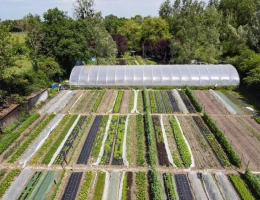
Local stock rests on plastic tunnels and, on better-equipped sites, on film-clad multi-span houses; heated glass is uncommon and mainly raises spring transplants. Climb onto the structures, judge the anchoring in ground that can be loose alluvium, how the film is holding, the state of doors and venting, whether back-up heating exists and what it burns. For an ornamental business, look instead at growing benches, container standing ground, shading and the potting area. A greenhouse business offered without adjoining land or a customer base follows pricing logic quite unlike that of a working unit.
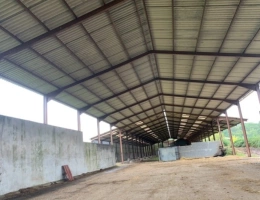
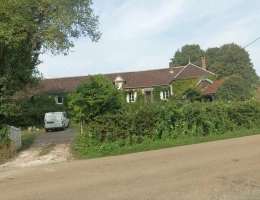
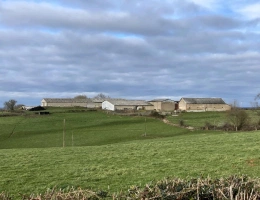
Many holdings combine dwelling house, shed, covered cropping and fields. Insist from the first visit on an item-by-item split of the price: the house tracks a residential market that remains affordable in this department, while the production tool is judged on earnings and funded over a shorter term. Then review what genuinely transfers, tractor and cultivation kit, planter, film layer, washer, trolleys, refrigeration unit, machinery still under lease. By contrast, a vegetable farm parcel offered on its own, with no buildings and no water right, trades against arable references rather than against a working unit.
The Loire terraces, from Nevers to La Charité-sur-Loire by way of Fourchambault and Pougues-les-Eaux, carry the lightest and most easily irrigated soils in the department: this is where most already-equipped vegetable sites sit, within immediate reach of the Nevers conurbation. The Allier valley, towards Decize and Saint-Pierre-le-Moûtier, offers comparable conditions. Further east, the Bazois and the country around Château-Chinon mean heavier soils and a later spring, with small direct-selling units predominating. The Nivernais Puisaye and the valleys near Clamecy hold a scattering of recent start-ups.
The department is thinly populated: the customer base comes down largely to Nevers, Cosne-Cours-sur-Loire and the market towns that hold a weekly market. Land is accordingly cheaper than on the fringe of a major city, but a smallholding here is judged as much on the delivery round it implies as on the asking price. Buyers who also aim at markets in neighbouring Cher or Yonne tend to favour communes close to the main Loire corridor.
Water comes first. Ask for the borehole or intake paperwork, its declaration receipt or abstraction licence, the flow genuinely available at the end of summer, and the record of prefectural restrictions, which are frequent on the river's tributaries. Then establish whether the parcels lie in a flood zone: part of the Loire terraces falls under a risk prevention plan that tightly controls where new buildings and new structures may go. Finally confirm that the existing greenhouses were declared to the town hall and that the sales room meets the hygiene rules applying to direct supply.
The sale falls under the structures control, the French authorisation regime for taking over farmland, and SAFER, the rural land agency, may pre-empt even on small areas. A rural lease in force continues automatically with the incoming operator: ask for the list and the renewal dates. Ask too for detail on the goodwill, markets held and subscribers included; where an organic conversion is under way, have the certifier confirm how far each field has progressed before you settle on a price.
Retiring growers, rural property firms and local notaries supply this selection, which now and again includes a plant nursery for sale or an ornamental horticulture business. Narrow it by area, price and type of production, switch on an alert so a new listing reaches you as it appears, then widen the search to the market gardens for sale in Bourgogne-Franche-Comté.


