

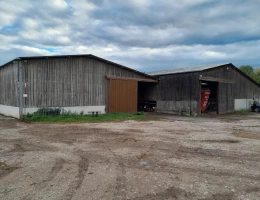
Anyone seeking a market garden for sale in the Jura turns to the western half of the department, where the plain carries vegetable growing: the Finage around Dole and Tavaux, the Bresse jurassienne towards Chaussin and Bletterans, the Val d'Amour along the Loue, and the outskirts of Lons-le-Saunier. These holdings are sent to us by vegetable and ornamental growers preparing to leave, by rural property agencies and by notaries; the particulars give the area cropped, the structures, the water resource and the outlets already in use. They also appear among our market gardens and nurseries for sale.
Beyond the listing, you need to know what Jura land is worth, which districts genuinely see holdings come up, how to assess a set of structures and what consents a takeover implies: that is what follows. Legal status, qualification and funding are dealt with in our white paper « Créer une exploitation agricole » (in French).
Land value drives much of the asking price for a market garden or nursery. French tax transfer statistics (DVF, vineyards excluded) show, for 2025, a median of €2,304/ha in Jura (39), an average of €2,546/ha and 124 sales; 80% of transactions settle between €1,650 and €4,123/ha, against a national median of €5,307/ha.
On the SAFER side, the value of vacant land and pasture is set at €2,540/ha for 2025, moving +3.7% over a year and +12.4% over ten, against €6,460/ha nationally; expect an average discount of 17% where a lease is running.
Hectares alone never explain a price. What weighs is soil quality and drainage, secure access to water and the title that goes with it, the age of the tunnels and multi-span houses, the benching and potting area of an ornamental unit, then the downstream chain — washer, grader, cold store, packing room, plant storage. After that comes the goodwill: market pitches, box scheme subscribers, agreements with producer shops, garden centres or public catering. Put the figure quoted beside our land price observatory, then model your takeover with our financial calculators.
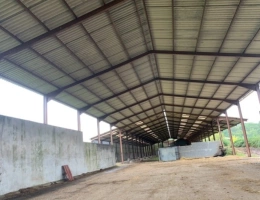
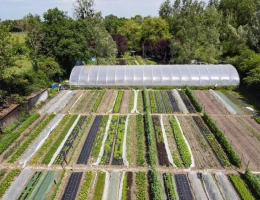
What comes up ranges from a smallholding under tunnels to a field-scale unit fitted with multi-span houses, by way of former ornamental sites with heated glass. Climb onto the frames: hoops, bracing, anchoring, gutter height, how the film is holding, automated venting, thermal screens, boiler and fuel. On an ornamental greenhouse business, value lies in the benching, the heated floor, the fertigation system and the ability to raise plants in house; on a plant nursery, in the living stock, its age and its health status. Lastly, check the irrigation from the abstraction point to the drip line, together with the administrative consent attached to it, since that governs what can be grown through summer.
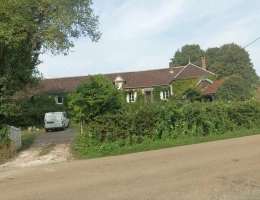
The ability to deliver is verified next: washing station, grader, cold store, a packing room meeting hygiene rules, trolley, delivery vehicle. Many sales bundle dwelling house, shed, covered cropping and adjoining land; ask for an item-by-item breakdown at the viewing, since the house belongs to the residential market while the business is valued on what it earns. Have it made clear, too, what the seller owns outright and what is still committed under a finance lease.
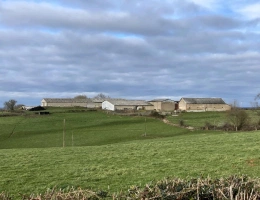
The Finage, the alluvial plain spreading around Dole and Tavaux, offers the lightest and most workable soils in the department together with water within reach: this is the heart of vegetable farming in the Jura. The Bresse jurassienne, from Chaussin to Bletterans, carries heavier ground but affordable area and mostly family-run units. The Val d'Amour, along the Loue, works sandy, easily tilled land. Around Lons-le-Saunier, demand from local public catering supports growers selling through short chains. On the Revermont and the plateaux, vines, livestock and forest leave little room for vegetables.
Land in the Jura remains more attainable than in neighbouring departments oriented towards large cities, which draws in buyers from elsewhere. The counterpart lies in the market: population is scattered, and success depends on a sales round built across several communes, sometimes reaching the nearest conurbations. A site that already comes with its customers therefore sells for appreciably more than bare ground of equivalent quality.
On the plain, irrigation usually draws on the alluvial water table: ask for the borehole declaration receipt or the abstraction licence, the flow available at the end of summer, the restriction orders already issued on that catchment, and check whether the plot lies within a water catchment protection perimeter that would govern practices. Consult the flood risk prevention plan in the Loue and Doubs valleys, along with the commune's planning document. Remember that above a certain ground footprint a structure requires a prior declaration or a building permit, a formality frequently neglected on the oldest frames.
The takeover falls under the structures control, the French authorisation regime for farming land, and SAFER, the rural land agency, keeps a pre-emption right it readily uses in favour of new entrants. Let parcels pass on with their rural lease. Ask for soil analyses and the treatment history, particularly on a former ornamental site. Where organic certification is advertised, the certifying body will confirm how long each field has been committed.
These offers come to us from retiring growers, from agencies specialising in rural property and from notaries based in the department. Use the filters for area, budget and location, keep several files to compare, schedule an alert so no publication passes you by, then widen your scope to market gardens for sale in Bourgogne-Franche-Comté.


