Buying a market garden for sale in France, and in Auvergne-Rhône-Alpes in particular, can mean very different businesses: open-field vegetables on the irrigated plains of the Rhône corridor, protected crops at the edge of the cities, ornamental growing supplying florists and garden centres, or a nursery raising young plants and shrubs. Growers preparing to hand over, rural property specialists and notaries place their holdings here, and each entry states the cropped area, how much of it sits under glass or plastic, the water available and the outlets already in place. They sit alongside every market gardens and nurseries for sale listed across France.
Next to the listings, this page gathers what helps you weigh an asking price: land values in the region, the departments where handovers come up most often, how to judge an ageing set of greenhouses, and the checks specific to these trades, from the water abstraction permit to taking over a business with its customers. If you are preparing to set up, our white paper « Créer une exploitation agricole » (in French) sets out the route from funding to the agricultural qualification.
Land value drives much of the asking price for a market garden or nursery. French tax transfer statistics (DVF, vineyards excluded) show, for 2025, a median of €3,887/ha in Auvergne-Rhône-Alpes, an average of €4,786/ha and 1,230 sales; 80% of transactions settle between €2,161 and €8,738/ha, against a national median of €5,307/ha.
On the SAFER side, the value of vacant land and pasture is set at €5,100/ha for 2025, moving +4.9% over a year and +3.7% over ten, against €6,460/ha nationally; expect an average discount of 17% where a lease is running.
Beyond the hectares, value here rests on the growing tool: glasshouses or multi-span structures, tunnels, heating and thermal screens, growing benches, drip lines, a licensed borehole, a washing and grading line, cold storage and standing space for young plants. Add the certifications, the local reputation and the goodwill, whether it rests on vegetable box schemes, wholesalers or long-standing garden centre accounts. Place the land with our land price observatory and cost the takeover with our financial calculators.
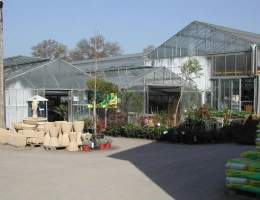
Start with the cover: the age of the glasshouses and multi-span houses, the condition of the tunnel films, the gutter height, heating, thermal screens and automated venting. A greenhouse business still performing well, correctly oriented and linked to a water reservoir changes the value of a whole holding. Then come the borehole and its abstraction permit, the irrigation and drip network, the washing shed, the cold room and the packing area. On the ornamental side, attention shifts to growing benches, shading, sub-irrigation and container standing beds; a nursery is also judged on how easily machinery moves between the beds.
Rolling stock matters too, and is often undervalued in the headline price: planters, a flame weeder, trailers and a tractor narrow enough for the wheelings. Where a holding comes with a dwelling house, ask for an item-by-item breakdown: house, growing structures and workshops, land, machinery, stocks of young plants, then the goodwill and its customer base. These items are neither written down nor financed on the same terms, which is why they deserve separate valuation before any written offer.
Drôme and Ardèche form the growing heart of the region, with a strong organic presence and consignments heading for the wholesale markets; Isère extends that corridor, from the Bièvre plain to the edges of the Grésivaudan. In Rhône, the Monts du Lyonnais and the Saône valley supply Lyon with vegetables and young plants alike, and hold a fair share of the ornamental growers. Loire relies on the Forez plain, Ain on the Dombes, the Bresse and the Saône valley land, where light soils and access to water suit open-field cropping.
Further west, Puy-de-Dôme draws on the Limagne and the green belt around Clermont-Ferrand, while Allier, Cantal and Haute-Loire hold smaller units geared to markets, producer shops and school catering. In Savoie and Haute-Savoie, demand from the Chambéry, Annecy and Geneva border areas sustains direct selling, but a vegetable farm close to those centres stays scarce and keenly contested.
Water governs everything else: check where the supply comes from, whether the abstraction permit is current, whether it actually transfers to the buyer and, in areas designated as water allocation zones, what restrictions can apply in a dry summer. Look next at the planning zoning, since a plot on the edge of a town attracts other uses and older structures are sometimes put up without notification. The soil deserves a full analysis: texture, drainage, cropping history, nematodes or soil-borne disease, all of which govern the rotations of the seasons ahead.
Legally, the sale goes through the structures control, the French authorisation regime for taking over farmland, and through SAFER's pre-emption right; rented parcels remain governed by the running rural lease. Whether you are looking at a plant nursery for sale or at a smallholding with a few tunnels, make sure organic certification carries over without a fresh conversion period. Seasonal labour then decides whether the plan works at all: available crews, housing on site and the organisation of harvest work.
The holdings shown here are entrusted to us by private sellers, by rural estate agencies and by notaries. Narrow the search by department, cropped area or budget, save an alert so a new market garden or nursery reaches you early, and widen your view where needed to all the farms for sale in Auvergne-Rhône-Alpes.