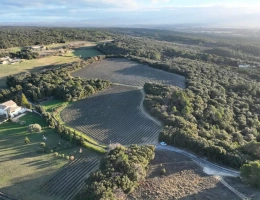
Searching for a market garden for sale in Drôme takes you to one of the major vegetable areas of the Rhône corridor, where irrigated field crops and covered growing share the plain and where organic production holds a leading place. The files published on this page reach us from farmers preparing their retirement, from rural estate agencies and from notaries in the Rhône valley; they state the irrigable area, how much is under glass or plastic, the packing equipment and the nature of the outlets. They are worth comparing with the rest of the market gardens and nurseries for sale in France.
We put each offer back into context here: what land is worth locally, the districts where holdings come up most often, how to read a set of greenhouses and its heating, and the obligations attached to a takeover. To shape your project, our white paper « Créer une exploitation agricole » (in French) sets out the steps, from support schemes to start-up working capital.
Land value drives much of the asking price for a market garden or nursery. French tax transfer statistics (DVF, vineyards excluded) show, for 2025, a median of €8,000/ha in Drôme (26), an average of €8,181/ha and 63 sales; 80% of transactions settle between €4,032 and €11,504/ha, against a national median of €5,307/ha.
On the SAFER side, the value of vacant land and pasture is set at €7,190/ha for 2025, moving +5.9% over a year and +0.1% over ten, against €6,460/ha nationally; expect an average discount of 17% where a lease is running.
In this department the price reflects a combination of soil, secured water and equipment. What weighs in the balance is the depth and evenness of the ground, connection to a collective irrigation network or a licensed borehole, the covered area and the age of the structures, the refrigeration capacity, the washing and grading station, the dispatch bay, along with the certification in place and the trading commitments passed on. Confirm all of it with our land price observatory and our financial calculators.
Equipment here is more capital-intensive than it is in most other departments. You will find wide multi-span structures, heated glasshouses, tall walk-in tunnels and open field ground irrigated by sprinkler or by buried drip line. Check when the structures were erected, how the gutters are holding, the state of the thermal screens, the heat generator and its fuel, the climate control and the automated fertigation, and then the packhouse itself: washer, grader, packing line, cold room and loading bay. A greenhouse business in ornamentals is judged on other criteria, benching, sub-irrigation, potting space and listings with garden centres.
The route to market changes the valuation entirely. A holding belonging to a producer organisation and supplying packers or retail buyers is worth first of all its volume and its regularity; a farm selling direct is worth its customer base and local standing. When the house, the greenhouses and the land are sold together, have a figure set for each component, since banks rarely fund the whole over the same term or against the same security.
The Valence plain, between Romans-sur-Isère, Loriol and Livron, is the productive heart: deep soils, organised irrigation, packers and the Rhône axis close at hand, and consequently some of the dearest farmland in the region. Further south, the Tricastin and the Rhône valley around Montélimar, Pierrelatte and Saint-Paul-Trois-Châteaux pair early warmth and irrigation with early vegetable crops. The Drôme des collines, to the north, offers more varied ground at more accessible prices. The Diois and the Baronnies, at altitude, follow another logic entirely, with small mixed holdings that sell locally and rarely reach the wholesale trade.
Competition for land does not come from vegetable growers alone: orchards, seed production, aromatic and perfume plants and urban growth all pull prices up across the plain as well. Newcomers tend to find more open situations on the edges of the basin, provided they accept less even soils, or a longer run to the dispatch points and the reorganised harvest logistics that go with it.
In irrigated country, water comes first. Ask for the deed connecting the holding to the collective network, the volume allocated and the standing charge payable each year, or for a borehole the abstraction permit and its meter, together with the restrictions applied in dry summers. Have the pressure available at peak spelled out, since it governs how many blocks can run at once. Then check how the parcels are classified, whether easements attach to buried pipework, and, for the greenhouses, that the planning consents were properly obtained when they were erected.
Verify the organic certification, how long each parcel has been committed and the conditions for keeping it after the sale, then the specifications signed with buyers, which may be personal to the seller and not follow the incoming farmer. The sale remains subject to the structures control, the authorisation required to farm, and to SAFER's pre-emption right. Rural leases in force continue with you, including where greenhouses stand on rented land, a situation that deserves close examination.
This section carries holdings entrusted by retiring farmers, by agencies specialising in rural property and by notaries of the Rhône valley. Set your criteria for area, for budget and for the district you have in mind, switch on an alert so nothing slips past you, then carry on to the market gardens for sale in Auvergne-Rhône-Alpes.