

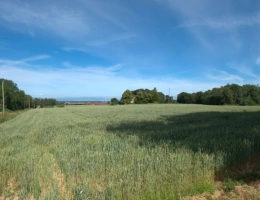
Buying a market garden for sale in Isère means choosing between very different farming worlds: the Bièvre plain, deep-soiled and widely irrigated; the Sud-Grésivaudan terraces around Saint-Marcellin and Chatte, where nursery growing is a long-established trade; the green belt around Grenoble, where vegetable boxes sell without leaving the valley; and the north of the department, which looks towards the wholesale trade of the Lyon conurbation. Holdings reach us from growers arranging their handover, from rural estate agencies and from notaries, each listing setting out the covered area, the irrigation equipment and the land genuinely fit for cropping. They sit alongside our market gardens and nurseries for sale.
A listing rarely says what the soil is worth or how secure the outlets are. This page supplies the missing benchmarks: local land values, the areas where holdings come up, the condition of the structures and equipment to inspect, and the checks specific to the trade. Our white paper « Créer une exploitation agricole » (in French) goes further into legal status, funding and the farming qualification required.
Land value drives much of the asking price for a market garden or nursery. French tax transfer statistics (DVF, vineyards excluded) show, for 2025, a median of €4,000/ha in Isère (38), an average of €4,555/ha and 79 sales; 80% of transactions settle between €2,497 and €7,089/ha, against a national median of €5,307/ha.
On the SAFER side, the value of vacant land and pasture is set at €4,950/ha for 2025, moving -0.2% over a year and +5.1% over ten, against €6,460/ha nationally; expect an average discount of 17% where a lease is running.
Hectares tell only part of the story. What you are really buying is the production tool: glasshouses and multi-span structures, cold tunnels, thermal screens, heating, growing benches, the drip network, and the borehole with the abstraction licence attached to it. Then come the washing and grading line, the cold store, the standing area for young plants, and the goodwill — market stalls, box schemes, garden centres, catering contracts — which seldom changes hands on its own. Set those figures against our land price observatory, then test your takeover plan with our financial calculators.
Any visit starts with the covered ground. Older glasshouses or newer multi-span structures, cold tunnels, heating and thermal screens: the year they went up, the gutter height, the weathertightness and the electrical compliance decide how much refurbishment lies ahead. On an ornamental horticulture site, add the growing benches, the collection pond, the fertigation unit and the boiler, all expensive to replace. The irrigation network matters just as much: where the water comes from, the flow available, the condition of the borehole, a valid abstraction licence, and how the drip lines are laid out field by field.
Downstream equipment often separates two holdings advertised at the same price: washing and grading line, cold store, a packing room that meets hygiene rules, forklift, delivery van. A plant nursery for sale is judged in addition on its living stock, its age and its saleable value. Where the sale includes a dwelling house, separate from the first visit what belongs to the home and what belongs to the business: the two are not valued in the same way, and they are not financed on the same terms either.
The Bièvre plain, from La Côte-Saint-André to Beaurepaire, combines deep soils with a dense irrigation network: this is field vegetable country, with blocks of land in one piece. The Sud-Grésivaudan, around Saint-Marcellin and Chatte, mixes nurseries, orchards and vegetable crops on the river terraces. The Grenoble fringe and the Grésivaudan valley live off peri-urban, short-circuit farming on smaller and much sought-after plots, where selling direct is the norm. The north of the department, between Bourgoin-Jallieu and La Tour-du-Pin, benefits instead from its closeness to Lyon and its wholesale outlets.
Peri-urban pressure shows straight away in asking prices: irrigated growing land on the edge of a town trades in a different register from comparable ground out in the open plain. New entrants find available area more readily in the west of the department, provided they organise their delivery rounds accordingly. Conversely, a fully equipped site with an established customer base close to the city often justifies its price through the trade it brings with it.
Water heads the list: a borehole must be declared and the abstraction authorised, sometimes capped during low-flow periods, under allocation rules that differ from one catchment to the next. Next, check how the plots are zoned in the local planning document, since farmland bordering a development area may carry restrictions on putting up new structures. Greenhouses above a certain footprint need either a prior declaration or a building permit, and a structure erected without formalities weakens both the resale and the insurance cover of the site.
SAFER, the rural land agency, is always involved and holds a pre-emption right, while the takeover itself falls under the structures control, the French authorisation regime for farmland. A plot already let keeps its rural lease, which the incoming grower carries on as it stands. Ask for soil analyses and the treatment history, especially on a site long used for ornamental production. If organic certification is advertised, have the certifying body confirm how long it has run: a conversion still to finish changes the economics of the early seasons.
These holdings are entrusted to us by private sellers, specialist rural property firms and notaries. You can sort by cropped area, by budget or by family of production, set an alert to receive new listings as they are published, and widen the search to market gardens for sale in Auvergne-Rhône-Alpes.


