

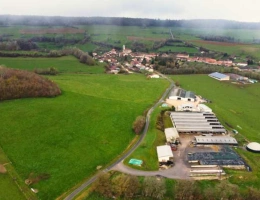
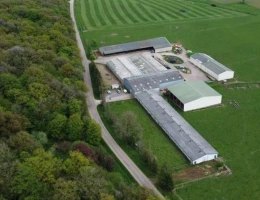
The market for farms for sale in the Meuse has a trait few French departments share: holdings here rank among the largest in the country, and the farming population among the thinnest. One consequence is direct — a large share of handovers happens not through the sale of a whole farm but by joining an existing farming company, or by a neighbour absorbing the area released. The properties listed come from farmers reaching the end of their careers, from partners selling their shares, from notaries in Bar-le-Duc, Verdun and Commercy, and from rural advisers. The particulars give the area, the soil quality, any tenancies running and the buildings. Each one feeds, country-wide, our list of farms for sale in France.
Reading this market means answering two questions first: are you buying buildings and land, or company shares? And is the advertised area genuinely free of occupation? The rest of this page answers both, with the checks worth making before an initial contract. For a project yet to take shape, our white paper « Créer une exploitation agricole » (in French) covers the company forms available, the funding and the sequence to respect.
Land forms the base of a farm's value. DVF, the property sales database published by the French tax administration (vineyards excluded), records a 2025 median of €5,000 per hectare in Meuse (55), an average of €5,026 and 153 sales; four transactions in five fall between €4,000 and €6,191, against a national median of €5,307.
The SAFER land value benchmark sets €4,940 per hectare for vacant land and pasture offered for sale in the same year, +2.1% over one year and -6.4% over ten, against €6,460 nationally. Land sold with a tenancy in place is valued at €4,490, a discount of about 9%.
Against the Grand Est region, whose median is €5,611 per hectare, this department sits 11% lower. For commune-level detail and comparisons with neighbouring areas, see our land price observatory, then cost your purchase with our financial calculators.
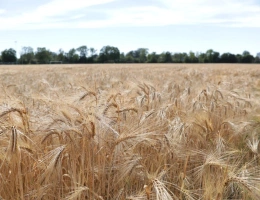
Relief governs everything. The Barrois plateaux and the south-western ground belong to arable holdings, growing wheat, barley, oilseed rape and industrial crops on large, regular blocks. The Woëvre, a clay basin east of the scarps, and the Argonne to the west have stayed grass country, dominated by dairy units and suckler herds of Charolais or Limousin cattle. The Meuse scarps carry the third register: mirabelle plum orchards, set on well-exposed slopes and backed by a long-standing processing trade.
That pattern dictates the capital required. A Barrois arable unit is judged on how tightly its blocks sit together, the rotation practised and the age of a usually heavy machinery fleet. A Woëvre grassland system is judged first on its livestock buildings, its forage self-sufficiency and the state of the field drainage. Between the two, mixed farming remains the most workable way in, because it allows a gradual build-up. A mixed working farm is in any case rarely transferred in one single operation.
In the south, the Barrois, around Bar-le-Duc, Ligny-en-Barrois and Void, gathers the most sought-after cropping soils and the firmest prices. The Ornois and the Gondrecourt country, on the Haute-Marne boundary, stay cheaper and more wooded. Westward, the Argonne, towards Clermont-en-Argonne and Varennes, combines grass, forest and small holdings. Eastward, the Woëvre, from Fresnes-en-Woëvre to Étain, lines up heavy meadows and dairy farms. The Verdun country and the Montmédy district, to the north, mix plateau cropping with livestock, farmsteads lying far apart.
Supply renews itself mainly in the livestock districts, where the workload discourages successors and where neighbours have already reached the limit of what they can absorb. The Barrois behaves the other way round: area changes hands between established farmers, often without advertising. For an outside candidate, the Woëvre, the Argonne and the north of the department offer the real openings, provided isolation is acceptable and buildings sometimes need taking back to bare walls.
The Woëvre calls for a check that is often skipped: the condition of the field drains and collector ditches. On these clays, a parcel that sheds water badly loses several weeks of trafficability in spring, and renewing an old network costs far more than replacing fencing. Ask for the plans, the year of installation and the list of recent work. Look alongside that at how the district is classified for wetlands and protection perimeters: it governs whether grassland may be ploughed, whether buildings may go up, and how effluent may be spread.
Legally, the Meuse stands out for how often a purchase takes the form of shares. Buying into a company does not escape structural control, and the incomer takes on the liabilities and multi-year commitments at the same time. SAFER, for its part, is told of transfers and may step in. The sitting tenant, finally, keeps the lease and the priority right to buy; in a department where most land is rented, frequently on long leases, that single point decides what you will actually be able to farm.
Meuse properties come up in small numbers and move quickly, partly for want of buyers but mostly for want of long-lived listings. The sound reflex is to set an e-mail alert at the very start of the search, then tighten the sector, area and district criteria as you go. Sellers and their advisers can publish a mandate on the site themselves. To compare with neighbouring departments, open our listings of farms across Grand Est.


