The market for farms for sale in the Aube reads through three successive geologies: the open chalk north-west of Troyes, the clays of the wet Champagne around the great reservoir lakes, then the plateaux of the Pays d'Othe and the Barrois. Each carries its own system, its own buildings and its own level of investment, with nothing in common between them. The properties gathered here come from farmers preparing their exit, from partners selling their shares, from firms specialising in rural succession and from local notaries; the listing sets out the cropping, how the land is held, the buildings and the machinery included. All of them sit within our national offer of farms for sale in France.
The rest is prepared in advance: what land is worth in the Aube, which sectors take on new entrants, which districts release area, and the compulsory formalities. One clarification: the vineyards of the Côte des Bar form a separate market here, handled in the wine category of this site, and they follow neither the same benchmarks nor the same rules. For a first purchase, the white paper « Créer une exploitation agricole » (in French) walks through each step.
Land forms the base of a farm's value. DVF, the property sales database published by the French tax administration (vineyards excluded), records a 2025 median of €11,373 per hectare in Aube (10), an average of €10,929 and 179 sales; four transactions in five fall between €5,000 and €17,000, against a national median of €5,307.
The SAFER land value benchmark sets €11,270 per hectare for vacant land and pasture offered for sale in the same year, +5.2% over one year and +17.4% over ten, against €6,460 nationally. Land sold with a tenancy in place is valued at €9,180, a discount of about 19%.
Against the Grand Est region, whose median is €5,611 per hectare, this department sits 103% higher. For commune-level detail and comparisons with neighbouring areas, see our land price observatory, then cost your purchase with our financial calculators.
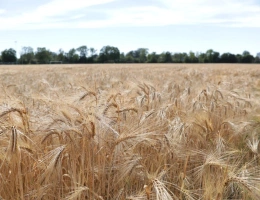
The Champagne chalk carries arable holdings with broad rotations: wheat, malting barley, oilseed rape, sugar beet, protein peas and above all dehydrated lucerne, which shapes a good share of the cropping. Free-draining soils also allow field-scale vegetable crops and potatoes wherever watering is secure. To the south-east, the Chaource country and the Barrois support dairy farming tied to a long-standing cheese appellation, while the pastures of the wet Champagne take suckler herds and grass-based systems needing far less capital.
The Pays d'Othe adds a note of its own, with cider apple orchards and a hedged field pattern left over from an older mixed farming tradition. For a buyer, the financial contrast is plain: a working farm on the chalk is financed first on soil and machinery, whereas a grassland business in the south-east rests on the herd, the buildings and the processing plant. In every case, ask what share of the lucerne is under contract and what delivery obligations come with the property.
To the north-west, the chalk plain of Arcis-sur-Aube, Méry-sur-Seine and Romilly-sur-Seine lines up large even blocks, keenly sought by adjoining businesses. The wet Champagne, between Brienne-le-Château, the Lac d'Orient and Dienville, alternates heavy clay, poplar plantations, pasture and woodland; holdings there are smaller and more varied. The Pays d'Othe, towards Aix-Villemaur and Estissac, keeps flinty soils and a fragmented field pattern. The Barrois and the Chaource country, to the south-east, rise onto limestone plateaux where livestock and cereals share the ground.
Most listings arise in the livestock districts and on the southern plateaux, where a retirement does not always find a taker. On the chalk plain, by contrast, an agricultural property is settled quickly and often between neighbours, with takeovers frequently going through the purchase of company shares rather than a direct sale of land. Nearness to Troyes and to the routes towards Paris also sustains non-farming demand for small parcels and isolated buildings.
Water deserves serious attention. On free-draining soils, watering decides which high-value crops are possible: establish where the abstraction comes from, what consent covers it, what volumes are allocated and what restrictions applied during recent low flows. The department is designated a nitrate vulnerable zone, with winter cover requirements and rules on the sizing of storage works. Around the reservoir lakes and inside the regional park, wetland protections limit drainage and the ploughing out of pasture; in wooded country, landlocked blocks need written rights of way.
Three regulatory filters follow. The sale is notified to SAFER Grand Est, which holds a pre-emption right and can put the property back out to competition. An application to farm must be lodged once the area concerned passes the ceiling set by the regional plan, which is also used to rank competing requests. Lastly, a live farm tenancy attaches a priority to buy to the tenant and fixes when the buyer may actually work the fields: collect every tenancy before reasoning about area.
Listings in the Aube come from sellers without a successor, from partnerships reorganising, from rural agencies and from notaries across the department. The sound reflex is to cross two filters — the production system and how much land is owned outright — then let the e-mail alert work, because properties come up in bursts. Posting a listing yourself takes a few minutes. Widen the search afterwards to farms for sale in Grand Est.