

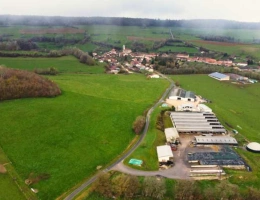
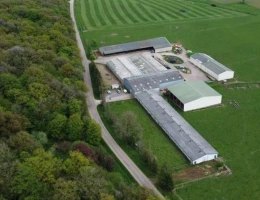
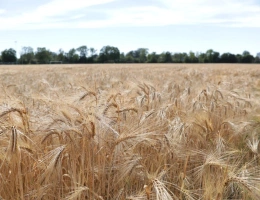
Finding farms for sale in Bas-Rhin is less a matter of choosing than of waiting: farmland here ranks among the most contested in the country, released area is absorbed at once by neighbours, and most handovers are settled within families without ever reaching the open market. What does appear concerns mainly the western half of the department, hillier and less coveted. The properties reach us from farmers giving up, from specialist agencies, from notaries in Strasbourg, Saverne and Haguenau, and from succession practices. The particulars give soil type, acreage, the tenure of each parcel and the equipment taken over. They join the Alsace pages within our wider listing of farms for sale in France.
Three things are almost always missing from a listing and yet decide a project: the very wide gap in value between the loess plain and the sandstone margins to the west, the fragmentation of inherited parcels, and the share of land held on tenancy. The sections below deal with each. If the plan has yet to be assembled, our white paper « Créer une exploitation agricole » (in French) sets out the legal, tax and financial framework.
Land forms the base of a farm's value. Land transaction data does not cover this department (Alsace-Moselle land register), so the figures below are those of the Grand Est region. DVF, the property sales database published by the French tax administration (vineyards excluded), records a 2025 median of €5,611 per hectare in Bas-Rhin (67), an average of €7,490 and 1,233 sales; four transactions in five fall between €3,151 and €14,830, against a national median of €5,307.
The SAFER land value benchmark sets €6,470 per hectare for vacant land and pasture offered for sale in the same year, -2.4% over one year and -5.5% over ten, against €6,460 nationally. Land sold with a tenancy in place is valued at €6,430, effectively the same level as vacant land, where the national discount runs close to 17%. That near-parity most likely reflects the fact that a sale of let land escapes SAFER's pre-emption right, and that the stated price of vacant land is held down by side arrangements, key money or the separate sale of payment entitlements. The gap is too small to read as anything other than parity.
Against the Grand Est region, whose median is €5,611 per hectare, this department sits 0% higher. For commune-level detail and comparisons with neighbouring areas, see our land price observatory, then cost your purchase with our financial calculators.
The Kochersberg and the loess hills around it hold one of the best agronomic potentials in France. Here you find arable businesses cropping wheat, maize, sugar beet and hops on deep silts that allow high yields without heavy irrigation. The Ried plain, between the Ill and the Rhine, combines maize, flood meadows and dairy farming. Market gardening holdings occupy a place of their own, from the sauerkraut cabbage grown around Obernai to open-field vegetables on the plain, with enterprises demanding in labour and logistics.
Westward the picture changes entirely. Alsace Bossue and the Vosges foothills belong to mixed farming, on less generous sandstone soils, with smaller holdings and older buildings. That is where most of the purchases within reach of a buyer without inherited capital come up. A working farm there usually implies a diversification plan — processing, visitor accommodation, direct selling — because primary production alone does not always repay the purchase.
In the centre, the Kochersberg and the Strasbourg ring concentrate the highest values: competition between expansion, building land and infrastructure makes buying a whole holding close to theoretical. The north, with the Outre-Forêt around Wissembourg and Soultz-sous-Forêts, keeps solid mixed cropping and rather more supply. The Haguenau and Brumath plain mixes crops, forest and industrial estates. The wine-growing foothills, from Obernai to Molsheim, reserve their land for vines and leave little room for arable holdings.
The west, finally, is the real seam of opportunity: the Saverne country, the western Kochersberg and then Alsace Bossue towards Drulingen and Sarre-Union offer coherent units at levels unrelated to the plain. The Bruche valley and the higher valleys, steeper, belong to grass and extensive systems. A buyer willing to move away from the plain multiplies the chances of getting a deal done.
The Rhine aquifer, which supplies much of the plain, places the department under strict obligations on fertilisation and soil cover: classification as a vulnerable zone, successive action programmes and water catchment perimeters bear directly on how crops are grown and how effluent is stored. On land near the towns, look next at planning documents and reserved sites: in so constrained a department, a parcel may sit inside a road or extension scheme without the outgoing farmer having allowed for it in the asking price.
The parcel pattern deserves equal attention. Inheritance has left holdings split into many separate plots with different owners; the livre foncier, the register peculiar to the local-law departments, fortunately allows an exact reconstruction of who owns what, and of the easements attached to each plot. That done, the general rules remain: possible pre-emption by SAFER once notified, permission to farm assessed under structural control, and the sitting tenant staying on, with priority to buy the land he works.
In a market this tight, district and area are more useful filters than budget: the price gap between the plain and the sandstone west makes any department-wide comparison misleading. An e-mail alert is the best tool here, since a Bas-Rhin listing is often withdrawn within days. Sellers and their advisers can publish a mandate directly. At regional scale: farms and agricultural estates in Grand Est.


