

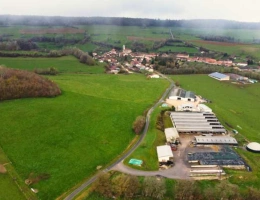
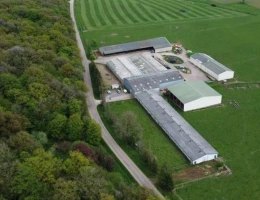
Buying farms for sale in Moselle calls for a context that economic geography explains better than agronomy: in a department where cross-border employment pays on a scale farming income cannot match, family succession has become the exception rather than the rule. Farmsteads therefore come free early, sometimes before retirement age, and local candidates are few. A legal singularity is added to that — the local law applying here as in the two Alsace departments, which changes the way a sale is completed. The properties published come from retiring farmers, outgoing partners, rural agencies, notaries in Metz, Sarreguemines and Château-Salins, and succession advisers; each listing details area, soils, occupancy and buildings. The same search also covers all our farms for sale in France.
This page therefore brings together two sets of information rarely found side by side: what each Moselle district actually produces, and the particular rules governing rural ownership and tenancy here. The checks are set out in the order in which they arise. Where a project has yet to take form, our white paper « Créer une exploitation agricole » (in French) lays the administrative and financial groundwork.
Land forms the base of a farm's value. Land transaction data does not cover this department (Alsace-Moselle land register), so the figures below are those of the Grand Est region. DVF, the property sales database published by the French tax administration (vineyards excluded), records a 2025 median of €5,611 per hectare in Moselle (57), an average of €7,490 and 1,233 sales; four transactions in five fall between €3,151 and €14,830, against a national median of €5,307.
The SAFER land value benchmark sets €5,380 per hectare for vacant land and pasture offered for sale in the same year, -4.6% over one year and +1.9% over ten, against €6,460 nationally. Land sold with a tenancy in place is valued at €4,950, a discount of about 8%.
Against the Grand Est region, whose median is €5,611 per hectare, this department sits 0% higher. For commune-level detail and comparisons with neighbouring areas, see our land price observatory, then cost your purchase with our financial calculators.
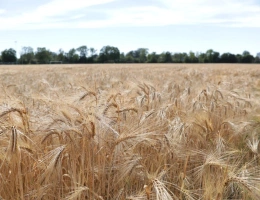
The loams of the Saulnois, around Château-Salins, Delme and Dieuze, carry the most productive arable holdings in the department: wheat, barley, oilseed rape and sugar beet, on a reorganised field pattern suited to large machinery. The Lorraine plateau and the Nied valleys remain country for mixed farming and dairying, with herds housed in buildings often put up decades ago. To the east, the pond country adds an activity rare elsewhere: pond fish farming, whose value rests on water control, on the rights attached to each pond and on the condition of the dykes.
Two additions deserve attention because they alter the shape of a property. The Moselle vineyard, replanted over recent decades on the valley slopes and towards Sierck, trades as a wine asset in its own right. Mirabelle and quetsch orchards, by contrast, are usually a secondary enterprise whose returns depend on a processing outlet. An agricultural property combining several of these should be examined block by block, each carrying its own operating and funding logic.
The north-west, between Thionville, Sierck-les-Bains and the border, faces the strongest pressure: the soils are good, but housing demand, industrial estates and land held in expectation lift values beyond what farming alone can justify. The Saulnois, in the centre-south, forms the main arable basin and sees area circulate among established farmers. The Nied country and the Warndt, towards Boulay and Forbach, mix livestock and crops over former mining and industrial ground.
Eastward, the wet Saulnois, the pond country towards Dieuze and the Sarrebourg district keep more extensive systems and distinctly gentler entry prices. The Bitche country, backed against sandstone and forest, belongs to grass and to modest holdings. It is these eastern margins that open real possibilities to a buyer from another department, provided the buildings can be taken on and modernised.
Property here is not published as it is elsewhere in France. Moselle, with Bas-Rhin and Haut-Rhin, comes under the livre foncier, a register kept under the authority of a judge at the court, where every property has its own folio recording transfers, easements and securities. In practice the notary files an application for entry, and the transfer takes full effect only once it is recorded: the timetable of a Moselle purchase does not match that of a neighbouring department. The benefit to a buyer is real, since the folio gives a dependable view of the charges over each parcel, rights of way and water rights included. Have it consulted before the preliminary contract, not after.
Tenancy likewise follows provisions specific to the three departments concerned, touching in particular the form of notice, the term and the local customs relied on in a dispute. A sitting tenant keeps occupation of the land and priority to buy it in every case. The national rules remain: SAFER, informed of the intended sale, may pre-empt; permission to farm depends on structural control under the thresholds set for the region. Add, across much of a department classed as a vulnerable zone, the duties on effluent storage and winter soil cover.
The useful way to work this page is by district before area: a Saulnois file and a pond-country file do not answer the same plan, even at identical size. Filtering by production, commune and budget serves exactly that, and an e-mail alert saves coming back week after week. Sellers and professionals lodge their mandates here too. For the regional view: farms available across Grand Est.


