

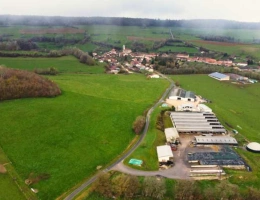
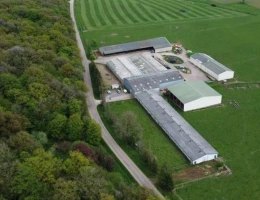
Tracking down farms for sale in the Marne calls for patience. The department holds some of the most productive soils in the country, and chances to take over a business tend to travel quietly, between neighbours or inside families. What does reach the open market often takes the form of company shares, a set of buildings with tenancies attached, or a partial block to be reassembled. Our instructions come from retiring owners, from outgoing partners, from succession advisers, from rural agencies and from notaries in the department; the listing states the cropping, the legal status of the land, the buildings and the machinery taken on. Each of them widens the range of farms for sale in France.
More than a catalogue, the page below places local land values, maps the systems in use and lists the checks to carry out first. A useful clarification: the Champagne vineyard belongs to a separate category on this site, with benchmarks of its own that do not apply to the figures given here. To prepare an entry from outside the family, the white paper « Créer une exploitation agricole » (in French) runs through the administrative and financial path.
Land forms the base of a farm's value. DVF, the property sales database published by the French tax administration (vineyards excluded), records a 2025 median of €12,317 per hectare in Marne (51), an average of €11,957 and 254 sales; four transactions in five fall between €7,052 and €16,000, against a national median of €5,307.
The SAFER land value benchmark sets €12,020 per hectare for vacant land and pasture offered for sale in the same year, +2.6% over one year and +22.4% over ten, against €6,460 nationally. Land sold with a tenancy in place is valued at €10,410, a discount of about 13%.
Against the Grand Est region, whose median is €5,611 per hectare, this department sits 120% higher. For commune-level detail and comparisons with neighbouring areas, see our land price observatory, then cost your purchase with our financial calculators.
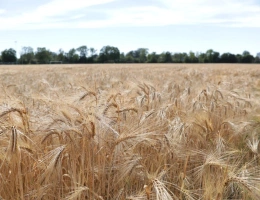
The Champagne chalk concentrates large-scale arable businesses: wheat, malting barley, oilseed rape, sugar beet, dehydrated lucerne and potatoes, with rotations aligned on the needs of processing industries. Field-scale vegetable production completes the cropping wherever watering is installed. West and east, the heavier ground of the Brie champenoise, the Tardenois, the Argonne and the Perthois carries dairy farming and mixed crop-and-livestock systems that make the most affordable way into the department for a newcomer.
On the chalk, the production plant counts as much as the soil: stores, irrigation equipment, the machinery chain and delivery contracts form a block that is hard to break up. A working farm is seldom sold bare here, and its valuation carries heavy fixed assets. In the livestock districts, the analysis turns instead on forage self-sufficiency, the state of the parlour and storage capacity. In both cases, have it spelt out what belongs to the operating company and what stays in the seller's private estate.
The chalk core, from Châlons-en-Champagne to Suippes, Mourmelon and Vitry-le-François, offers vast regular field patterns, with a large share of the cropped area held on tenancy. The Brie champenoise, around Sézanne and Montmirail, combines crops and livestock on loam and clay. The Tardenois and the Ardre valley, to the north-west, keep a mixed landscape of woodland, pasture and ploughed ground. Eastwards, the Marne Argonne and the Côtes de Champagne return to grass and forest; to the south-east, the Perthois and the edges of the Der line up wet meadows and poplar plantations.
Competition for land is fierce wherever the chalk performs to its full potential: every parcel released interests several adjoining businesses, and the matter is often settled without an advert ever appearing. The margins of the department — Argonne, Tardenois, Perthois — offer a more open market, with complete units including buildings and a dwelling house. There, an agricultural property remains affordable for a buyer with no family capital behind them.
The legal status of the land is the first subject to settle here, where a large share of the area is farmed under tenancy. Ask for the complete schedule of tenancies, their expiry dates, their form and the names of the tenants: a sitting tenant has first refusal, and the date from which you can crop each field follows directly from those contracts. Holding land through a farmland company is common in the department; our listings of GFA shares answer a wealth-planning logic quite unlike a direct purchase.
On the administrative side, SAFER Grand Est is notified of every agricultural sale and may pre-empt before allocating the property at the end of a call for applications. Without an authorisation to farm, granted against area thresholds defined across Grand Est, no occupation is lawful. Environmental constraints come on top: the department is a nitrate vulnerable zone, abstraction for watering is regulated, water-catchment protection perimeters apply, and specific rules govern the wet meadows of the east and south-east.
Retiring owners, partners at the end of their careers, succession advisers and notaries in the Marne lodge their files here, with sales coming up at long intervals. In this department the decisive filter is not budget but how much land is owned outright: start there, then let the e-mail alert flag each new listing. Putting a property online as a seller is immediate. For a wider view, see farms for sale in Grand Est.


