

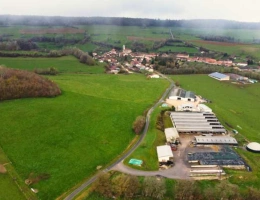
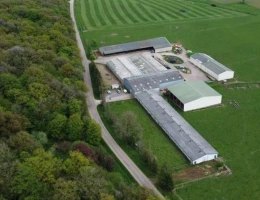
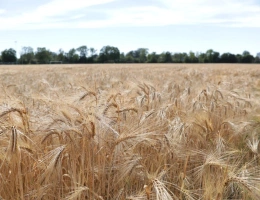
Almost every one of the farms for sale in the Vosges takes the same shape: permanent grassland, a livestock building, a few hectares of woodland and a dwelling attached. This is one of the departments where a newcomer to farming can still buy a complete working unit, because value rests on grass and on buildings rather than on high-yielding soils. Behind each listing stands a stockman with no successor, an inheritance a notary must unwind, or a rural agency instructed to sell a set of buildings with its land; the listing gives forage area, the type of meadow, how the animals are housed and what machinery is included. Such properties widen the choice offered by our national list of farms for sale in France.
A listing stops short of the essentials: what meadow and arable are worth according to relief, which sector keeps each massif alive, how often supply renews, and the checks to run before committing. Water and protected catchments deserve particular attention here. Our white paper « Créer une exploitation agricole » (in French) guides those building a set-up project.
Land forms the base of a farm's value. DVF, the property sales database published by the French tax administration (vineyards excluded), records a 2025 median of €3,200 per hectare in Vosges (88), an average of €3,428 and 126 sales; four transactions in five fall between €2,528 and €5,000, against a national median of €5,307.
The SAFER land value benchmark sets €3,460 per hectare for vacant land and pasture offered for sale in the same year, -3.9% over one year and -0.3% over ten, against €6,460 nationally. Land sold with a tenancy in place is valued at €3,210, a discount of about 7%.
Against the Grand Est region, whose median is €5,611 per hectare, this department sits 43% lower. For commune-level detail and comparisons with neighbouring areas, see our land price observatory, then cost your purchase with our financial calculators.
Milk shapes farming in the Vosges. Dairy holdings dominate from the Xaintois to the Moselle and Vologne valleys, with Montbéliarde and Holstein herds and, higher up, the black-and-white Vosgienne breed tied to mountain cheeses. Part of the milk goes to protected cheese designations, which impose their own rules on feeding and hay. Suckler beef occupies the steepest ground, and mixed farming appears on the plain, where some arable accompanies the grass.
Two income strands recur in the files: woodland, widely present, which is a reserve of value as much as a maintenance burden, and on-farm processing, from cheese to boxed beef. Other livestock enterprises — draught horses, small ruminants, free-range poultry — sometimes complete the picture. Check case by case whether these rest on a transferable health approval: a working farm here often draws most of its margin from them.
To the west, the sub-Vosges lowland, the Xaintois around Mirecourt and the Neufchâteau country hold the most even soils and the largest holdings, arable and meadow together. The Vôge, in the south, alternates woods, ponds and grazing on acid ground. The massif itself, from the high Vosges to the Moselotte valley, lives on grass and upland pasture, with fragmented parcels and sometimes awkward access. In the north-east, the Déodatie around Saint-Dié and Bruyères mixes small dairy units with forest.
Lowland districts attract buyers looking to expand and trade higher. The mountain, where handovers come up less often, suits a coherent project provided the buyer accepts the slope, the length of winter and the cost of collection. It is there that the most complete units come free, summer pasture included, and there that buyers from other regions look for an agricultural property, for want of a comparable entry price elsewhere.
The department holds mineral water reserves whose protection extends well beyond the bottling sites. Around Vittel, Contrexéville and Bulgnéville, protection perimeters and contractual undertakings govern fertilisation, stocking rates and sometimes the very crops grown on the parcels concerned. A buyer in that area must read those agreements before the preliminary contract: they follow the land and weigh on the farming system as heavily as a tenancy.
The rest follows the common rules. Every agricultural sale is notified to SAFER Grand Est, whose pre-emption right frequently serves a new entrant. Approval to farm is assessed against the regional structure plan. A sitting tenant keeps his lease and his priority right to buy. In mountain areas add winter access, snow clearing and rights of use over the upland pastures, all to be set down in writing before signing.
Set an altitude and a forage area first, then filter on whether a dwelling comes with the holding and on the state of the livestock building: those two items decide a Vosges budget. The e-mail alert then flags each new listing, and a retiring farmer can put a property online without an intermediary. The regional overview is one click away: farms for sale in Grand Est.


