

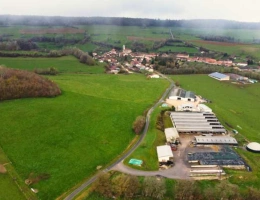
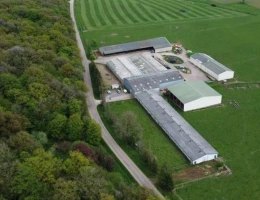
Hunting for farms for sale in Meurthe-et-Moselle means working a department stretched from the Saintois to the Luxembourg border, whose two ends follow different logics. In the south, plateaux and limestone scarps where farming keeps its standing; in the north, a Pays-Haut whose cross-border wages drain farms of labour and bring retirement decisions forward. The urban corridor from Nancy to Pont-à-Mousson cuts through the middle and weighs on prices. Instructions arrive from farmers nearing retirement, from partners leaving a farming company, from rural agencies, notaries and succession advisers. Every listing gives the type of system, the area, whether parcels are owned or rented, and the working assets. They round out the wide choice among our farms for sale in France.
Two unknowns count more than any others locally: what the subsoil still holds from former iron workings, and how far the property really lies from the pressure of the urban corridor. Both are covered below, together with the permissions to obtain. Where the purchase is being prepared outside the family, our white paper « Créer une exploitation agricole » (in French) lists the steps, the company forms available and the funding that can be drawn on.
Land forms the base of a farm's value. DVF, the property sales database published by the French tax administration (vineyards excluded), records a 2025 median of €5,000 per hectare in Meurthe-et-Moselle (54), an average of €5,398 and 143 sales; four transactions in five fall between €3,692 and €8,558, against a national median of €5,307.
The SAFER land value benchmark sets €5,410 per hectare for vacant land and pasture offered for sale in the same year, +6.3% over one year and +25.5% over ten, against €6,460 nationally. Land sold with a tenancy in place is valued at €4,800, a discount of about 11%.
Against the Grand Est region, whose median is €5,611 per hectare, this department sits 11% lower. For commune-level detail and comparisons with neighbouring areas, see our land price observatory, then cost your purchase with our financial calculators.
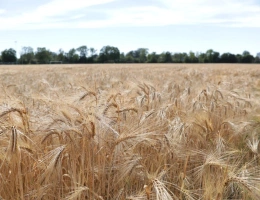
The limestone plateaux of the Toulois, the Saintois and the Pays-Haut carry most of the arable businesses, cropped with wheat, barley, oilseed rape and sometimes sugar beet. The heavy clay hollows of the Woëvre and the Meurthe and Moselle valleys have stayed grassland country and dairy country, with mixed farming everywhere in between. The Toul scarps add a third register: a vineyard of pale rosé and, above all, mirabelle plum orchards, a niche fruit sector where a purchase turns as much on processing outlets as on the trees themselves.
The other local feature is the weight of anaerobic digestion and of selling straight to the conurbation. A site fitted with a slurry and manure digester no longer values like an ordinary farm: income then rests on a contract, on feedstock availability and on the spreading plan. Ask for the farming result and the energy result to be shown apart before you settle on a price. A working farm with a direct-sales operation raises the same question, transposed to labour.
The Pays-Haut, around Briey, Longuyon and Longwy, offers sound plateau soils and often large holdings, but a farming population thinned by the pull of Luxembourg: sales come up earlier there and buyers are scarce. The Woëvre, towards Conflans and Jarny, stays wet, heavy and grass-based. The Toulois, the Saintois around Vézelise and the neighbouring Xaintois form the arable core of the south. The Lunévillois and the Vermois, between Lunéville and Saint-Nicolas-de-Port, combine cash crops and livestock on lighter ground.
Between these blocks runs the Moselle corridor, from Nancy to Pont-à-Mousson and Frouard, where building, industrial estates and land held in expectation make any farming purchase awkward and dear. A buyer after a complete farmstead with grouped land will look instead to the Saintois or to the far edges of the Pays-Haut, where values stay contained and single blocks remain possible.
The local peculiarity lies underground. Much of the north of the department was worked for iron ore, and the old concessions leave hazards that mining risk prevention plans map commune by commune. The issue is not the crops but the structures: a livestock building, a silo or an extension project may fall inside a zone where the rules restrict, or forbid, construction. Ask for those documents before costing any building investment, since they also govern insurance and resale.
Three administrative filters then apply. The notary informs SAFER, free to exercise pre-emption over the sale. Permission to farm is governed by structural control: the regional plan in force sets the areas above which an application becomes necessary. Lastly, a rented parcel stays in the hands of its tenant, who may buy in priority: on holdings where much of the land belongs to landlords, that mechanism alone decides whether a deal is worth pursuing. Add, in designated vulnerable zones, the duties attached to effluent storage and soil cover.
Notaries, rural agencies and retiring farmers post properties here throughout the year, with a cluster after the autumn meetings of farming companies. Sorting by sector, area and commune tells a Pays-Haut file apart from a Saintois one, and an e-mail subscription warns you as soon as something matches. To look beyond the department, see farms for sale across the Grand Est region.


