

Looking for a goat farm for sale in Yonne means aiming at a department of transition, between arable plateaus, vineyards and damp bocage, where goat keeping rests almost entirely on cheesemaking at the farm. Herds are found mainly in the Puisaye, in the Avallon country and on the fringes of the Morvan, wherever grassland has held out against cropping. Closeness to the Paris region, served by the motorway corridor, opens outlets that few rural departments can claim. Properties are offered by breeders at the end of their careers, by rural estate firms and by notaries in Auxerre, Sens or Avallon. They sit among the goat farms for sale followed throughout France.
This page gathers what the adverts lack: the level of local land values, the areas where a dairy goat holding most often appears, the survey to carry out on an older building and the duties attached to cheesemaking. To prepare the setting-up itself, work through our white paper « Créer une exploitation agricole » (in French).
Land weighs heavily on the budget for a goat farm. Transfers published by the French tax authorities (DVF, excluding vineyards) put the median for farmland in Yonne (89) at €3,094/ha in 2025, with an average of €3,294/ha over 164 sales. Eight transactions in ten settle between €2,385 and €4,500/ha, where the national median is €5,307/ha.
A second reference, the SAFER land value benchmark, sets vacant land and pasture at €3,140/ha for 2025, -12.3% in a year and -14.7% over a decade; the French average is €6,460/ha, and a sitting tenant costs a plot roughly 17% of its value.
Beyond the pasture, the value of such a property is built on the goat shed and its bedded area, on the milking parlour and milk room, on the cheese room, drying room and cellar, on haymaking equipment and forage storage capacity. The herd contributes through its size, genetics and consistency, and goodwill through the sales outlets already won: markets, box schemes, producer shops, restaurants. Our land price observatory and our financial calculators let you put a figure on each of those items.
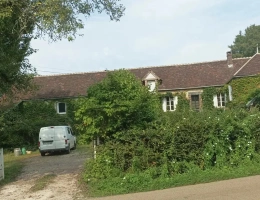
Units here often occupy buildings inherited from older mixed farming: a brick or stone longhouse, a barn with a hayloft, a lean-to shed. Inspection covers frame and roof, ventilation, drainage of the bedded area, then the parlour, the plant and the bulk tank. Where the farm processes, the cheese room and drying room are the heart of the business: an upgrade left too late means heavy works and a break in selling that the cash-flow plan has to absorb. Field shelters and fencing likewise deserve close attention.
On the herd, check the number of milking does, the share of kids retained, the number of bucks, the kidding calendar, average yields and health reviews. Alpine and Saanen animals form the base of most herds, with a few farms keeping Poitevine stock. Where the dwelling house is part of the package, obtain a separate appraisal: within reasonable reach of Paris, rural housing changes hands dearly and can distort how the working tool is priced.
The Puisaye, around Toucy and Saint-Sauveur-en-Puisaye, remains the most goat-minded area: damp meadows, hedged fields, medium-sized farms and affordable land. The Avallon country and the northern Morvan, from Quarré-les-Tombes to Avallon, offer grass, rough grazing and visitors drawn by Vézelay. The Tonnerre and Chablis country carries dearer ground, contested between vines and cereals, but with passing trade that suits direct selling. The Sens and Joigny areas and the Gâtinais plateaus are dominated by arable farming, with few livestock units available and a tight land market.
No protected designation covers goat cheese in the department, which throws most of the value onto direct selling and onto the farm's reputation. A goat cheese farm near the Auxerre to Sens corridor or a well-visited site sells on the spot; further south, marketing means organised rounds towards the Paris conurbation.
A goat unit falls under the classified installations regime, the French environmental permitting system, from the herd threshold set in the official nomenclature, with declaration and then registration according to size, and notice to the prefecture when the operator changes. On processing, the workshop must hold health approval or come under the direct retail exemption, with a food safety plan, own-checks and traceability of each make. Also examine the effluent storage works and whether the spreading plan suits the land taken on, in a department where several water catchments are protected.
Legally, list the rented parcels, have the continuation of rural leases confirmed, and allow for the structures control, the French authorisation regime for taking over farmland, and SAFER's pre-emption right, used all the more readily because arable farmers are looking to expand. If the farm is organic, check the certification date and the conditions for keeping it. Passing on a market customer base, finally, takes time: plan an overlap with the seller.
Owner-occupiers, rural estate agencies and notarial offices in the department are behind the properties published on this page. Filter by grass area, by budget or by the presence of a processing workshop, then put an alert in place: a smallholding of this kind rarely stays available for long. You can also explore goat farms for sale in Bourgogne-Franche-Comté.