

Buying a goat farm for sale in Jura usually means taking over a family-sized cheesemaking holding, backed by natural grassland and wooded grazing. Goats have survived here on the edge of the Comté world, in the Revermont, on the plateaus and in the Bresse lowlands, sustained by direct sales, by visitors to the high Jura and by traffic through the vineyards. Offers are placed by retiring owners, rural property firms and notaries in Lons-le-Saunier, Dole or Champagnole, detailing herd, acreage and machinery. They appear among the goat farms for sale recorded across the country.
Through this page you will find the decision points a listing does not supply: the value of Jura grassland, the areas where handovers are taking shape, the condition to expect of an older livestock building and the food hygiene duties attached to farmhouse cheesemaking. To structure a setting-up project, lean on our white paper « Créer une exploitation agricole » (in French).
Land weighs heavily on the budget for a goat farm. Transfers published by the French tax authorities (DVF, excluding vineyards) put the median for farmland in Jura (39) at €2,304/ha in 2025, with an average of €2,546/ha over 124 sales. Eight transactions in ten settle between €1,650 and €4,123/ha, where the national median is €5,307/ha.
A second reference, the SAFER land value benchmark, sets vacant land and pasture at €2,540/ha for 2025, +3.7% in a year and +12.4% over a decade; the French average is €6,460/ha, and a sitting tenant costs a plot roughly 17% of its value.
Beyond the land parcels, it is the means of production that carry value: the shed and its bedded area, the milking parlour and plant, the milk room, the cheese room and ripening cellar, hay drying, grazing fences. The herd comes next, through its size, genetics and consistency of yield, and then goodwill: selling rounds, markets, producer shops, wine cellars. Our land price observatory and financial calculators let you cost each of these items before making an offer.
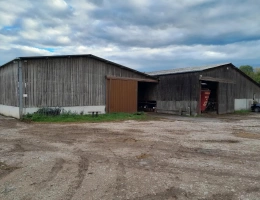
Local goat units often sit in multi-purpose buildings: a converted cow byre, a timber-framed shed closed on three sides, a barn part of which serves as storage. The buyer checks the roof and frame, ventilation, the nature of the floor, compliance of the milking block and the presence of a workable washing area. Where the farm makes cheese, the dairy, drying room and ripening cellar form a unit inseparable from the livestock enterprise, and upgrading them quickly costs more than upgrading the animal housing. Hay storage capacity again determines how self-sufficient the farm is through winter.
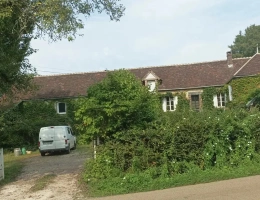
The herd is judged on numbers, age structure, replacement kids, milking results and health status. Wooded grazing, common on the plateaus, calls for solid fencing and close attention to parasites. Where the package includes the dwelling house, ask for two separate appraisals: a dairy goat holding with a complete working tool and a farmstead in need of renovation belong to different markets.
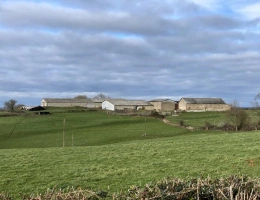
The Revermont and the first plateaus, from Poligny to Saint-Amour, hold most of the goat units, on limestone slopes close to the Arbois and Château-Chalon vineyards. The Lons plateau and the Champagnole area offer more grass but face competition for land from designation dairy holdings. The Bresse lowlands, towards Bletterans and Saint-Amour, provide more affordable ground and farms that do come up for sale. The high Jura, around Saint-Claude, Les Rousses and Morez, suits small herds selling to visitors present in both winter and summer.
That pattern guides the choice of area: a goat cheese farm near the vineyards or a resort enjoys an immediate outlet but a higher entry price, whereas the Bresse and the outer margins of the department allow more forage ground for an equivalent budget.
The department has no protected goat cheese designation, so marketing rests entirely on the farm's reputation, which needs to be verified and secured during the handover. Administratively, the unit falls under the classified installations regime, the French environmental permitting system, once it passes the threshold in the official nomenclature, moving from declaration to registration with herd size, with notice to the prefecture when the operator changes. The cheese room must be covered by health approval or by the direct retail exemption, with traceability, own-checks and a food safety plan you can read before buying.
Then look at the land: the share of rented parcels, continuation of rural leases subject to the owner's agreement, the compulsory structures control, the French authorisation regime for taking over farmland, and exposure to SAFER's pre-emption right. Grazing inside water catchment zones or protected natural sites may carry restrictions. Finally, such a business is best taken over with the seller alongside you for a season or two: customers, selling rounds and the practical knack of cheesemaking pass on through presence rather than paperwork. Build that period into the sale agreement and into the cash-flow plan.
The properties shown here are put on the market by working farmers, by estate agencies oriented towards rural property and by notarial offices across the Jura. Refine by area, by budget or by the presence of a cheese room, then switch on an alert so you do not miss a smallholding when it first appears. You can equally browse goat farms for sale in Bourgogne-Franche-Comté.