
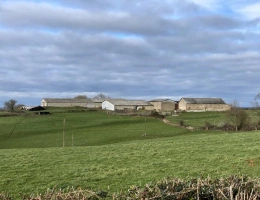

Finding a goat farm for sale in Doubs takes patience: the department lives to the rhythm of Comté cheese, and goats hold a niche here, kept by farmers who process their own milk and sell it on the markets of the high plateaus and around Besançon. The holdings concerned usually combine permanent grassland, sloping pasture and old stone buildings. Offers reach us through retiring owners, rural agencies and notaries in Besançon, Pontarlier or Montbéliard, stating herd size, acreage and milking equipment. You will find them among the goat farms for sale offered nationwide.
This page supplies the context a listing lacks: land price levels in a department where a cow's milk designation drives the market, the areas where handovers arise, what to inspect in a building made for hard winters, and the formalities attached to processing milk. Our white paper « Créer une exploitation agricole » (in French) helps prepare the application.
Land weighs heavily on the budget for a goat farm. Transfers published by the French tax authorities (DVF, excluding vineyards) put the median for farmland in Doubs (25) at €3,314/ha in 2025, with an average of €3,569/ha over 132 sales. Eight transactions in ten settle between €2,485 and €5,000/ha, where the national median is €5,307/ha.
A second reference, the SAFER land value benchmark, sets vacant land and pasture at €3,280/ha for 2025, +7.9% in a year and +27.6% over a decade; the French average is €6,460/ha, and a sitting tenant costs a plot roughly 17% of its value.
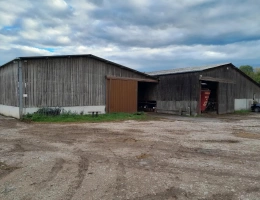
What creates value in a property like this owes little to acreage. The shed, its milking parlour, the bulk tank, the cheese room and cellar, the forage barn and haymaking machinery form the base; to these add the herd, its yield level and health status, and the goodwill built on markets, producer shops and village outlets. Tax treatment and financing are worked out item by item, which our land price observatory and our financial calculators make easier.
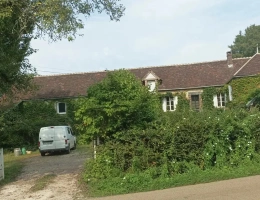
Units here are almost always housed in thick old masonry designed for winter: the large-volume Comtois farmhouse, its chimney tower, the attached barn. The advantage is thermal mass and forage stored under the same roof; the drawback is ventilation that is hard to control and interiors needing rework. Examine the frame, the roof, the wiring, the lying area and the drainage of effluent, then the milking parlour, the number of units relative to the herd and the condition of the plant. The milk room, cheese room and cellar must form a circuit kept separate from the animals.
Long winters make forage self-sufficiency central: hay storage capacity, barn drying equipment where it exists, access kept clear of snow. On livestock, ask for the number of milking does and replacement kids, the kidding calendar, cell counts and CAEV monitoring. If the sale covers the dwelling and the land, have them appraised separately: a dairy goat holding is valued on its working tool, not on the charm of the farmhouse.
Land prices follow the map of the Comté designation. On the plateaus of Levier and Nozeroy and across the high country towards Pontarlier and Morteau, demand from dairy cattle holdings keeps the market tight and leaves little room for a goat project. The Loue valley around Ornans and the lower plateaus near Besançon mix grassland, woodland and residential settlement. The Montbéliard country, the Lomont ridge and the lower Doubs valley offer more affordable ground and more available farms, with an urban customer base close by.
Anyone setting up is therefore well advised to look outside the most contested zones: a goat cheese farm in the north of the department or on the foothills costs less for comparable equipment, while keeping direct access to the markets of Besançon, Montbéliard and the valley towns.
No protected goat cheese designation exists in the department: value rests on the farm's own name, which makes goodwill fragile unless it transfers with the business. Check the sales channels, the market pitches, which cannot be traded freely, and any agreements with retailers. On the regulatory side, the unit falls under the classified installations regime, the French environmental permitting system, by declaration or registration according to herd size, while processing requires health approval or the exemption applying to direct retail sale, with an up-to-date food safety plan.
Land is rarely taken over freehold: rural leases continue with the landlord's agreement, the structures control applies, and SAFER watches transactions closely inside the designation area. Ask as well about easements linked to water catchments, numerous on this limestone plateau country, and the resulting rules on effluent storage and spreading, since they govern any future change in herd size. Snow clearance on the access road and the practical reach of outlying parcels are worth judging on site, ideally in winter, before you commit.
Retiring farmers, agencies specialising in rural property and notaries across the department post their offers here. Very little comes up in any given season, so it pays to watch the department continuously rather than in bursts. Use the filters for area, price or type of unit, then request the e-mail alert: a smallholding of this kind does not stay available for long in this part of France. You can also browse goat farms for sale in Bourgogne-Franche-Comté.