
The market for a goat farm for sale in Haute-Saône is marked by modest-sized holdings, plentiful grassland and some of the most affordable farmland in north-eastern France. Goats have carved out a place here alongside the dairy cattle sector, sustained by farmhouse cheesemaking and by nearby town customers, from Vesoul to the Belfort and Montbéliard conurbation. Retiring breeders, rural property firms and notaries in Vesoul, Gray or Lure publish these properties with details of the herd, the grass acreage and the processing equipment. They join the goat farms for sale recorded across the country.
What the advert leaves out sits here: benchmarks for local land values, the areas where a dairy goat holding is most likely to come up, the usual condition of the buildings and the requirements attached to a farm cheese room. To prepare a move into the sector, our white paper « Créer une exploitation agricole » (in French) serves as a guide.
Land weighs heavily on the budget for a goat farm. Transfers published by the French tax authorities (DVF, excluding vineyards) put the median for farmland in Haute-Saône (70) at €2,615/ha in 2025, with an average of €2,727/ha over 156 sales. Eight transactions in ten settle between €1,999 and €3,577/ha, where the national median is €5,307/ha.
A second reference, the SAFER land value benchmark, sets vacant land and pasture at €2,660/ha for 2025, -1.5% in a year and +0.8% over a decade; the French average is €6,460/ha, and a sitting tenant costs a plot roughly 17% of its value.
Acreage is only part of the price here. The rest lies in the livestock building and its bedded area, in the parlour and milk room, in the cheese room and its ripening cellar, in haymaking and drying equipment, and in the fencing of grazing often bordered by woodland. The herd then counts through its size and performance, and goodwill through the regularity of rounds, markets and delivered boxes. Cost each item with our land price observatory and our financial calculators.
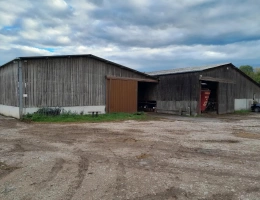
Goat units in this department usually sit in a former Franche-Comté cow byre or in an enclosed shed with direct access to the fields. The buyer examines the frame and roof, air renewal, flooring and bedding, the state of the milking plant, the cleanliness of the milk room and how the water supply performs. Where the farm processes, the cheese room, the drying room and the cellar should be seen before any commitment: their compliance decides whether selling can resume straight away. Hay storage volume counts double in a department where winter lingers on the higher ground.
The herd is read from the records: numbers of milking does, kids kept for replacement, bucks, the spread of kidding, average yields and veterinary follow-up. Alpine and Saanen animals form the backbone of most herds, sometimes joined by hardy stock used to keep rough grazing in check. Where house and land are included, ask for a written breakdown of the price: residential buildings gain value quickly in the valleys, regardless of what the working tool is truly worth.
The southern Vosges, from Melisey to Faucogney-et-la-Mer and Servance, around the plateau of the Thousand Ponds, offer grass, rough grazing and cheap land, but long winters and scattered settlement. The Ognon valley, towards Rioz and Montbozon, benefits from the closeness of Besançon for direct selling. The Vesoul plateau and the Combeaufontaine and Jussey country mix arable with livestock, and competition for land is fed by dairy farms inside the Comté designation area. The Saône valley, around Gray and Port-sur-Saône, holds more sought-after ground, largely turned towards cereals.
No protected designation covers goat cheese in this department, so value rests on the farm's own name and on how close the customer is. A goat cheese farm set between Lure, Luxeuil-les-Bains and Héricourt has a dense pool of buyers, whereas the more remote north-west means organising regular deliveries.
On the regulatory side, a goat unit falls under the classified installations regime, the French environmental permitting system, once the herd passes the threshold in the official nomenclature, with declaration and then registration according to size, and notice to the prefecture when the operator changes. The cheese workshop needs health approval or must come under the exemption applying to direct retail sale, with a food safety plan, own-checks and batch traceability. Add to that the inspection of effluent storage works, the spreading plan and the watering points, often fed by springs on the higher ground.
Legally, separate owned parcels from rented ones, have the continuation of rural leases confirmed, and allow for the structures control, the French authorisation regime for taking over farmland, as well as SAFER's pre-emption right. Grazing along the forest edge calls for a look at rights of way and at the status of the woodland. Finally, such a business hands over better with a few months of shared presence: cheesemaking know-how, customers and the grazing calendar are learned on site.
The offers visible on this page come from owner-occupiers, from estate agencies specialising in rural property and from notarial offices in the department. Refine by forage area, by the budget available or by the presence of a cheese room, then switch on an alert to hear as soon as a smallholding goes online. A wider perimeter is reachable through goat farms for sale in Bourgogne-Franche-Comté.