
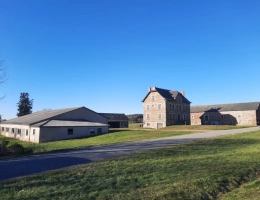
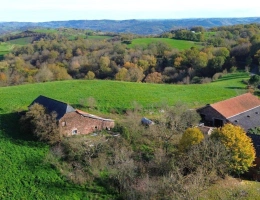

A goat farm for sale in Aveyron belongs to a livestock department above all, where dairy ewes rule the limestone causses but where goat herds have carved out a place on the hillsides of the Ségala, the heights of the Lévézou and the slopes of the Lot valley. The properties shown here reach us from breeders arranging their succession, from rural land professionals and from notaries of the Rouergue; they set out how many dairy goats are milked, how the shed is designed, whether a processing workshop is attached and how the area splits between meadow and rough grazing. Find them within our national selection of goat farms for sale.
To the description this page adds what a decision needs: local land values, the cantons where a holding comes free, how tired the buildings are likely to be, and the checks that on-farm cheese making imposes. Anyone preparing a first entry into farming will find in our white paper « Créer une exploitation agricole » (in French) the procedures, the grants and the funding structure spelled out.
Land weighs heavily on the budget for a goat farm. Transfers published by the French tax authorities (DVF, excluding vineyards) put the median for farmland in Aveyron (12) at €7,200/ha in 2025, with an average of €7,868/ha over 107 sales. Eight transactions in ten settle between €4,730 and €11,493/ha, where the national median is €5,307/ha.
A second reference, the SAFER land value benchmark, sets vacant land and pasture at €7,570/ha for 2025, +3.0% in a year and +11.7% over a decade; the French average is €6,460/ha, and a sitting tenant costs a plot roughly 17% of its value.
On a caprine property the hectares rarely make the difference. The buyer pays for the shed and its airflow, the bedded area, the parlour and its bulk tank, the make room, the drying room and cellar where they come with the unit, then the forage stocks and the security of the water supply. The herd is weighed next through breeds, health record and age structure, the trade through its customers or its delivery contract. Set that against our land price observatory and our financial calculators.
Built heritage in the Rouergue is solid and often old: stone barn-byres, enlarged sheepfolds, sheet-metal buildings added season after season. On a plateau where winter lasts, check insulation, ventilation without draughts, the headroom needed to bed down by machine, access for tractors during frost, and hay storage, because forage self-sufficiency decides the economics here. The parlour is judged on its milk line, its washing system, the sizing of the tank and the compliance of the effluent store. A unit recently overhauled costs more than a structure that would force a complete upgrade.
Processing changes the scale of the property: make room, drying room, cellar, cold store and sales point form a whole valued according to the approval obtained, the volumes worked and the standing built on market stalls. A unit delivering to a dairy is measured differently, through the regularity of collection and the terms negotiated. As soon as a complete farmstead is offered, separate dwelling, farm buildings, livestock and parcels: a characterful Aveyron house often weighs more in the advertised figure than the production tool itself.
The Ségala, from Rieupeyroux to Baraqueville and towards Naucelle, gathers grassy hillsides, fragmented parcels and many family-sized farms likely to change hands. The Lévézou, around Pont-de-Salars and Salles-Curan, offers grass, wind and buildings designed for altitude. The Lot valley, from Entraygues-sur-Truyère to Espalion, and the Villefranchois bring sunlit slopes that suit rough grazing. The great causses, from the Larzac to the Causse Comtal, remain largely organised around the dairy ewe, which makes caprine units scarcer there and grazing land keenly sought.
Outlets rest on the markets of Rodez, Villefranche-de-Rouergue, Millau and Espalion, on producers' shops and on steady summer visitor numbers along the valleys. The Rocamadour designation area extends onto the western fringe of the department, something to confirm commune by commune before committing. Cantons furthest from the main roads keep the most accessible prices, while the surroundings of Rodez and of the motorway tighten noticeably.
Depending on herd size, such a unit falls under declaration, registration or authorisation within the French classified installations regime, and a change of operator is notified to the prefecture; modest numbers remain governed by the departmental health regulation, in particular on distances from neighbours, a delicate matter in the clustered villages of the Rouergue. Call for the herd's status on CAEV, the caprine arthritis-encephalitis virus, and on paratuberculosis, for the veterinary record, and for the manure spreading plan and effluent storage capacity in relation to sensitive zones.
Where cheese is made, the food safety plan, the approval or the derogation covering direct supply and the self-monitoring results should be handed over without reservation. The land calls for careful reading: many holdings mix owned and rented ground, rural leases continue with the buyer subject to the landlord's agreement, and grazing agreements over common or upland pasture do not transfer automatically. The whole passes through the structures control, the French authorisation regime for taking over farmland, then through SAFER.
Private sellers ending their careers, rural estate agencies and notarial offices of the Rouergue feed this page. Compare properties on forage area, on budget or on whether a cheese room comes with them, then set up an e-mail alert, because a goat cheese farm here attracts several candidates within days. Preparing your own handover? Publish the listing. Carry the search into goat farms for sale in Occitanie.