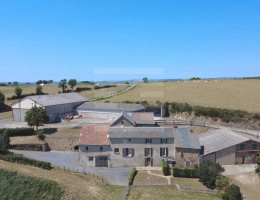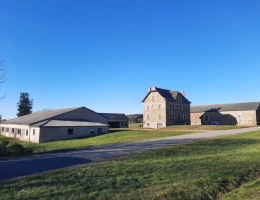
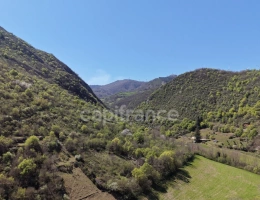
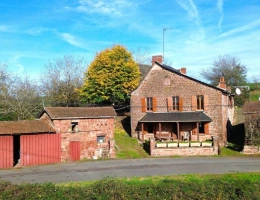
In this department, farms for sale in Aveyron almost always come with an outlet attached: a protected cheese chain, a contract to supply sheep's milk, a quality beef label, sometimes a ripening cellar a few valleys away. That singularity has to be measured before areas are compared, because the contract weighs as much as the soil here and does not always pass on with the fields. We publish instructions from stockmen arranging their succession, from partnerships being dissolved, from rural agencies and from Aveyron notaries, detailing areas, rough grazing, livestock housing and milking equipment. They are part of the record of farms for sale in France kept on this site.
Gathered below are the elements that shape a decision: the value of meadow, rough grazing and ploughland across the different plateaux, the supply chains that structure each district, the cantons where supply stays plentiful and the verifications any offer should follow. Our white paper « Créer une exploitation agricole » (in French) supports those approaching a first purchase.
Land forms the base of a farm's value. DVF, the property sales database published by the French tax administration (vineyards excluded), records a 2025 median of €7,200 per hectare in Aveyron (12), an average of €7,868 and 107 sales; four transactions in five fall between €4,730 and €11,493, against a national median of €5,307.
The SAFER land value benchmark sets €7,570 per hectare for vacant land and pasture offered for sale in the same year, +3.0% over one year and +11.7% over ten, against €6,460 nationally. SAFER publishes no local figure for let land, too few sales being recorded; nationally, land sold with a farm tenancy in place trades at a discount of about 17%.
Against the Occitanie region, whose median is €7,015 per hectare, this department sits 3% higher. For commune-level detail and comparisons with neighbouring areas, see our land price observatory, then cost your purchase with our financial calculators.
The south of the department is the heart of a system unique in France: dairy sheep flocks supplying ripening cellars set in limestone scree, with a local breed selected for milk yield and a specification that governs what the flock is fed. North and west, suckler herds and the finishing of young cattle under quality labels prevail. Dairy cattle holdings hold the north-eastern plateaux, backed by long-established cheese appellations, while a number of goat herds process their milk on the farm.
A buyer should therefore examine three things the price does not reveal: the reference or collection volume that can genuinely be transferred, whether the parcels fall inside the appellation area being targeted, and whether the flock meets the breed and feeding requirements. Buildings matter too: a sheep house laid out for milking and properly ventilated represents a large share of working value, often more than a few extra hectares would.
The Ségala, west of Rodez towards Baraqueville and Rieupeyroux, carries acid soils limed over generations into productivity: this is the district of intensified cattle systems, grouped parcels and the most frequent transactions. The causses — Comtal, Sévérac, Larzac — offer instead very large areas of lightly stocked rough grazing, where what you buy is space rather than grass. The Aubrac, to the north-east, combines summer pasture, stone shepherds' huts and upland stock rearing. The windswept central Lévézou mixes milk, beef and high meadows.
The more sheltered Lot and Aveyron valleys hold small diversified units and some plantings, while the Rougier de Camarès in the south is recognisable by its red soils and extensive sheep holdings. The Bassin and the approaches to Rodez feel a limited but real peri-urban pull. A working farm lying in a single block is easier to find on the causses and the Aubrac than in the deep valleys.
The first reflex is cartographic: confirm that the parcels in question fall within the appellation area on which the outlet depends, since a move of a few communes is enough to fall outside it. The second is contractual: obtain in writing the collector's position on transferring the volume, and read the specification governing the share of grass, the origin of forage and the management of the flock. Both points underpin the profitability being claimed.
The usual controls follow: SAFER pre-emption notified by the notary, approval to farm measured against the Occitanie thresholds, and the sitting tenant's priority over let land. On the plateaux, add the collective management of certain summer pastures, environmental protection perimeters across the causses and the question of stock water, since the resource there is karstic and unevenly distributed.
Listings follow the rhythm of the supply chains: numerous retirements across the Ségala, partnerships reorganised when a member leaves, and handovers prepared years ahead in the appellation zones. Choose the production chain first, then the collection area, before reasoning in hectares at all; an e-mail alert then takes over the watching. Sellers publish their property directly. For the wider view, see farms for sale in Occitanie.