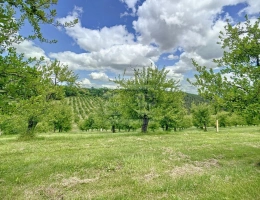
Few departments pack so much contrast into so short a distance for anyone prospecting farms for sale in Tarn-et-Garonne. In the south, the low terraces where the Garonne, the Tarn and the Aveyron meet form one of the great French orchards, watered by a dense irrigation network and connected to long-established despatch chains. In the north, the Quercy Blanc and the limestone uplands answer with thin soils, lower rainfall and larger livestock structures. The properties gathered here are brought to market by farmers arranging their succession, by rural land agencies, by notaries in the department and by handover advisers. Descriptions set out planted varieties, orchard age, irrigation equipment, fruit stations and co-operative shares. All of them feed the directory of farms for sale in France.
A catalogue does not say everything: this page explains what makes a parcel's value swing according to whether it has access to raw water, where orchards pass from hand to hand, and which formalities condition a takeover. Chasselas table grapes and the Brulhois vines belong to the wine-estate category. Before building a case, read the white paper « Créer une exploitation agricole » (in French), which covers legal status, funding plan and timing.
Land forms the base of a farm's value. DVF, the property sales database published by the French tax administration (vineyards excluded), records a 2025 median of €7,301 per hectare in Tarn-et-Garonne (82), an average of €7,959 and 113 sales; four transactions in five fall between €4,458 and €12,529, against a national median of €5,307.
The SAFER land value benchmark sets €7,540 per hectare for vacant land and pasture offered for sale in the same year, +0.7% over one year and +20.4% over ten, against €6,460 nationally. SAFER publishes no local figure for let land, too few sales being recorded; nationally, land sold with a farm tenancy in place trades at a discount of about 17%.
Against the Occitanie region, whose median is €7,015 per hectare, this department sits 4% higher. For commune-level detail and comparisons with neighbouring areas, see our land price observatory, then cost your purchase with our financial calculators.
Fruit growing gives the department its identity. Fruit-growing holdings on the terraces of Moissac, Castelsarrasin and Montauban line up apple, plum, kiwi and table grape; value is split between the planting itself, frost and hail protection equipment, the chilled store and the marketing commitment. Beside them, market gardening in the open and under cover has settled on the same alluvium, with a large seasonal workforce to organise from the first year. Both sectors demand solid working capital: an orchard does not crop in the year it is planted.
The upper part of the department follows a different logic. Arable holdings occupy the local Lomagne, country of white garlic and melon, while the Quercy causses and the Pays de Serres carry sheep farms and mixed systems combining cereals with a flock. A working farm there offers more hectares for less money, but water is scarce and mechanisation is constrained by relief and by field size.
The plain running from Valence-d'Agen to Montauban, through Moissac and Castelsarrasin, holds the most sought-after properties in the department: deep soils, irrigation already installed, despatch points close by. Supply is thin and contested, including by buyers from neighbouring departments. The Bas-Quercy, around Molières and Montpezat, offers smaller mixed and fruit-growing units. Towards Lauzerte and Bourg-de-Visa, the Quercy Blanc and the Pays de Serres remain the districts where area can still be bought.
To the east, the Aveyron gorges and the edge of the Rouergue, around Saint-Antonin-Noble-Val and Caylus, combine dry grazing, woodland and isolated livestock buildings: access and water supply decide the matter there. The north-east, around Caussade, mixes cereals with livestock enterprises on mid-sized holdings, usually passed on as a whole.
In the valley the water question comes before any other. Check where the abstraction comes from, whether the authorisation is current, whether the holding is linked to a collective network, what volumes the single management body has notified and which restrictions applied during recent low flows. An orchard deprived of water loses its purpose. At the same time, check how parcels are classed under the flood risk prevention plan: part of the confluence land is exposed, which blocks some construction and weighs on crop insurance.
On the regulatory side, the sale is notified to SAFER, which may pre-empt to settle a young farmer or reorganise holdings. Working the land then requires an authorisation issued under structural control, against the thresholds adopted in Occitanie. And where land is let, the tenant stays and his priority right to buy outranks yours: have that verified before making an agricultural property offer.
Retiring fruit growers and stock farmers, rural agencies in Tarn-et-Garonne and local notaries publish their mandates here. Filters on area, production and budget isolate irrigated properties, or conversely hillside blocks, in a few clicks; saving the search triggers a notice with every new publication. Sellers have a listing form of their own. To compare across the region, open farms for sale in Occitanie.