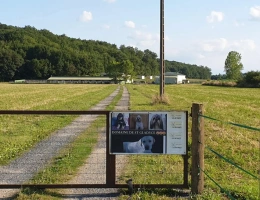


A buyer considering farms for sale in Hautes-Pyrénées is working in a tiered department, where three farming worlds follow one another in under a hundred kilometres: irrigated cropping on the Adour plain in the north, mixed systems on the hills and the central plateau, and valley holdings backing onto summer pasture in the south. A project has to be pitched at one of those tiers, because area, buildings and the working season obey different logics on each. Sales gathered here are entrusted by growers and stockmen with nobody in the family to follow them, by notarial offices in Tarbes, Vic-en-Bigorre and Lannemezan, by succession advisers and by rural property agencies. Every entry accounts for the area worked, access to water or to the mountain, the buildings and the stock. They complete our overview of farms for sale in France.
Added to that is what gets decided before an offer: the gap in value between irrigable lowland and a valley meadow, the part quality schemes play in the income of a Bigorre livestock business, and how access to high grazing is actually acquired. Our white paper « Créer une exploitation agricole » (in French) handles the setting-up route itself.
Land forms the base of a farm's value. DVF, the property sales database published by the French tax administration (vineyards excluded), records a 2025 median of €8,219 per hectare in Hautes-Pyrénées (65), an average of €7,982 and 61 sales; four transactions in five fall between €4,817 and €11,797, against a national median of €5,307.
The SAFER land value benchmark sets €7,850 per hectare for vacant land and pasture offered for sale in the same year, +0.1% over one year and +8.3% over ten, against €6,460 nationally. SAFER publishes no local figure for let land, too few sales being recorded; nationally, land sold with a farm tenancy in place trades at a discount of about 17%.
Against the Occitanie region, whose median is €7,015 per hectare, this department sits 17% higher. For commune-level detail and comparisons with neighbouring areas, see our land price observatory, then cost your purchase with our financial calculators.
The Adour plain and the Rivière-Basse carry the department's arable holdings: grain and seed maize on irrigated terraces, soya and straw cereals, with a share of contract growing that secures income while framing the rotation. Specialist crops hold a real place there, from pole-grown beans to hillside vegetables produced in short runs. On the hills and the Lannemezan plateau, mixed farming is the norm, pairing maize and grassland with a livestock enterprise.
Livestock takes over as soon as the slope steepens: suckler herds of Blonde and Pyrenean Gasconne cattle, ewe flocks of local breeds taken up to summer pasture, outdoor pig units under quality schemes, and farmhouse dairies in the valleys. A working farm in the mountain zone is rarely taken on without its grazing rights: the farmstead and its hay meadows are worth something only while attached to a summer pasture.
The north of the department, between Maubourguet, Vic-en-Bigorre and Rabastens, belongs to the Adour plain: deep soils, irrigation networks, sizeable holdings and contested land, extended by the Madiran vineyard on the Vic-Bilh slopes. Around Tarbes, the urban ring eats into the terraces and breaks up field patterns. The Lannemezan plateau and the Baronnies, in the centre-east, offer larger grassland blocks, heavier soils and noticeably more moderate entry prices.
In the south, the valleys of the Aure, the Louron, the Adour de Campan, the Lavedan and Barèges run on a pastoral economy: small private areas, high barns, common summer grazing and seasonal transhumance. Supply is thin there and usually tied to a career ending. An agricultural property holding both mowable meadow and secure access to the mountain is the most sought-after asset in the department.
The decisive point in the south is the use of common grazing. Communal pastures, section land, valley syndical commissions and pastoral groups govern access to the mountain under agreements that do not mechanically follow a sale. Ask which areas are genuinely attached to the farmstead, in what form, for how long and against what shepherding costs. On the plain the scrutiny falls on water: where the volume comes from, whether the holding is served by the network fed from the Neste system, whether a borehole is declared, and what restrictions applied in recent seasons.
Formalities are those of any agricultural sale. The notary refers the matter to SAFER, which may buy before putting the property back on the market under its own priorities. The authorisation to farm depends on the Occitanie structure plan, whose thresholds are read against the kind of land being taken on. Let parcels stay occupied and their tenant keeps the priority right to purchase. Add the planning rules that apply in mountain zones and restrict what can be done with older buildings.
Properties appear here as businesses wind down, more often on the hills and the plateau than in the high valleys, where handovers are frequently settled within the family. Sorting by production, size, altitude or budget brings out the files that suit your project; an e-mail alert then takes care of announcing what is new. The rest of the region can be consulted from farms for sale in Occitanie.