
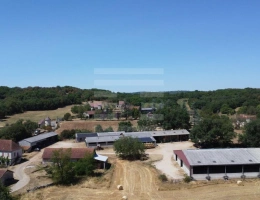
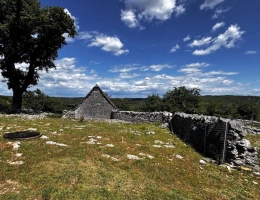
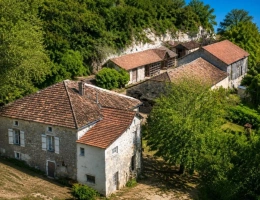
Few departments place a goat farm for sale in Lot inside so well organised a sector: the limestone plateau has fed herds for centuries and cheese making is a trade in its own right here. Breeders reaching the end of their career, rural transaction firms and Quercy notaries are the ones who entrust us with the properties on this page; their descriptions set out herd size, how the housing was designed, whether a make room exists and how much of the area is rough grazing. Each also appears in our national selection of goat farms for sale.
The page extends the listings with the markers that matter when a decision is near: local land values, the districts where a holding comes free, what to look at in a building set on limestone, and the checks tied to farmhouse cheese making. To prepare a start-up, the white paper « Créer une exploitation agricole » (in French) sets out the administrative and financial stages.
Land weighs heavily on the budget for a goat farm. Transfers published by the French tax authorities (DVF, excluding vineyards) put the median for farmland in Lot (46) at €5,500/ha in 2025, with an average of €6,345/ha over 43 sales. Eight transactions in ten settle between €3,399 and €9,880/ha, where the national median is €5,307/ha.
A second reference, the SAFER land value benchmark, sets vacant land and pasture at €5,590/ha for 2025, -1.1% in a year and -0.4% over a decade; the French average is €6,460/ha, and a sitting tenant costs a plot roughly 17% of its value.
On the causse, area tells only part of the story. What counts first is the housing and its airflow, the parlour, the bulk tank, the cheese room with its drying room and cellar, then the security of the water supply, a standing issue on karst ground. The animals follow, with their breeds, their replacement rate and their health record, and finally the goodwill: rounds, markets, farm shop or collection contract. Test the whole picture against our land price observatory and our financial calculators.
Buildings range from converted causse barns to timber-clad goat housing and sheds extended season after season. The inspection turns on ventilation within an often wide volume, on bedding quality and how it is removed, on the collecting yard, the milk room and forage storage, which summer drought makes strategic. A compliant muck pad and a washing station spare the buyer immediate outlay. Also check access and how well the tracks carry weight: a holding served by a metalled road all year defends its price better than a farm at the end of a white stone lane.
Many holdings process on site. Make room, drying room, ripening cellar, cold store and sales point then form a tool whose price rests on the approval held, the volumes produced and the customer base handed over. A herd sending its milk to a dairy is judged instead on how reliably collection runs and on the clauses of the contract. Where the sale takes in a stone manor or farmstead with its outbuildings, isolate the residential share: the second-home market weighs heavily on advertised figures here.
The Causses du Quercy form the caprine heart of the department, from Gramat to Labastide-Murat and on to the causse de Limogne, with dry grazing, limestone swards and herds used to making something of a thin resource. The northern Quercy, towards Martel and Rocamadour, adds heavy visitor traffic to the same pattern. The Bouriane, around Gourdon, mixes woodland, chestnut and more acid soils. The Ségala of Lot, from Figeac to Latronquière, offers more grass and often mixed holdings. The Lot and Dordogne valleys, contested by vines, crops and housing, leave less room.
The Rocamadour designation, whose area covers much of the department, shapes how milk is valued and steers the strategy of many units, between delivery to a dairy and farmhouse production. Visitor flows in the valleys and around the listed sites support direct selling, while districts furthest from the main roads keep land more affordable and offer larger building sets for the same budget. On the causses, the sheer extent of grazing offsets a low forage yield, which is why advertised areas often exceed those of grassland departments.
Taking over a dairy goat holding means checking which regime applies: depending on numbers, the unit falls under declaration, registration or authorisation within the French classified installations regime, and a change of operator is declared to the prefecture; below that threshold the departmental health regulation fixes distances from dwellings. Karst imposes vigilance of its own: where the water comes from and how dependable it is, the abstraction permit, the capacity of storage, the quality of drinking points and the protection of catchments, all to be examined before any offer.
Ask for the herd's status on CAEV, the caprine arthritis-encephalitis virus, and on paratuberculosis and, where milk is worked on site, for the food safety plan and the self-monitoring results; accreditation to the designation is confirmed with the inspection body. On land, a sizeable share of the parcels is rented and often fragmented: the rural lease continues with the buyer subject to the owner's agreement, and the deal falls under the structures control, the French authorisation regime for taking over farmland, then SAFER.
Retiring breeders, rural estate agencies and Quercy notarial offices publish what is gathered here. Compare holdings on grazing area, on price or on where the milk goes, and switch on an e-mail alert, because a goat farm on the market in this department finds a buyer quickly. Selling your own? Publish the listing. Extend the search to goat farms for sale in Occitanie.