

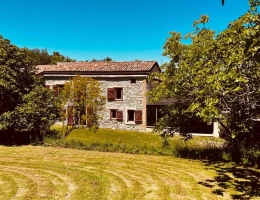
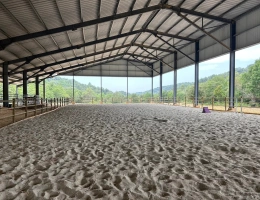
Looking for a goat farm for sale in Aude takes you into a department where caprine herds hold a quiet but stubborn place, working garrigue, sun-facing slopes and wooded hillsides that neither vines nor cereals contest. What appears here is entrusted to us by breeders preparing their withdrawal, by firms specialising in rural land and by notarial offices of the department; each description states herd size, what the buildings consist of, whether a make room is attached and how much of the area is rough grazing. These properties belong to our national selection of goat farms for sale.
Added to that is what a description never carries: where local land values actually sit, which districts most often release a holding, the condition of buildings frequently inherited from sheep enterprises, and the controls that raw-milk processing brings with it. The white paper « Créer une exploitation agricole » (in French) sets out the administrative and financial path of a start-up.
Land weighs heavily on the budget for a goat farm. Transfers published by the French tax authorities (DVF, excluding vineyards) put the median for farmland in Aude (11) at €5,765/ha in 2025, with an average of €6,627/ha over 59 sales. Eight transactions in ten settle between €3,315 and €10,351/ha, where the national median is €5,307/ha.
A second reference, the SAFER land value benchmark, sets vacant land and pasture at €6,610/ha for 2025, +3.9% in a year and +0.2% over a decade; the French average is €6,460/ha, and a sitting tenant costs a plot roughly 17% of its value.
Past the hectares, the worth of such a holding rests on its working tool and on its outlets: the shed and its airflow, the parlour, the bulk tank, the cheese room and ripening cellar where they exist, the water store, the tracks reaching the grazing. Then come the animals, their breeds, their age and their replacement stock, followed by the trade built up: delivery rounds, market stalls, producers' shops or a collection contract. Weigh each of these items beside our land price observatory and our financial calculators.
Buildings here often come from converted sheep units: stone-walled folds, farm sheds re-partitioned, sometimes a recent clad extension. Inspection begins with height under the purlin, with air movement in a climate where summer arrives early, with shade over the collecting yard and with insulation of the milk room. Then come the milk line and its washing system, tank capacity, effluent handling, and forage storage, a sensitive matter as soon as hay has to be bought in. A unit already brought up to standard sells higher, but spares the buyer work made expensive by distance from mains services.
Where the farm processes, the make room, drying room, cellar, cold store and sales point form a block whose value follows the approval or derogation held, the volume worked and the customer base won. A herd delivering to a dairy is judged otherwise, on how reliably the tanker comes and on what the contract says. If the property includes a house, outbuildings and land, insist on a breakdown: residential worth and farming worth answer to very different markets in this department.
The Hautes-Corbières, between Mouthoumet, Tuchan and the ridges rising towards Durban-Corbières, offer dry grazing, wide and little-contested areas, and farmsteads a long way from services. The Montagne Noire, on the Cabardès side, brings more grass, wooded slopes and buildings often left by mixed farms. The Pays de Sault, around Belcaire and Espezel, imposes a long winter, full forage self-sufficiency and genuinely insulated premises. The Razès, the Limouxin and the Chalabrais mix livestock with vines. Down on the plain, from the Lauragais to the Narbonnais, cereals, vineyards and edge-of-town pressure leave few openings and push land values up.
Marketing follows that geography: part of the department lies within the Pélardon designation area, while the rest leans on the markets of Carcassonne, Limoux and Narbonne, on producers' shops and on a large summer clientele. The inner districts, harder to reach, stay the most affordable; communes near the coast and the tourist routes hold firmer prices, livestock aside.
A dairy goat holding here is read first against the French classified installations regime: depending on numbers the unit falls under declaration, registration or authorisation, and any change of operator must be notified to the prefecture, while smaller herds remain governed by the departmental health regulation and its siting distances from dwellings. Water deserves a serious enquiry: where it comes from, the abstraction permit, late-summer flow, summer restrictions and drinking arrangements on distant grazing. Ask finally for the herd's health status, in particular on CAEV, the caprine arthritis-encephalitis virus, and on paratuberculosis.
Fire risk governs the use of scrubbed-over grazing: clearance obligations, access for emergency services, available water points. Where the unit processes, call for the food safety plan, the approval or the derogation covering direct supply, the self-monitoring records of recent seasons, and any designation or organic commitments. On the land side, rural leases over rented parcels continue with the buyer subject to the landlord's agreement, and the deal remains subject to the structures control, the French authorisation regime for taking over farmland, then to SAFER.
This page brings together properties offered by retiring breeders, rural estate agencies and notaries of the department. Sort them by grazing area, by budget or by whether a processing workshop comes with them, then arm an e-mail alert: a smallholding of this kind stays rare and moves quickly. Handing yours on? Post the listing. Widen the search afterwards to goat farms for sale in Occitanie.