




Acquiring a goat farm for sale in Lozère means choosing a department where livestock remains the leading activity and where a caprine herd turns slopes, heath and high pasture to account as nothing else could. Breeders arranging their departure, rural land specialists and notaries of the Gévaudan keep this page supplied; their descriptions cover how the herd is run, what the buildings consist of, whether a cheese room is attached and how far the grazing extends. Each of them, whether a small terraced unit or a plateau holding with wide grazing, sits within our national selection of goat farms for sale.
Beyond the properties themselves, you have here what actually weighs on a decision: local land values, the valleys and plateaux where a caprine holding most often appears, the state of buildings that must face winter, and the checks specific to raw milk. The white paper « Créer une exploitation agricole » (in French) throws light on the route into farming and how it is funded.
Land weighs heavily on the budget for a goat farm. Transfers published by the French tax authorities (DVF, excluding vineyards) put the median for farmland in Lozère (48) at €3,079/ha in 2025, with an average of €3,523/ha over 18 sales. Eight transactions in ten settle between €1,858 and €6,253/ha, where the national median is €5,307/ha. * Fewer than 30 recorded sales: indicative value.
A second reference, the SAFER land value benchmark, sets vacant land and pasture at €4,330/ha for 2025, -21.0% in a year and +14.9% over a decade; the French average is €6,460/ha, and a sitting tenant costs a plot roughly 17% of its value.
In mountain country, value lies less in the hectares than in what makes them workable. A buyer looks at the housing, its insulation and its forage store, the parlour, the bulk tank, the cheese room and its ripening cellar, then the water resource and winter access. The animals come next, through their breeds, their replacement rate and their health record, ahead of the outlet: an established clientele or dependable collection. Weigh all that against our land price observatory and our financial calculators.
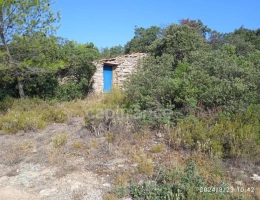
Buildings run from converted granite or schist barns to recent structures set on a levelled platform. Altitude dictates the priorities: insulation, no draughts over the lying area, controlled ventilation, hay storage large enough for a long winter, and cleared access for the collection lorry and straw deliveries alike. The parlour is judged on the condition of the milk line, the washing system, tank capacity and the reliability of the electricity supply, which can be fragile in remote hamlets. A holding already brought fully up to standard trades higher but avoids works that are hard to carry out in an isolated setting.
Farmhouse processing dominates: make room, drying room, cellar, cold store and sales point form a tool whose worth depends on the approval held, on volumes and on a customer base often built around the summer season. Herds delivering to a dairy are assessed differently, on the regularity of collection and on contract terms. Where the sale covers a Cévennes farmstead with dwelling, outbuildings and land, set the price out item by item, because old stone buildings also attract residential demand.
The Lozère Cévennes concentrate the caprine tradition, from the valleys of Saint-Germain-de-Calberte and Sainte-Croix-Vallée-Française to the surroundings of Florac and Le Pont-de-Montvert: slopes, chestnut groves and terraces shape modest herds strongly geared to processing. Mont Lozère and the causse Méjean offer wide grazing, hardy swards and buildings often inherited from sheep farming, which suit larger herds. The causse de Sauveterre and the Valdonnez carry the same pattern towards Mende. The Aubrac and the Margeride, from Marvejols to Langogne, stay dominated by cattle and ewes, which leaves goat units more scattered there.
The Pélardon designation reaches the Cévennes side of the department and underpins solid cheese marketing, completed by markets, collective outlets and visitor numbers concentrated in the warmer months. Land stays broadly more affordable than elsewhere in Occitanie, yet well-equipped and accessible holdings are scarce enough that real competition appears whenever a good one comes free, above all where a compliant workshop and an established clientele come together.
A dairy goat holding is also read through its paperwork. Depending on numbers, the unit falls under declaration, registration or authorisation within the French classified installations regime, with any change of operator brought to the prefecture's attention, while the smallest herds come under the departmental health regulation and its distances from dwellings. Check the water resource, its abstraction permit and its flow, the mountain-zone classification and what it means for support payments, and whether any zoning tied to the Cévennes national park applies to the land.
Ask for the herd's status on CAEV, the caprine arthritis-encephalitis virus, and on paratuberculosis and, where processing takes place, for the food safety plan and recent self-monitoring results; accreditation to the designation or organic certification is verified with the inspection body. Part of the area often consists of common grazing or pastoral agreements whose renewal is never automatic: have the full list drawn up. The sale remains subject to the structures control, the French authorisation regime for taking over farmland, and to SAFER.
What appears here is entrusted by private sellers, rural estate agencies and notarial offices based between Mende, Florac and Marvejols. Rank the holdings by altitude, by budget or by how the milk is valued, then set up an e-mail alert: in Lozère a goat unit offered for handover does not stay available long. Passing yours on? Post the listing. Keep looking among goat farms for sale in Occitanie.