

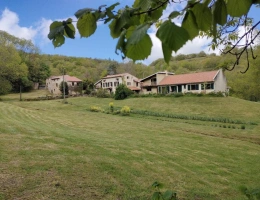
The market for a goat farm for sale in Ariège stays narrow, yet it regularly attracts newcomers drawn by a pastoral department where grass is plentiful, ground costs less than on the Toulouse plain and cheesemaking on the farm is widely practised. What comes to market is entrusted by breeders arranging their succession, by agencies specialising in rural estates and by notaries in Foix, Saint-Girons or Pamiers; the descriptions give herd size, the nature of the building, the milking equipment, whether a cheese room exists and how the grazing is reached. They are listed alongside the rest of our goat farms for sale nationwide.
Beyond the description, this page supplies the missing benchmarks: the scale of land values in Ariège, the valleys where a holding comes free, the building condition commonly met, and the controls attached to processing and to mountain grazing. To lay the groundwork for your project, open our white paper « Créer une exploitation agricole » (in French).
Land weighs heavily on the budget for a goat farm. Transfers published by the French tax authorities (DVF, excluding vineyards) put the median for farmland in Ariège (09) at €7,533/ha in 2025, with an average of €7,099/ha over 26 sales. Eight transactions in ten settle between €3,541 and €9,991/ha, where the national median is €5,307/ha. * Fewer than 30 recorded sales: indicative value.
A second reference, the SAFER land value benchmark, sets vacant land and pasture at €5,900/ha for 2025, +0.7% in a year and +7.7% over a decade; the French average is €6,460/ha, and a sitting tenant costs a plot roughly 17% of its value.
In this market the working tool weighs more than the acreage: housing and bedded area, milking parlour and milk room, forage store, shelters and fencing on the grazing, an access road usable in winter, then make room, drying room, ripening cellar and sales point. The herd counts through its breeds, its hardiness and its health record; the goodwill, through a customer base built on markets, in producers' shops and among tourist accommodation. Weigh that against the figures in our land price observatory and run the numbers with our financial calculators.
Buildings here are usually modest: timber or sheet structures set against the slope, former sheepfolds taken over, stone barns converted with a hayloft above the animals. Altitude and snow steer the inspection towards the frame, the load-bearing capacity of the roof, insulation of the milk room, frost protection of the services and whether the access holds up in winter. Then come the milking plant, generally sized for a small herd, hay storage capacity, often bought in from the lowlands, and effluent handling on sloping ground where spreading gets complicated.
Nearly every unit processes on site. Make room, drying room, ripening cellar, cold store and sales point carry most of the added value, and their compliance determines whether trading can continue immediately after the handover. The customer base, frequently built across several weekly markets, passes on with the goodwill. Where the sale covers the house, the barns and the meadows, ask for a precise breakdown: in well-served valleys and near the ski resorts, residential value rises independently of the farming asset.
The Couserans, around Saint-Girons, Massat and Castillon-en-Couserans, holds most of the goat units, with small structures, summer pastures and scattered settlement. The Séronais, towards La Bastide-de-Sérou, and the Ariège valley, from Foix to Tarascon-sur-Ariège and Ax-les-Thermes, offer valley-floor meadows and high grazing. The Pays d'Olmes, around Lavelanet and Mirepoix, combines hillsides and hedged country. The lower Ariège and the Lèze valley, towards Pamiers and Saverdun, belong to lowland farming where crops make parcels far more contested.
The department holds no protected goat cheese designation, so everything turns on short chains: weekly markets at Saint-Girons, Foix, Mirepoix and Pamiers, producers' shops, and visitors in both the summer and the ski season. That reliance on short chains makes location decisive: a goat cheese farm poorly served in winter forces a complete rethink of the delivery rounds.
Small numbers often place a unit under the departmental health regulation rather than the classified installations regime, the French environmental permitting system, but the threshold must be checked against the official nomenclature, and any planned expansion calls for declaration or registration. Since processing carries the value, the food safety file is central: safety management plan, approval or direct-sale exemption, own-checks, raw milk traceability, and compliance of the cellar and drying room. Have the herd's status for CAEV, the caprine arthritis-encephalitis virus, and for paratuberculosis set out as well.
Mountain land calls for careful reading: fragmented parcels, commune-held sections, summer pastures entrusted to pastoral groupings, grazing agreements that do not necessarily follow the sale. Check the status of every area, the landlords' agreement for leases to continue, the structures control, the French authorisation regime for taking over farmland, and SAFER's involvement. Predation, a long-standing reality in this range, finally makes it worth assessing the protective measures in place and the labour they absorb.
Sellers, rural property agencies and local notaries publish the holdings shown here. Select by meadow area, by budget or by processing capacity, then set up an e-mail alert, since supply is thin and openings come round infrequently. Passing on your own herd? Post the listing. Continue with goat farms for sale in Occitanie.