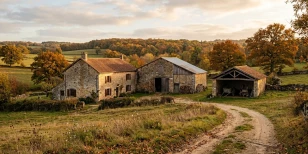

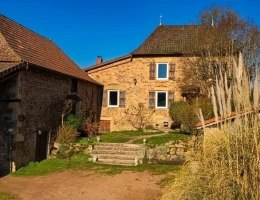
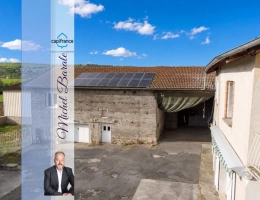
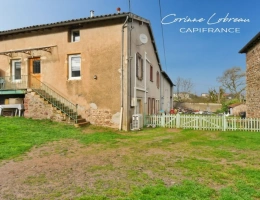
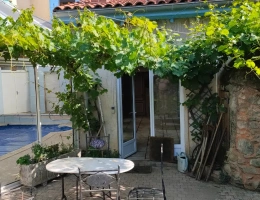
Buying a mill for sale in Rhône (69) means choosing a department where the Beaujolais hills, the Monts du Lyonnais and the Lyon conurbation share a network of modest but numerous rivers: the Azergues, Brévenne, Turdine and Garon once powered watermills for flour and fulling mills linked to the former Lyon silk-weaving industry. On this page, ma-propriete.fr brings together the mills for sale in Rhône: watermills in golden stone to restore, former flour mills, and millers' houses with outbuildings.
You will also find price benchmarks based on actual sales, an overview of the areas where these properties are concentrated, and the specific points to check before buying a mill. To prepare your project, read our guide to buying a country house in France, whose advice on old buildings, outbuildings and financing applies fully to a mill.
There are no official statistics dedicated to mills: sales are too rare and too varied (a ruin to restore, a habitable mill, a flour mill with a turbine). The most reliable market benchmark remains the price of country houses, which a habitable mill resembles, with a premium for the water, the character and the water rights, and a discount for the work required.
How much does a country house cost in Rhône (69)? According to DVF data (notarised sales) analysed by the ma-propriete.fr observatory, the median price of a country house in Rhône (69) stood at €285,700 in 2025, with an average price of €290,903 and a median price of €2,664/m² of living space (952 house sales in rural municipalities over the year). The price range is wide: 10% of houses sold for less than €145,000 (floor price, 1st decile) and 10% for more than €441,728 (ceiling price, 9th decile). The typical country house here offers 113 m² of living space on an average plot of 2,430 m², i.e. around 0.2 ha.
This market is well above the regional median (Auvergne-Rhône-Alpes: €230,000) and well above the national median (€189,200). Since the second half of 2020, the median price has risen from €253,000 to €285,700, i.e. +12.9%; over one year (2024-2025) the change is +4.9%.
| 2025 indicator | Rhône | Auvergne-Rhône-Alpes | France |
|---|---|---|---|
| Median price | €285,700 | €230,000 | €189,200 |
| Average price | €290,903 | €246,927 | €207,100 |
| Floor price (1st decile) | €145,000 | €98,000 | €90,000 |
| Ceiling price (9th decile) | €441,728 | €410,000 | €340,000 |
| Median price per m² of living space | €2,664/m² | €2,200/m² | €1,830/m² |
| Average living space | 113 m² | 109 m² | 108 m² |
| Average plot size | 2,430 m² | 3,243 m² | 3,181 m² |
| Number of sales in 2025 | 952 | 16,528 | 150,313 |
A departmental average hides large gaps. A smallholding to renovate, a restored longère with its outbuildings, a farmhouse on several hectares of land or a manor house with parkland do not sell at the same price, and the location matters as much as the building: coastline, tourist area, peri-urban countryside close to a job market or deep countryside. The table below shows the median price of country houses in Rhône (69) by type of municipality (cumulative sales from mid-2020 to 2025) and its change between 2021 and 2025.
| Type of municipality | Median price 2020-2025 | Median price per m² | Change 2021-2025 | Sales 2020-2025 |
|---|---|---|---|---|
| Inland tourist areas (hinterland, mountains) * | €139,800 | €1,420/m² | +9.6% | 38 |
| Peri-urban countryside (city catchment area) | €328,500 | €3,018/m² | -1.1% | 3,167 |
| Deep countryside (outside urban influence) | €230,000 | €2,152/m² | +2.1% | 2,488 |
* Between 30 and 99 sales: indicative value.
These benchmarks help you assess a listing, estimate a property before putting it up for sale, or set your budget for a holiday home or a permanent move to the French countryside. To go further, see our observatory of country house prices in France (national, regional and departmental analysis, downloadable annual report) and work out the full cost of your purchase, including French notary fees, with our notary fees calculator.
Rural Rhône is organised around the Azergues, which flows through the green Beaujolais hills between Lamure-sur-Azergues and Anse, the Brévenne and Turdine rivers in the Monts du Lyonnais, and the Garon and Yzeron, closer to Lyon. These modest, upland rivers with steady flows powered many watermills for flour, often built in the golden stone characteristic of the Beaujolais.
The Brévenne valley and the Lyon basin also saw fulling mill and weaving activity linked to the rise of the Lyon silk industry, which left a number of industrial buildings now converted to other uses. Windmills, for their part, are absent from the department, since the hilly relief offered enough rivers to favour water power throughout.
The green Beaujolais area, around Lamure-sur-Azergues, Chénelette and Cours-la-Ville, concentrates former watermills valued for their wooded, hilly setting. The Monts du Lyonnais, around Sainte-Foy-l'Argentière and L'Arbresle, offer mill buildings close to the railway station and the Lyon conurbation. The wine-growing Beaujolais, around Villefranche-sur-Saône and Beaujeu, completes the offering with golden-stone mills in the heart of the vineyards. Buyers should also expect competition from Lyon-based professionals seeking a countryside second home within easy commuting distance of the city.
Areas close to Lyon and the Beaujolais vineyards, in high demand, command prices notably above the regional average. Conversely, the green Beaujolais and the upper Monts du Lyonnais, more remote, remain more affordable for a watermill to renovate. The immediate proximity of the Lyon metropolitan area, France's second-largest economic centre, keeps sustained land pressure on rural communes across the department, mills included.
Check the existence and scope of the water rights (a mill fondé en titre or holding an authorisation), the condition of the millrace, weir and sluice gates, and the ecological-continuity obligations on the Azergues, Brévenne and Turdine rivers, which are prone to sudden flooding during storms. Original water wheels and millstones, where they survive, are a heritage asset, but restoring them has a cost. A prior assessment by a specialist in older buildings is strongly advisable.
As for the building, the golden stone of the Beaujolais, under flat-tile roofing, requires attention to damp and flood zoning at the bottom of the valley. Outbuildings (barn, former workshop) make it possible to plan a gîte, an activity in demand both close to the Lyon conurbation and near the vineyards and hiking trails of the Beaujolais. It is also worth checking the planning rules that apply on hillside land, common in the wine-growing Beaujolais where several communes have listed their landscapes.
On ma-propriete.fr, mill listings in Rhône are published by private sellers, estate agents and notaries. Filter by budget, living space and land area, set up an email alert to be told of new listings, and browse all mills for sale in Auvergne-Rhône-Alpes if your search extends beyond the department.