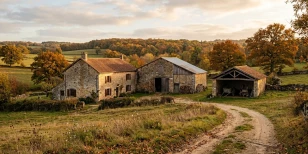

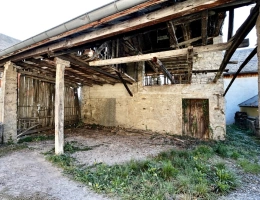
Looking for a mill for sale in Savoie (73) means stepping outside the lowland template: here the water comes from alpine torrents, and mills line the steep valleys of the Arc, the Isère, the Doron and the Guiers, more often paired with a sawmill or a small forge than with a large flour mill. On this page, ma-propriete.fr brings together the mills for sale in Savoie: former valley watermills, miller's houses converted into homes, and mill ruins with a millrace still waiting to be restored. These properties, far fewer than in lowland departments, stand out for their valley-floor setting and their mountain stone architecture.
You will also find price benchmarks based on actual sales, an overview of where these buildings still stand, and the specific points to check on a mountain mill, from water rights to exposure to flash floods. To frame your project, read our white paper on creating a rural gîte, particularly useful if you plan to let the outbuildings of a former Savoie mill, in a department where alpine tourist demand stays strong year-round.
There are no official statistics dedicated to mills: sales are too rare and too varied (a ruin to restore, a habitable mill, a flour mill with a turbine). The most reliable market benchmark remains the price of country houses, which a habitable mill resembles, with a premium for the water, the character and the water rights, and a discount for the work required.
How much does a country house cost in Savoie (73)? According to DVF data (notarised sales) analysed by the ma-propriete.fr observatory, the median price of a country house in Savoie (73) stood at €320,205 in 2025, with an average price of €336,636 and a median price of €3,100/m² of living space (888 house sales in rural municipalities over the year). The price range is wide: 10% of houses sold for less than €180,000 (floor price, 1st decile) and 10% for more than €523,018 (ceiling price, 9th decile). The typical country house here offers 109 m² of living space on an average plot of 2,520 m², i.e. around 0.3 ha.
This market is well above the regional median (Auvergne-Rhône-Alpes: €230,000) and well above the national median (€189,200). Since the second half of 2020, the median price has risen from €256,500 to €320,205, i.e. +24.8%; over one year (2024-2025) the change is +6.8%.
| 2025 indicator | Savoie | Auvergne-Rhône-Alpes | France |
|---|---|---|---|
| Median price | €320,205 | €230,000 | €189,200 |
| Average price | €336,636 | €246,927 | €207,100 |
| Floor price (1st decile) | €180,000 | €98,000 | €90,000 |
| Ceiling price (9th decile) | €523,018 | €410,000 | €340,000 |
| Median price per m² of living space | €3,100/m² | €2,200/m² | €1,830/m² |
| Average living space | 109 m² | 109 m² | 108 m² |
| Average plot size | 2,520 m² | 3,243 m² | 3,181 m² |
| Number of sales in 2025 | 888 | 16,528 | 150,313 |
A departmental average hides large gaps. A smallholding to renovate, a restored longère with its outbuildings, a farmhouse on several hectares of land or a manor house with parkland do not sell at the same price, and the location matters as much as the building: coastline, tourist area, peri-urban countryside close to a job market or deep countryside. The table below shows the median price of country houses in Savoie (73) by type of municipality (cumulative sales from mid-2020 to 2025) and its change between 2021 and 2025.
| Type of municipality | Median price 2020-2025 | Median price per m² | Change 2021-2025 | Sales 2020-2025 |
|---|---|---|---|---|
| Residential coastline | €395,500 | €3,719/m² | +9.2% | 379 |
| Inland tourist areas (hinterland, mountains) | €280,900 | €3,018/m² | +17.3% | 1,108 |
| Peri-urban countryside (city catchment area) | €300,970 | €2,833/m² | +12.1% | 2,491 |
| Deep countryside (outside urban influence) | €262,250 | €2,569/m² | +17.7% | 1,230 |
Note: in Savoie (73), the municipalities classified as "coastline" have no access to the sea. They are municipalities bordering lakes of more than 1,000 hectares (or, in Eure, the Seine estuary) covered by the 1986 Loi Littoral, which also applies to such inland lakes and estuaries.
These benchmarks help you assess a listing, estimate a property before putting it up for sale, or set your budget for a holiday home or a permanent move to the French countryside. To go further, see our observatory of country house prices in France (national, regional and departmental analysis, downloadable annual report) and work out the full cost of your purchase, including French notary fees, with our notary fees calculator.
In Savoie, the terrain sets the pace: mills were built on diversions of mountain torrents and rivers, the Arc in the Maurienne valley, the Isère in the Tarentaise and the Combe de Savoie, the Doron near Bozel and Beaufort, the Guiers in the Chartreuse massif and the Chéran in the Bauges. These small watermills were often used for several successive purposes, grinding grain, threshing, sawing wood, before being abandoned or turned into homes. Many have lost their original machinery but keep a clearly recognisable millrace, sometimes still fed by a working intake on the neighbouring torrent.
Windmills are almost absent from the department, as the terrain and local winds do not favour them. The properties closest to a lowland flour mill are former grain mills built at the bottom of a valley, close to a village, whose stone structure and part of the machinery sometimes survive. A few former hydraulic sawmills, tied to the forestry use of the slopes, complete this distinctive mountain building stock.
The Combe de Savoie, between Albertville and Chambéry, has the largest number of former valley mills, with easy access to the Chambéry-Challes-les-Eaux railway station and the motorways towards Grenoble and Annecy. In the Maurienne valley, around Saint-Jean-de-Maurienne and Aiguebelle, mill remains are mostly found on tributaries of the Arc, in hamlets still marked by the valley's former farming and metalworking activity. The Tarentaise valley, near Moûtiers and Bozel, and the Bauges massif offer more isolated examples, often linked to remote former farming hamlets.
Areas close to Aix-les-Bains and Lac du Bourget, as well as the outskirts of Chambéry, sit well above the departmental average, driven by both residential and tourist demand. The more remote valleys of the Maurienne and mid-mountain hamlets remain the most affordable for a mill to renovate, provided buyers accept a substantial restoration project.
A mountain mill comes with its own hydraulic constraints: check for existing water rights or a fondé en titre status, the condition of the intake, the millrace and sluice gates, and the ecological-continuity rules that apply to classified torrents, increasingly strict across the Alps. A small hydroelectric turbine project is sometimes possible but needs a prior technical and administrative study, since alpine torrent flow varies sharply between spring snowmelt floods and a marked winter low-water period.
On the building itself, watch for damp in a narrow valley bottom, flash-flood risk rather than slow lowland flooding, and the condition of the stone outbuildings, sometimes former barns or farm sheds. Being close to a hamlet, these properties are well suited to a mountain gîte project given the strength of alpine tourism, in both summer and winter.
On ma-propriete.fr, mill listings in Savoie are published by private sellers, estate agents and notaries. Filter by budget, living space and land area, set up an email alert to be told of new listings, and browse all mills for sale in Auvergne-Rhône-Alpes if your search extends beyond the department.