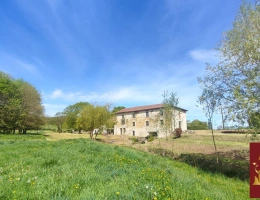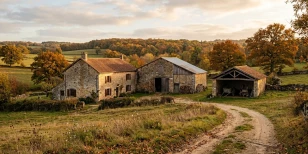
Buying a mill for sale in Ain (01) means choosing a department crossed by many rivers, between the Bresse, Dombes, Bugey and Revermont areas: the Ain, Reyssouze, Suran, Veyle and Albarine rivers powered millstones and flour mills well into the 20th century. On this page, ma-propriete.fr brings together the mills for sale in the department: watermills to renovate by a riverbank, former flour mills from the Bresse plain, and miller's houses with their outbuildings.
You will also find price benchmarks based on actual sales, an overview of the areas where these properties are concentrated in Ain, and the points to check before buying. To prepare your project, read our guide to setting up a rural gîte, especially useful if you are considering turning a mill's outbuildings into guest accommodation. Our listings clearly distinguish habitable properties from ruins needing full reconstruction, an important distinction for a mill.
There are no official statistics dedicated to mills: sales are too rare and too varied (a ruin to restore, a habitable mill, a flour mill with a turbine). The most reliable market benchmark remains the price of country houses, which a habitable mill resembles, with a premium for the water, the character and the water rights, and a discount for the work required.
How much does a country house cost in Ain (01)? According to DVF data (notarised sales) analysed by the ma-propriete.fr observatory, the median price of a country house in Ain (01) stood at €257,221 in 2025, with an average price of €264,997 and a median price of €2,356/m² of living space (2,088 house sales in rural municipalities over the year). The price range is wide: 10% of houses sold for less than €147,940 (floor price, 1st decile) and 10% for more than €388,780 (ceiling price, 9th decile). The typical country house here offers 115 m² of living space on an average plot of 2,489 m², i.e. around 0.2 ha.
This market is above the regional median (Auvergne-Rhône-Alpes: €230,000) and well above the national median (€189,200). Since the second half of 2020, the median price has risen from €220,975 to €257,221, i.e. +16.4%; over one year (2024-2025) the change is +3.7%.
| 2025 indicator | Ain | Auvergne-Rhône-Alpes | France |
|---|---|---|---|
| Median price | €257,221 | €230,000 | €189,200 |
| Average price | €264,997 | €246,927 | €207,100 |
| Floor price (1st decile) | €147,940 | €98,000 | €90,000 |
| Ceiling price (9th decile) | €388,780 | €410,000 | €340,000 |
| Median price per m² of living space | €2,356/m² | €2,200/m² | €1,830/m² |
| Average living space | 115 m² | 109 m² | 108 m² |
| Average plot size | 2,489 m² | 3,243 m² | 3,181 m² |
| Number of sales in 2025 | 2,088 | 16,528 | 150,313 |
A departmental average hides large gaps. A smallholding to renovate, a restored longère with its outbuildings, a farmhouse on several hectares of land or a manor house with parkland do not sell at the same price, and the location matters as much as the building: coastline, tourist area, peri-urban countryside close to a job market or deep countryside. The table below shows the median price of country houses in Ain (01) by type of municipality (cumulative sales from mid-2020 to 2025) and its change between 2021 and 2025.
| Type of municipality | Median price 2020-2025 | Median price per m² | Change 2021-2025 | Sales 2020-2025 |
|---|---|---|---|---|
| Inland tourist areas (hinterland, mountains) | €200,000 | €1,918/m² | +4.5% | 250 |
| Peri-urban countryside (city catchment area) | €250,000 | €2,325/m² | +4.0% | 8,023 |
| Deep countryside (outside urban influence) | €243,000 | €2,259/m² | +13.1% | 3,496 |
These benchmarks help you assess a listing, estimate a property before putting it up for sale, or set your budget for a holiday home or a permanent move to the French countryside. To go further, see our observatory of country house prices in France (national, regional and departmental analysis, downloadable annual report) and work out the full cost of your purchase, including French notary fees, with our notary fees calculator.
The Ain river, canalised in places between Pont-d'Ain and its confluence with the Rhône, the Reyssouze near Bourg-en-Bresse, the Suran in the Revermont hills and the Albarine in the Bugey area once drove a large number of watermills with their millstones, many now converted into homes, some keeping their original water wheel. Bresse also has larger former flour mills, tied to its grain and poultry-farming tradition. Proximity to Lyon, less than an hour away via the A42 motorway, also adds to the appeal of these properties for city buyers looking for a country base. Prices for such properties vary widely depending on the state of the machinery and the size of the land attached to the mill.
The Dombes plateau, a land of a thousand ponds, has almost no mills at all: its terrain was shaped for fish farming rather than the power of running water. Windmills are likewise almost absent from the department, for want of open, sufficiently windy plateaus. Some former mills in the Ain valley were converted into small hydroelectric plants as early as the start of the 20th century, a use that a few owners still maintain today.
The Ain valley around Pont-d'Ain and Priay offers a wooded, hilly setting well suited to a habitable mill. In the Bugey area, the surroundings of Belley and Ambérieu-en-Bugey, a rail hub towards Lyon and Geneva, combine accessibility with hydraulic heritage. The Revermont area, around Treffort-Cuisiat and Pont-de-Vaux on the Bresse side, remains a rural area where former watermills survive on the Suran and Reyssouze rivers. The wet meadows that often border these rivers shelter protected wildlife, whose presence can affect certain landscaping plans.
Properties near Bourg-en-Bresse or the Pays de Gex, within reach of the Geneva basin, sell well above the departmental average. Conversely, isolated mills in deep Bresse or the Revermont, often needing renovation, remain among the most affordable in the region. Between the two, the Revermont hills and the Bugey foothills form an intermediate zone, valued for its rolling countryside without the price pressure of the Geneva basin.
As everywhere, a mill is bought together with its water: check the existence of the water rights (a mill fondé en titre or holding an authorisation), the condition of the millrace, weir and sluice gates, and the ecological-continuity obligations on classified rivers such as the Ain or the Albarine. A hydroelectric project using a turbine requires a prior technical and administrative study, often a lengthy one on these fish-sensitive rivers. Part of the Albarine river and its tributaries is classified for fish-passage requirements, rules worth checking before committing to a turbine project.
As for the buildings, Bresse favours rammed earth and timber framing under clay tile, while Bugey and Revermont use more local stone: check for damp at the bottom of the valley, drainage and flood zoning. The farm outbuildings, often generous in Bresse, lend themselves well to a gîte project. A structural survey of the wheel and hydraulic building, carried out by a specialist, helps assess the real cost of restoration before signing. Local estate agents in Bourg-en-Bresse and Belley often handle these niche properties alongside more conventional farmhouses.
On ma-propriete.fr, mill listings in Ain are published by private sellers, estate agents and notaries. Filter by budget, living space and land area, set up an email alert to be told of new listings, and browse all mills for sale in Auvergne-Rhône-Alpes if your search extends beyond the department. It is also worth comparing mills with traditional Bresse farmhouses, often listed in the same areas.