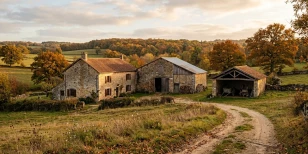

Buying a mill for sale in Loire (42) means looking at a department shaped by the Loire river itself and by its tributaries in the Forez and Roanne areas: the Lignon du Forez, the Rhins and the Sornin around Roanne, and the Coise and Furan towards the Monts du Lyonnais and Saint-Étienne, once powered numerous watermills and flour mills. On this page, ma-propriete.fr brings together the mills for sale in Loire: watermills to renovate, former flour mills and millers' houses with their outbuildings.
You will also find price benchmarks based on actual sales, an overview of the areas where these properties are concentrated, and the points to check before buying a mill. To prepare your project, read our guide to buying a country house in France, whose advice on old buildings, outbuildings and financing applies fully to a mill. The textile-industry heritage of the Roanne area also explains why some mills stand near former factories or industrial wasteland, which can influence a property's immediate surroundings.
There are no official statistics dedicated to mills: sales are too rare and too varied (a ruin to restore, a habitable mill, a flour mill with a turbine). The most reliable market benchmark remains the price of country houses, which a habitable mill resembles, with a premium for the water, the character and the water rights, and a discount for the work required.
How much does a country house cost in Loire (42)? According to DVF data (notarised sales) analysed by the ma-propriete.fr observatory, the median price of a country house in Loire (42) stood at €205,000 in 2025, with an average price of €205,173 and a median price of €1,957/m² of living space (1,565 house sales in rural municipalities over the year). The price range is wide: 10% of houses sold for less than €108,000 (floor price, 1st decile) and 10% for more than €308,300 (ceiling price, 9th decile). The typical country house here offers 109 m² of living space on an average plot of 3,352 m², i.e. around 0.3 ha.
This market is below the regional median (Auvergne-Rhône-Alpes: €230,000) and above the national median (€189,200). Since the second half of 2020, the median price has risen from €178,460 to €205,000, i.e. +14.9%; over one year (2024-2025) the change is +3.5%.
| 2025 indicator | Loire | Auvergne-Rhône-Alpes | France |
|---|---|---|---|
| Median price | €205,000 | €230,000 | €189,200 |
| Average price | €205,173 | €246,927 | €207,100 |
| Floor price (1st decile) | €108,000 | €98,000 | €90,000 |
| Ceiling price (9th decile) | €308,300 | €410,000 | €340,000 |
| Median price per m² of living space | €1,957/m² | €2,200/m² | €1,830/m² |
| Average living space | 109 m² | 109 m² | 108 m² |
| Average plot size | 3,352 m² | 3,243 m² | 3,181 m² |
| Number of sales in 2025 | 1,565 | 16,528 | 150,313 |
A departmental average hides large gaps. A smallholding to renovate, a restored longère with its outbuildings, a farmhouse on several hectares of land or a manor house with parkland do not sell at the same price, and the location matters as much as the building: coastline, tourist area, peri-urban countryside close to a job market or deep countryside. The table below shows the median price of country houses in Loire (42) by type of municipality (cumulative sales from mid-2020 to 2025) and its change between 2021 and 2025.
| Type of municipality | Median price 2020-2025 | Median price per m² | Change 2021-2025 | Sales 2020-2025 |
|---|---|---|---|---|
| Inland tourist areas (hinterland, mountains) | €149,000 | €1,435/m² | +12.0% | 262 |
| Peri-urban countryside (city catchment area) | €205,000 | €1,950/m² | +13.2% | 5,101 |
| Deep countryside (outside urban influence) | €190,000 | €1,831/m² | +1.2% | 3,621 |
These benchmarks help you assess a listing, estimate a property before putting it up for sale, or set your budget for a holiday home or a permanent move to the French countryside. To go further, see our observatory of country house prices in France (national, regional and departmental analysis, downloadable annual report) and work out the full cost of your purchase, including French notary fees, with our notary fees calculator.
The Lignon du Forez, flowing down from the Forez mountains to the plain before joining the Loire near Feurs, fed numerous watermills tied to grain and local weaving. Around Roanne, the Rhins, Sornin and Oudan rivers, in the steep valleys of the Roanne area and neighbouring Beaujolais, still hold former flour mills and fulling mills linked to the textile trade. Several of these mills still have an original metal or wooden wheel, installed during the late-19th-century modernisation campaigns.
Near Saint-Étienne, the steep Furan and its tributaries mainly powered mills and forges tied to metalworking rather than flour alone. Windmills are practically absent from the department, since the mountainous relief and abundant rivers made water power largely sufficient.
The Forez plain, around Feurs, Montbrison and Boën-sur-Lignon, offers the largest number of habitable mills, with easy access to the A72 motorway and Saint-Étienne railway station. The Roanne area, between Roanne and the neighbouring Beaujolais vineyards, appeals to buyers seeking character mills in golden stone. The more remote Monts du Forez and Monts du Lyonnais offer isolated properties to renovate, in a mid-mountain setting. Proximity to Lyon, under an hour's drive from the Roanne area, widens the pool of potential buyers. The Roanne area also benefits from the nearby Côte Roannaise vineyard, an added asset for a guest-room project around a former mill.
Mills near Montbrison or the Lignon valley, with easy access, sell for more than those in the Monts du Forez, which are more isolated and often sold needing more work. Mills at the bottom of a gorge, harder to access, remain among the most affordable properties in the department for a buyer willing to invest in improving road access.
On the Lignon as on the Rhins, check the mill's water rights — fondé en titre or authorised — and the condition of the weir, spillway and sluice gates: ecological continuity is closely monitored on these classified trout rivers. The Forez's steep relief exposes some valley-bottom mills to fast flooding and flood zoning that should be checked. The local water and territory authorities can usefully be consulted beforehand to confirm the precise classification of a given river.
Original machinery — water wheel, millstone, gearing — is an asset for a hydroelectric project using a small turbine, subject to a prior study. Outbuildings in volcanic or granite stone lend themselves to a gîte project, a growing activity around the Forez and the Monts du Lyonnais. The flat-tile roofs typical of the Forez region require particular expertise for their upkeep or replacement.
On ma-propriete.fr, mill listings in Loire are published by private sellers, estate agents and notaries. Filter by budget, living space and land area, set up an email alert to be told of new listings, and browse all mills for sale in Auvergne-Rhône-Alpes if your search extends beyond the department. Because the market here is smaller than in the Rhône valley proper, comparing several listings before making an offer is particularly useful. Local notaries in Feurs and Roanne often have early knowledge of upcoming mill sales before they reach the open market. Booking a visit outside the wettest months makes it much easier to judge how the river, the weir and the surrounding land actually behave through the seasons.