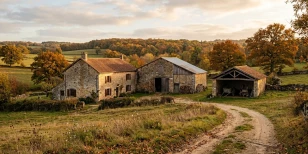

Looking for a mill for sale in Drôme (26) means exploring a department of contrasts, spanning the Rhône valley, the hills of the Diois and Drôme provençale: it has former watermills along the Drôme, Roubion, Eygues and Bourne rivers, as well as many old oil mills inherited from the local olive and walnut growing tradition, two crops that still shape the department's economy today. On this page, ma-propriete.fr brings together the mills for sale in Drôme: watermills to restore, former flour mills, olive mills or millers' houses with their millrace.
You will also find price benchmarks based on actual sales, an overview of the areas where these properties are concentrated, and the specific points to check before buying a mill, from water rights to flood risk. To prepare your project, read our white paper on setting up a rural gîte, especially useful if you plan to convert a Drôme mill's outbuildings into visitor accommodation, whether a bed and breakfast or a self-catering cottage.
There are no official statistics dedicated to mills: sales are too rare and too varied (a ruin to restore, a habitable mill, a flour mill with a turbine). The most reliable market benchmark remains the price of country houses, which a habitable mill resembles, with a premium for the water, the character and the water rights, and a discount for the work required.
How much does a country house cost in Drôme (26)? According to DVF data (notarised sales) analysed by the ma-propriete.fr observatory, the median price of a country house in Drôme (26) stood at €283,800 in 2025, with an average price of €291,447 and a median price of €2,631/m² of living space (1,335 house sales in rural municipalities over the year). The price range is wide: 10% of houses sold for less than €172,120 (floor price, 1st decile) and 10% for more than €420,880 (ceiling price, 9th decile). The typical country house here offers 114 m² of living space on an average plot of 3,508 m², i.e. around 0.4 ha.
This market is well above the regional median (Auvergne-Rhône-Alpes: €230,000) and well above the national median (€189,200). Since the second half of 2020, the median price has risen from €255,141 to €283,800, i.e. +11.2%; over one year (2024-2025) the change is +2.2%.
| 2025 indicator | Drôme | Auvergne-Rhône-Alpes | France |
|---|---|---|---|
| Median price | €283,800 | €230,000 | €189,200 |
| Average price | €291,447 | €246,927 | €207,100 |
| Floor price (1st decile) | €172,120 | €98,000 | €90,000 |
| Ceiling price (9th decile) | €420,880 | €410,000 | €340,000 |
| Median price per m² of living space | €2,631/m² | €2,200/m² | €1,830/m² |
| Average living space | 114 m² | 109 m² | 108 m² |
| Average plot size | 3,508 m² | 3,243 m² | 3,181 m² |
| Number of sales in 2025 | 1,335 | 16,528 | 150,313 |
A departmental average hides large gaps. A smallholding to renovate, a restored longère with its outbuildings, a farmhouse on several hectares of land or a manor house with parkland do not sell at the same price, and the location matters as much as the building: coastline, tourist area, peri-urban countryside close to a job market or deep countryside. The table below shows the median price of country houses in Drôme (26) by type of municipality (cumulative sales from mid-2020 to 2025) and its change between 2021 and 2025.
| Type of municipality | Median price 2020-2025 | Median price per m² | Change 2021-2025 | Sales 2020-2025 |
|---|---|---|---|---|
| Inland tourist areas (hinterland, mountains) | €257,585 | €2,491/m² | -0.3% | 874 |
| Peri-urban countryside (city catchment area) | €287,000 | €2,611/m² | +3.9% | 4,634 |
| Deep countryside (outside urban influence) | €265,760 | €2,574/m² | +7.1% | 2,680 |
These benchmarks help you assess a listing, estimate a property before putting it up for sale, or set your budget for a holiday home or a permanent move to the French countryside. To go further, see our observatory of country house prices in France (national, regional and departmental analysis, downloadable annual report) and work out the full cost of your purchase, including French notary fees, with our notary fees calculator.
Drôme is mostly a land of watermills, built on rivers flowing down from the pre-Alps: the Drôme itself between Die and Crest, the Roubion near Montélimar, the Eygues around Nyons, and the Bourne on the border with Isère. These mills ground grain but were just as often used to press olives or crack walnuts, two crops emblematic of Drôme provençale and the Diois, where old stone buildings still stand beside a feeder channel.
Windmills are almost non-existent here, since relief and hydrography have always favoured water power over wind. Traditional oil mills, on the other hand, often attached to a bastide or mas farmhouse, form a distinct category of property much sought after by olive-oil lovers, walnut growers and rural tourism buyers wanting to combine heritage buildings with a working activity. Some also retain their original stone press or vat, a rare detail that adds to their historic value, along with the occasional carved lintel dating the building.
Around Die and the Drôme valley, between Saillans and Crest, former watermills sit alongside clairette vineyards and lavender fields on the first foothills of the Vercors. Near Nyons and Buis-les-Baronnies, olive oil mills dominate a landscape of hills and intermittent streams typical of the Baronnies provençales. To the north, the Romans-sur-Isère area and the Isère valley give quick access to Valence TGV station, while the Vercors around Die keeps a more mountainous, forested character, popular with hikers and climbers.
Properties near Valence, Montélimar and along the Rhône corridor are clearly above the departmental average because of their accessibility and the land pressure typical of the Rhône axis. Isolated mills in the Diois or the Baronnies, harder to reach, remain comparatively more affordable, at the cost of a winding mountain road to get there and a longer drive to the nearest shops and services.
Always check the existence and scope of the water rights attached to the mill, the condition of the millrace, weir and sluice gates, and the ecological-continuity obligations that apply to several classified rivers in the department, including stretches of the Drôme itself. A hydroelectric project using a small turbine requires a prior study with the relevant authorities, as Drôme has several rivers sensitive for fish populations, particularly brown trout, and any works on the riverbed need prior clearance from the water police.
The building, in limestone or river-cobble depending on the area, needs particular attention to damp and to flood zoning in valley bottoms, a well-known risk in the Diois during heavy-rain episodes. Outbuildings (annexe farmhouse, barn, bread oven) often lend themselves to a gîte project, a well-established activity in touristic Drôme, between Provençal markets and hiking trails, provided the septic system and access road are also checked before committing to the project.
On ma-propriete.fr, mill listings in Drôme are published by private sellers, estate agents and notaries. Filter by budget, living space and land area, set up an email alert to be told of new listings, and browse all mills for sale in Auvergne-Rhône-Alpes if your search extends beyond the department, for instance towards neighbouring Ardèche or southern Isère, both sharing a similar landscape.