

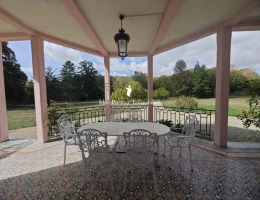
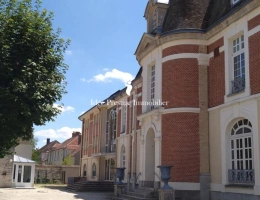
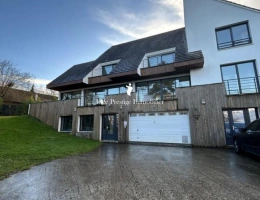
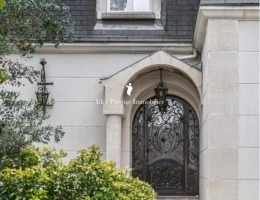
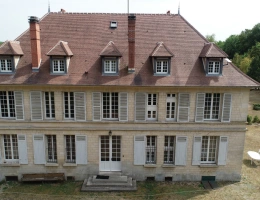
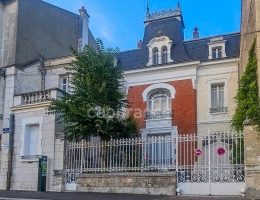
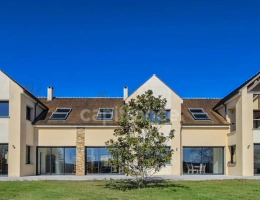
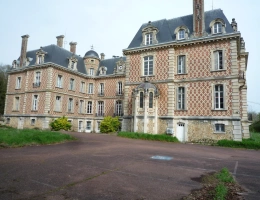
A manor house for sale in Île-de-France is mostly found in the outer ring, in the still-rural valleys of Seine-et-Marne, Yvelines, Essonne and Val-d'Oise, where noble residences of stone and brick from the fifteenth to eighteenth centuries survive. The inner ring, heavily built up, has almost no rural stock of this kind left. Regional listings range from restored manors on the edge of forests to residences awaiting renovation with their farm outbuildings. Browse the manor houses for sale listed by the region's private owners, agencies and notaries.
This page gives real price benchmarks for residences across the Paris region, the departments where rural supply genuinely survives, what sets one area's building style apart from another, and the checks specific to an old residence close to the capital. To approach the purchase of a character property as a whole, read our guide to buying prestige property in France. Given how limited genuine rural supply has become this close to Paris, buyers who move quickly on a well-priced listing tend to fare best.
DVF land registry data does not identify manor houses as such: the benchmarks below cover sales of houses over 300 m² of living space on 0.05 to 10 ha, above €1,000/m², tracked by our observatory. They frame the market for large residences without describing it entirely: an estate with 30 ha of parkland or a listed monument sold with its farmland falls outside this scope.
In Île-de-France, 90 sales were recorded in 2025, with a median price of €1,445,000*, a floor/ceiling range (P10–P90) of €700,000 to €3,496,500 and a median of €4,247/m² of living space (average 366 m² of living space on 7,207 m² of land). Over five years (2021-2025), the regional median comes to €1,263,100 across 592 sales. Nationally, the 2025 median stands at €822,000 across 981 sales, with a ceiling (P90) of €3,100,000.
| Scope | Sales | Median price | Floor – ceiling (P10–P90) | €/m² living space (median) |
|---|---|---|---|---|
| Île-de-France (2025) | 90 | €1,445,000* | €700,000 – €3,496,500 | 4,247 |
| Île-de-France (2021-2025) | 592 | €1,263,100 | €601,200 – €2,988,300 | 3,363 |
| France (2025) | 981 | €822,000 | €428,000 – €3,100,000 | 2,308 |
The breakdown by stratum (coastal, rural tourist, ordinary rural) and the five-year trend are in our observatory of prestige property prices in France (in French). Before making an offer, work out purchase costs and borrowing capacity with our financial tools and calculators.
Source: DVF (DGFiP), transactions from 1 January 2021 to 31 December 2025, processed by ma-propriete.fr; prices rounded to the nearest €100. * Fewer than 100 sales: read as an indication only.
The old residence in the Paris region often combines dressed limestone with brick, with steeply pitched slate roofs and pedimented dormers inherited from classical Parisian architecture. In Seine-et-Marne and Yvelines, manors sit at the edge of state forest, sometimes on former hunting estates; in Essonne and Val-d'Oise, rural buildings still stand alongside large arable farms. Volumes are generally more modest than the great residences of provincial France, with outbuildings scaled accordingly.
Outbuildings rank among the sought-after features: a dovecote, pigeon house, private chapel, ice house, bread oven and stone or brick barns. Some residences kept a farming role into the twentieth century, which explains roofs or frames sometimes needing renewal alongside original panelling and flooring in good condition. Recent restorations favour traditional materials, lime render and oak joinery, suited to the region's heritage requirements, and planning permission is generally easier to secure when a project follows this approach.
Seine-et-Marne, taking in the Brie plain, the Loing valley and Fontainebleau forest, holds the region's largest supply. Yvelines, around Rambouillet and the Chevreuse valley, and Essonne, between the Hurepoix and the Gâtinais français, complete this still-accessible rural belt. Val-d'Oise, around the Vexin français and the Oise valley, offers comparable buildings within reasonable reach of Paris. Hauts-de-Seine, Seine-Saint-Denis and Val-de-Marne, heavily urbanised, hold almost no manor houses left; buyers drawn to this type of property naturally look to the neighbouring outer-ring departments.
Marne-la-Vallée–Chessy is the region's only TGV station; the other departments are served by the Transilien network and a dense motorway network including the A6, A10, A13 and A1. The most sought-after areas remain the Chevreuse valley and the edge of Fontainebleau; the Vexin français and the Gâtinais offer comparable residences on gentler terms. Proximity to a station or a motorway junction often weighs more heavily on price here than in more rural regions.
Some residences in Seine-et-Marne and Yvelines are registered historic monuments or sit near a classified site, putting exterior work under the authority of the Architecte des Bâtiments de France; at the edge of state forest, check easements linked to forestry regulations and hunting rights. Close to major roads and rail lines, check noise exposure before buying. Given the pressure on land in the region, a specialist survey of the outbuildings and boundaries is well worth the cost.
On the technical side, have foundations checked in clay-rich areas prone to soil shrink-swell, common across the outer ring, and review private drainage in isolated hamlets. Also check the condition of old roofing and joinery, and confirm the status, municipal or private, of rural tracks serving the property before signing. Buyers moving out from Paris often underestimate how much these small checks affect the eventual renovation budget.
Manor house listings in Île-de-France come from private owners, agencies specialising in character properties and notaries; filter by price, living space, land and outbuildings, and set an e-mail alert to follow new listings. Explore the full regional offer with prestige property for sale in Île-de-France. Comparing terms across the outer-ring departments is well worth the extra time.


