

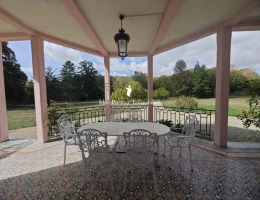
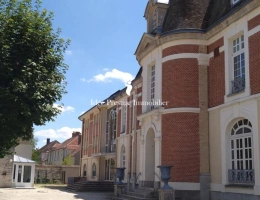
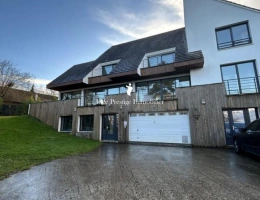
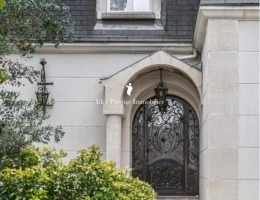
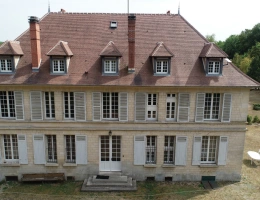
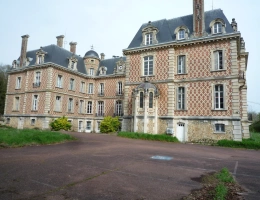

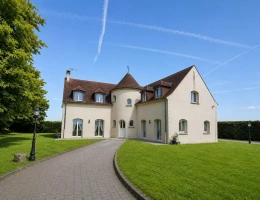
A manor house for sale in Seine-et-Marne benefits from a rare position: that of a rural department right on the doorstep of Paris, where old stone houses in Brie limestone stand alongside the sandstone of the Fontainebleau forest and Brie farmhouses. The grain-growing Brie plain, the Loing valley and the Provins area offer residences that keep a farming use while staying under an hour from the capital. Browse the manor houses for sale listed by the department's private owners, agencies and notaries. This closeness to Paris makes for a livelier market than elsewhere, driven by buyers wanting a rural setting without giving up quick access to the capital.
This page brings together real price benchmarks for these Seine-et-Marne houses, the areas where they cluster, what sets their Brie architecture apart and the points to watch in this Paris-region territory. To prepare the purchase of a character property as a whole, read our guide to buying prestige property in France.
DVF land registry data does not identify manor houses as such: the benchmarks below cover sales of houses over 300 m² of living space on 0.05 to 10 ha, above €1,000/m², tracked by our observatory. They frame the market for large residences without describing it entirely: an estate with 30 ha of parkland or a listed monument sold with its farmland falls outside this scope.
In Seine-et-Marne, 168 sales were recorded from 2021 to 2025, with a median price of €785,000, a floor/ceiling range (P10–P90) of €437,500 to €1,668,700 and a median of €2,094/m² of living space, for an average of 381 m² of living space and 7,873 m² of land. Across the Île-de-France region, the 2025 median stands at €1,445,000* (90 sales), against €822,000 in France in 2025 (981 sales).
| Scope | Sales | Median price | Floor – ceiling (P10–P90) | €/m² living space (median) |
|---|---|---|---|---|
| Seine-et-Marne (2021-2025) | 168 | €785,000 | €437,500 – €1,668,700 | 2,094 |
| Île-de-France (2025) | 90 | €1,445,000* | €700,000 – €3,496,500 | 4,247 |
| France (2025) | 981 | €822,000 | €428,000 – €3,100,000 | 2,308 |
The breakdown by stratum (coastal, rural tourist, ordinary rural) and the five-year trend are in our observatory of prestige property prices in France (in French). Before making an offer, work out purchase costs and borrowing capacity with our financial tools and calculators.
Source: DVF (DGFiP), transactions from 1 January 2021 to 31 December 2025, processed by ma-propriete.fr; prices rounded to the nearest €100. * Fewer than 100 sales: read as an indication only.
The Brie residence is traditionally built in local limestone, sometimes paired with exposed millstone-grit rubble and, close to the Fontainebleau forest, with plinths of dressed sandstone. Slate or flat-tile roofs cover generous volumes inherited from large grain estates, with sober facades pierced by tall windows. In the south of the department, around Provins, a few residences still show sections of half-timbering closer to the neighbouring Champagne models. Some houses still keep a free-standing dovecote in the middle of the courtyard, a distinctive feature of the large Brie seigneurial farms.
The outbuildings take up a considerable share of the estate: large barns built for storing wheat, a dovecote, a bread oven, stables and sometimes a wine press. The park, often planted with an orchard or crossed by a stream feeding the Loing or the Seine, completes properties designed for farming. Recent restorations combine energy upgrades with the preservation of old floors and roof timbers.
The central Brie plain, around Coulommiers and Rozay-en-Brie, holds many residences set deep in the large grain fields. The Provins area, a town listed as a UNESCO World Heritage site, keeps rural residences amid valleys and historic vineyards long since gone. To the south, the Loing valley, from Moret to Nemours and around the Fontainebleau forest, offers properties valued for their wooded setting, while the north-east of the department, towards Meaux and the Marne valley, keeps a more peri-urban character. The Melun area and the Seine valley, at the centre of the department, round out the offer with residences close to the roads towards the capital.
Marne-la-Vallée–Chessy station, served by TGV, links directly to several regions without passing through Paris, and RER lines complete access to the capital from Melun, Meaux or Provins. The most expensive areas remain the outskirts of the Fontainebleau forest and the south of the Brie plain near the N4 road; the north-east of the department and the Provins area offer more affordable houses for a comparable size.
Closeness to Paris raises land pressure: check the local development plan and any pre-emption zones carefully before any extension project, particularly in villages near the Fontainebleau forest, protected under several environmental schemes. Properties on the edge of state-owned forest may be subject to clearance rules and to easements linked to the movement of forestry vehicles.
Have the drainage checked, still often private in Brie hamlets, along with the presence of millstone-grit rubble in the foundations, a material sensitive to changes in moisture. The clay subsoil of some Brie areas encourages ground shrink-swell: a geotechnical survey is recommended before any extension, as is checking the status of the rural tracks serving isolated estates. For a property near a major road, also have noise exposure checked, a criterion increasingly scrutinised by Paris-region buyers.
Manor houses in Seine-et-Marne are offered by private owners, agencies specialising in character properties and notaries; filter listings by price, floor area, land and outbuildings, and set an e-mail alert to follow new ones. To widen the search across the region, browse the manor houses for sale in Île-de-France. The local notary can clarify the pre-emption rules that sometimes apply to adjoining farmland.


