

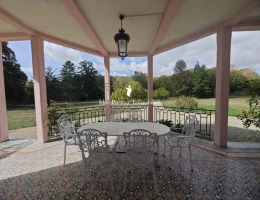
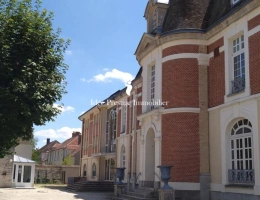
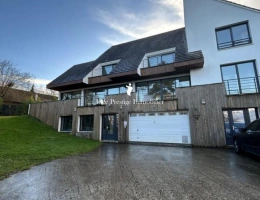
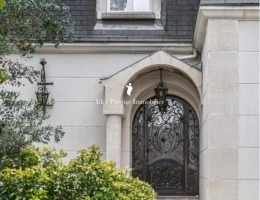
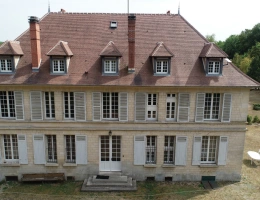
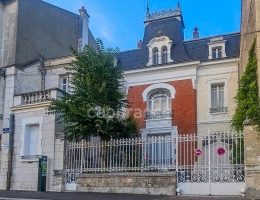
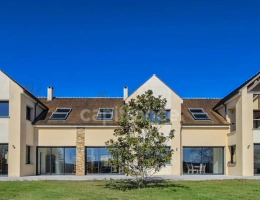
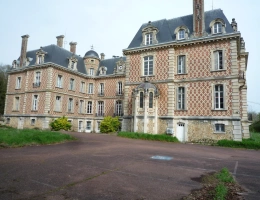
A manor house for sale in Seine-Saint-Denis is a genuine exception: the department, densely built up and industrialised since the early twentieth century, retains almost no rural residence with attached land, apart from a few remnants of parks and estates now crossed by major regional infrastructure. The rare older residences still visible, around the Courneuve park or on the edge of the Bondy regional forest, are mostly bourgeois houses with a garden rather than complete farming manors, a legacy of estates broken up long before the current wave of dense redevelopment. You will still find the manor houses for sale listed by private owners, agencies and notaries across the department and its surrounding areas.
This page explains plainly what the Seine-Saint-Denis market genuinely offers in older residences, the few areas worth considering and why a search for a manor with land almost always moves toward Seine-et-Marne, Yvelines, Essonne or Val-d'Oise. Setting realistic expectations early saves a great deal of wasted viewing time. To approach this kind of purchase as a whole, read our guide to buying prestige property in France.
DVF land registry data does not identify manor houses as such: the benchmarks below cover sales of houses over 300 m² of living space on 0.05 to 10 ha, above €1,000/m², tracked by our observatory. They frame the market for large residences without describing it entirely: an estate with 30 ha of parkland or a listed monument sold with its farmland falls outside this scope.
This inner-suburb department has no rural municipalities: the benchmarks below are those of the Île-de-France region. Across the Île-de-France region, the 2025 median stands at €1,445,000* (90 sales), against €822,000 in France in 2025 (981 sales).
| Scope | Sales | Median price | Floor – ceiling (P10–P90) | €/m² living space (median) |
|---|---|---|---|---|
| Île-de-France (2025) | 90 | €1,445,000* | €700,000 – €3,496,500 | 4,247 |
| France (2025) | 981 | €822,000 | €428,000 – €3,100,000 | 2,308 |
The breakdown by stratum (coastal, rural tourist, ordinary rural) and the five-year trend are in our observatory of prestige property prices in France (in French). Before making an offer, work out purchase costs and borrowing capacity with our financial tools and calculators.
Source: DVF (DGFiP), transactions from 1 January 2021 to 31 December 2025, processed by ma-propriete.fr; prices rounded to the nearest €100. * Fewer than 100 sales: read as an indication only.
Industrialisation followed by intensive urbanisation erased most of the old rural building stock that still existed in the nineteenth century, replaced by housing estates, business parks and large developments. The seigneurial estates that survive, such as the Courneuve park, were kept as public open space rather than as habitable private property. The few older residences still standing, in Gournay-sur-Marne or along the Marne, are usually found without the land and outbuildings that historically accompanied a manor, as development pressure led to the gradual sale of surrounding plots over the decades and left only the main dwelling in private hands.
When a character property does appear on the market, it is generally modest in size, without the park or farm buildings expected of a classic manor, and its rarity makes it much contested as soon as it is listed. Properties to renovate with genuine land potential are practically non-existent in this dense urban setting, and the few remaining wooded plots mostly belong to public authorities rather than private owners.
The eastern communes, around Gournay-sur-Marne and the Marne valley, keep a few traces of older riverside building, while the rest of the territory, from Saint-Denis to Bobigny by way of Aulnay-sous-Bois, offers almost no residence of this kind. Buyers seeking a genuine manor with land naturally turn to Seine-et-Marne to the east, or to Yvelines, Essonne and Val-d'Oise to the west and north, where rural building stock remains widely available on considerably better terms, often within an hour's drive of central Paris.
The department has no TGV station; links run on RER and Transilien services into Paris, plus Paris-Charles-de-Gaulle airport to the north. This dense and well-organised network for urban and professional travel is, however, of no particular use when searching for a rural property with land and outbuildings to match.
Within Seine-Saint-Denis itself, any remaining undeveloped land is subject to a tightly controlled local development plan, usually geared toward densification rather than preserving a large private park; systematically check this status before considering any conservation or extension project, including the potential for future rezoning. Near a historic monument, exterior works require the approval of the Architecte des Bâtiments de France, even for a modest bourgeois house.
If your search widens toward Seine-et-Marne, Yvelines or Val-d'Oise, plan to have the private drainage system checked, common outside built-up areas, the condition of the roof timbers, and the municipal or private status of access tracks, matters practically absent from the urban context of Seine-Saint-Denis but decisive once the search is genuinely widened to rural properties.
The few listings for older residences in Seine-Saint-Denis are placed by private owners, agencies and notaries; filter them by price, living space and land, and set an e-mail alert to hear as soon as a matching property appears in the department or in nearby areas worth watching. To widen the search usefully toward a genuine manor with attached land, browse the manor houses for sale in Île-de-France.


